Medical School Trains Clinicians to Build AI Workflow Agents
University of Miami's 100-day challenge produced custom automation tools for billing, compliance, and patient communication—no coding required.
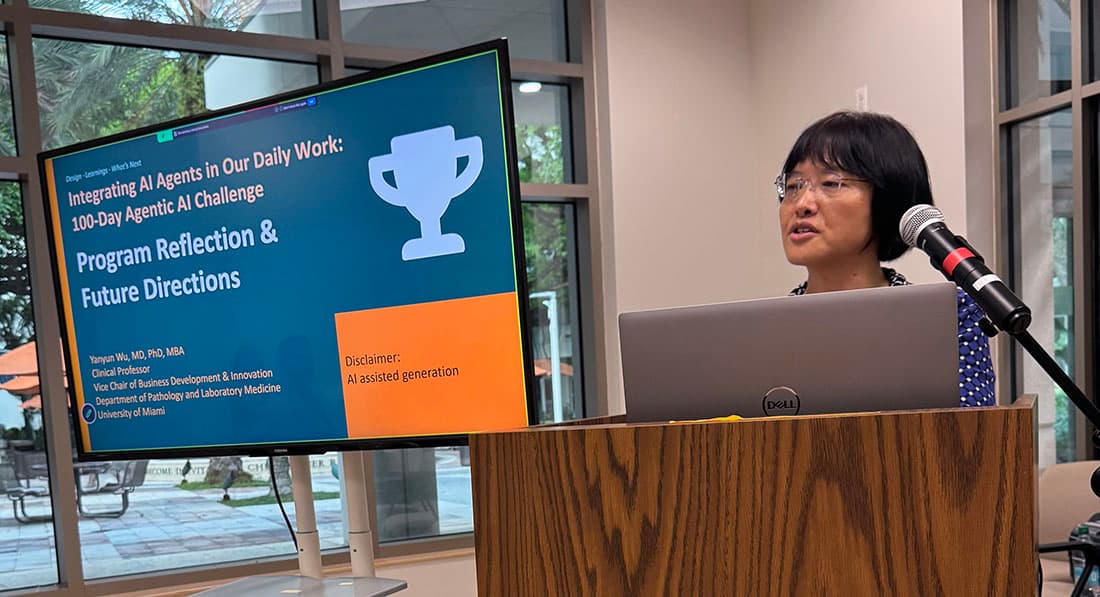
Physicians and administrative staff at the University of Miami Miller School of Medicine have built and deployed functional AI agents that automate clinical and administrative tasks, demonstrating how healthcare professionals without programming backgrounds can create practical workflow tools.
The Department of Pathology and Laboratory Medicine recently showcased results from its 100-Day Agentic AI Challenge, a structured program designed to move medical professionals beyond conversational AI chatbots toward building autonomous digital assistants. Participants created eleven working agents that now handle tasks ranging from billing code assignment to regulatory compliance checks.
Why it matters
This initiative represents a significant shift in how healthcare organizations approach AI adoption. Rather than waiting for vendors or IT departments to deliver solutions, clinical staff are directly building tools tailored to their specific workflows. The low-code approach and structured training model could provide a template for other medical institutions seeking to reduce administrative burden while maintaining control over sensitive healthcare data within secure environments.
From Learning to Deployment
The challenge divided its timeline into three phases: Learn, Apply, and Showcase. Participants worked with Microsoft Copilot Studio and Power Automate, low-code platforms that operate within the university's private enterprise tenant, ensuring data security.
Yanyun Wu, M.D., Ph.D., M.B.A., clinical professor of pathology and vice chair of business development and innovation, spearheaded the initiative alongside University of Miami AI experts and Microsoft's cloud solution team. The program assumed no prior software development experience from participants.
"The goal of the challenge was simply to build a practical bridge, taking the mystery out of the technology and allowing people to safely automate repetitive, time-consuming tasks," Wu explained, according to the University of Miami Miller School of Medicine.
Practical Applications Across Clinical Workflows
The agents participants built address specific pain points in medical practice:
Resident Felipe Ruiz Casas created a CPT Coding Assistant that reduces a traditionally 20-minute daily task to seconds by matching clinical narratives to billing codes using institutional guidelines.
Diego Montoya Cerrillo, an assistant professor of anatomic pathology, developed a Radical Prostatectomy Report Validator that automatically cross-checks surgical pathology reports against staging criteria, replacing manual audits with immediate quality checks.
Carmen Gomez-Fernandez, clinical professor and vice chair of education, built a Breast Pathology Patient Assistant that translates technical pathology terminology into sixth-grade reading level explanations to reduce patient anxiety.
Other agents handle ACGME compliance questions, specimen request protocols, platelet inventory expiration tracking, staff scheduling, and regulatory gap analysis against College of American Pathologists accreditation standards.
Scaling Beyond Early Adopters
Wu referenced Rogers' Diffusion of Innovations theory to explain the program's strategy for institutional adoption. The challenge deliberately engaged innovators and early adopters whose success stories provide proof points for broader organizational acceptance.
"The practical success stories we saw today provide the real-world proof points needed to gently encourage the wider university community across the chasm into active AI engagement," Wu said.
Merce Jorda, M.D., professor and J.R. Coulter Chair of pathology and laboratory medicine, emphasized the cultural dimension: "By cultivating a safe sanctuary to boldly experiment and fail forward, we have ignited a practical movement."
Details of the program and participant presentations were first reported by the University of Miami Miller School of Medicine.
This is an original analysis by the Omega editorial team. Source reporting: AI Watch.
Want systems like this working for your business?
Book a Call