Collins Aerospace Demos Cockpit Automation to Cut Pilot Workload
Automated checklists and transcribed ATC communications are among the near-term tools the avionics maker is developing to simplify flight operations.
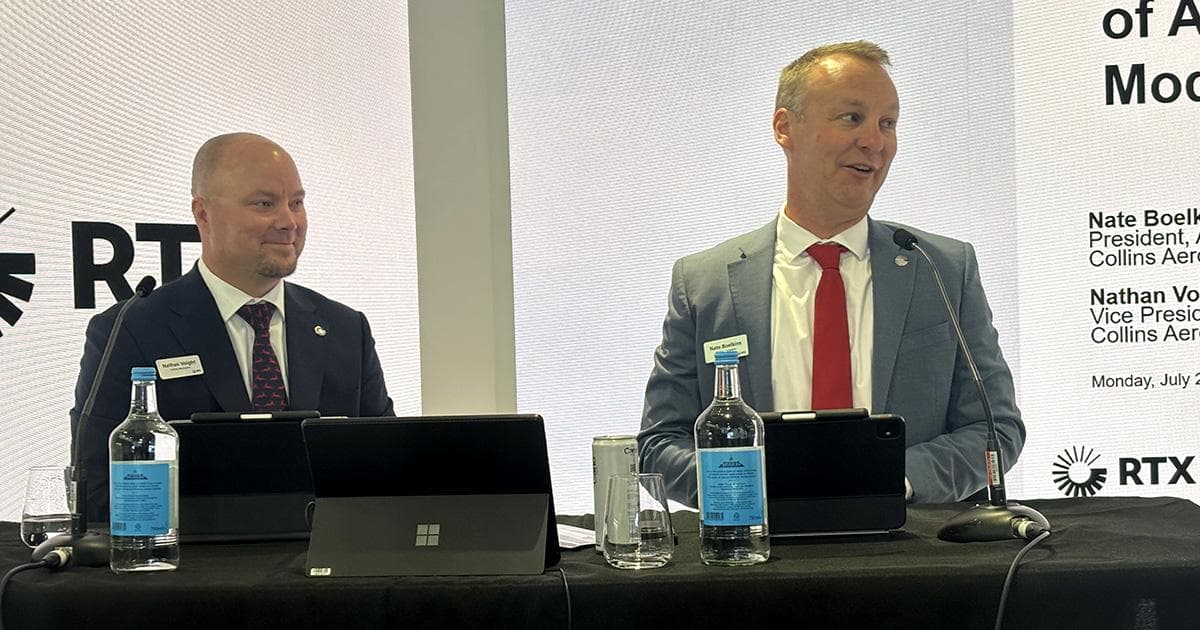
Collins Aerospace is advancing a suite of cockpit automation technologies designed to reduce pilot workload during critical phases of flight, the company disclosed at the Farnborough International Airshow.
The avionics manufacturer is leveraging data from across its air traffic control, flight tracking, and flight deck divisions to build systems that simplify both cockpit operations and airspace management. The effort comes as demands on pilots and controllers grow increasingly complex, according to Collins avionics president Nate Boelkins.
Automated checklists and voice transcription
Two near-term applications illustrate Collins' approach. The first involves automated checklist management during flight operations. While pre- and post-flight checklists are already automated, pilots still manually navigate checklists when rerouting or addressing mechanical issues mid-flight. Collins is developing applications that automatically surface the appropriate checklist based on the situation and ensure relevant data appears in front of the crew.
The second technology transcribes radio communications between pilots and air traffic controllers into digital text. Nathan Voight, vice president and general manager of advanced flight systems at Collins, explained that radio exchanges can be difficult to parse across different dialects and background noise. The transcription system would allow pilots to read and replay communications, reducing misunderstandings. Pilots could then respond to controllers via voice or text, streamlining the exchange.
The transcription capability becomes particularly valuable during approaches, where erroneous clearances pose the greatest risk. The system can flag discrepancies and alert pilots to take corrective action.
Data-driven development
Collins is using flight data from its FlightAware tracking platform to stress-test these systems under real-world conditions. Voight emphasized that engineers are designing solutions "by pilots for pilots" to ensure they address practical operational challenges.
The company is processing aircraft-generated data on the ground rather than onboard, reducing computational load on aircraft systems while still delivering actionable insights to crews when needed. This approach synthesizes information from multiple sensors and surveillance sources into simplified displays.
Why it matters
Pilot workload during abnormal situations and congested airspace is a persistent safety concern. Automation that reduces cognitive load during high-stress phases of flight—without removing pilots from decision-making—could prevent errors that lead to incidents. The transcription technology addresses a known vulnerability: miscommunication between pilots and controllers has been a contributing factor in numerous accidents and near-misses.
Airspace modernization and certification timeline
Beyond the cockpit, Collins is developing an open-architecture automation platform for air traffic management that can operate in the cloud. The platform is designed to support trajectory-based operations in Europe and aligns with the FAA's vision for future air traffic management, though Congress has not yet funded a common automation platform for the agency.
Collins is already testing aspects of the platform in trials involving uncrewed aircraft operations with an unnamed international air navigation service provider.
Boelkins declined to provide a timeline for when these cockpit technologies will enter service, noting that certification schedules will determine availability. The company continues to refine the systems with customer input during testing.
Details were first reported by Aviation International News.
This is an original analysis by the Omega editorial team. Source reporting: Automation Watch.
Want systems like this working for your business?
Book a Call