Five Million Industrial Robots Now Operating Worldwide
China accounts for 59% of global deployments as Asia drives adoption, while Europe lags and the U.S. overtakes Japan in market size.
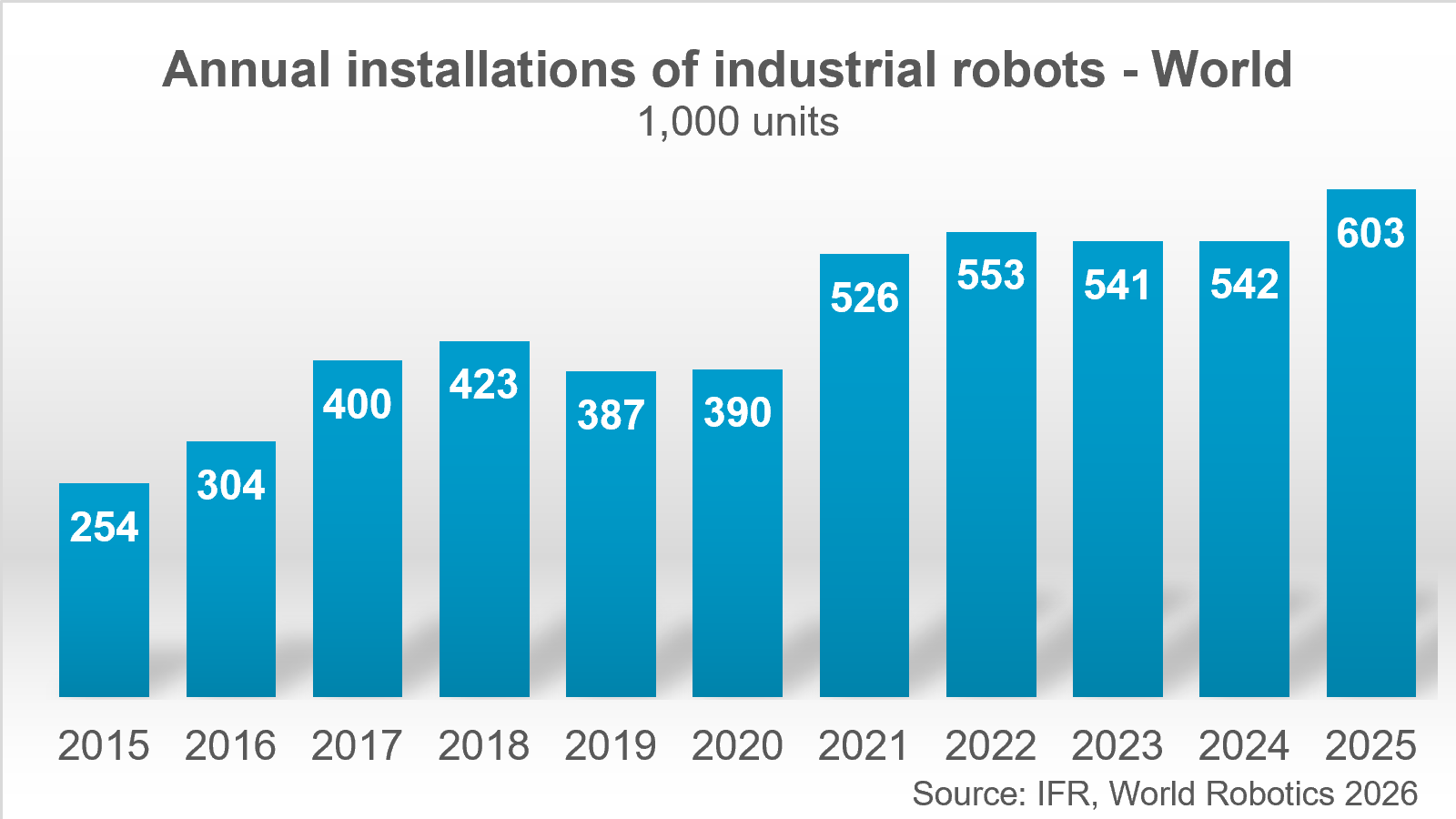
The global installed base of industrial robots has reached five million units—more than double the count from seven years ago—marking a significant acceleration in factory automation across manufacturing sectors.
China continues to dominate the landscape, installing 354,000 industrial robots in 2025, a 20% year-over-year increase that represents 59% of all global deployments. Domestic Chinese manufacturers captured 55% of their home market with 195,000 units, slightly down from 57% the previous year but demonstrating the maturation of local robotics suppliers.
Regional Shifts Reshape Market Rankings
The United States climbed to second place globally in 2025, surpassing Japan with nearly 38,500 robot installations—a 12% increase and the third-highest figure in the country's robotics history. Japan, meanwhile, saw installations drop 19% to 36,219 units, pushing it to third place worldwide.
South Korea held steady as the fourth-largest market with 30,000 units installed, down just 1% in a sideways trend that has persisted since 2019. However, new automotive industry investments are expected to break this pattern in 2027.
India emerged as a notable growth story, installing nearly 10,500 units in 2025—a 15% increase that secured sixth place globally, just behind Germany. Between 2020 and 2025, India's annual installations grew at a 27% compound annual rate, the fastest expansion among major markets.
Europe Faces Headwinds
Germany remains Europe's largest robot market and fifth globally, but installations fell 8% to fewer than 25,000 units in 2025. The country accounts for 41% of European Union deployments, yet growth has averaged just 2% annually from 2020 to 2025.
Italy saw an 11% decline to approximately 7,800 units, while France dropped 8% to nearly 4,500 units. Spain recorded a 15% decrease to about 4,300 units.
In the Americas beyond the U.S., Brazil stood out with 38% growth to almost 4,300 units, driven largely by Chinese automotive manufacturers investing in local production. The automotive sector alone installed nearly 2,100 robots, a 212% surge. Mexico, conversely, experienced its third consecutive year of decline with a 7% drop to fewer than 5,200 units.
Why it matters
The geographic redistribution of robot demand reflects broader shifts in manufacturing strategy. As companies pursue supply chain resilience and navigate evolving trade policies, automation becomes essential for building competitive production capacity in high-wage economies and labor-constrained markets. This trend suggests robotics growth will persist even as installation patterns shift regionally, particularly as AI, machine vision, and simplified programming lower barriers to adoption for new industries and smaller manufacturers.
Outlook Through 2029
Global installations are forecast to reach 655,000 units in 2026—a 9% increase—and climb to 806,000 units by 2029. Demographic pressures and technological advances in artificial intelligence and sensing capabilities are expected to sustain long-term demand despite regional variations.
These figures were reported by the International Federation of Robotics, with data compiled from manufacturers and national robotics associations worldwide.
This is an original analysis by the Omega editorial team. Source reporting: Automation Watch.
Want systems like this working for your business?
Book a Call