Simbe's 3,000 Tally Robots Mark Shift to Public-Space Automation
The retail inventory robot's commercial milestone signals robotics moving beyond controlled factory floors into unpredictable human environments.
Simbe's 3,000 Tally Robots Mark Shift to Public-Space Automation
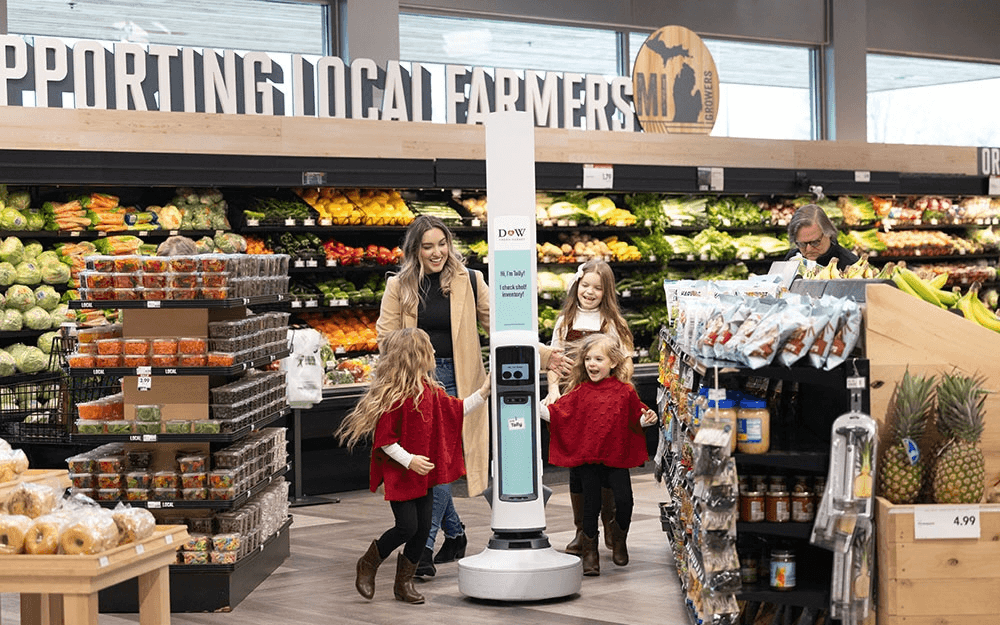
Simbe announced this week it has secured contracts for more than 3,000 units of Tally, its autonomous retail inventory robot. The company characterizes this as the largest commercially committed fleet of autonomous shelf-intelligence technology based on its market research, though it did not specify how many units are currently deployed versus contracted.
The milestone matters less for the raw number than for what it represents: thousands of robots designed to operate not in controlled factory cells or restricted warehouse zones, but in grocery aisles alongside shoppers and employees.
Why it matters
Public-space robotics requires fundamentally different engineering than factory automation. Retailers cannot eliminate unpredictable elements—customers who stop suddenly, carts blocking aisles, products on floors—because those elements are their business. As robots move into hospitals, airports, hotels and stores, the industry must solve for machines that function reliably in environments they do not control. Simbe's commercial traction suggests this transition is accelerating beyond pilot programs into operational scale.
Operating in Uncontrolled Environments
Tally navigates store aisles while employees restock shelves and customers move through the same space. According to Simbe, the robots have accumulated 5 million hours of fully autonomous operation, captured 45 billion shelf photos, and scanned 18 billion price tags. The platform now operates across more than 75 retail banners in nearly a dozen countries.
Factory automation typically asks how to automate tasks while controlling the surrounding environment. Public-space robotics inverts that question: how does a machine operate reliably when the environment belongs to everyone else?
International Federation of Robotics data indicates nearly 200,000 professional service robots were sold in 2024, up 9 percent from the prior year. Transportation and logistics accounted for 102,900 units, hospitality for more than 42,000 units, and professional cleaning exceeded 25,000 units. While indoor transportation without public traffic represents the largest portion, the trend shows growing deployment in semi-public and public settings.
Value Without Human-Level Capability
Tally's primary function is observation, not manipulation. The robot scans aisles for out-of-stock products, pricing discrepancies and misplaced merchandise. Simbe's software converts that information into prioritized tasks for employees and actionable data for managers.
The robot does not need to restock shelves to create value—it simply needs to identify what requires restocking more consistently than periodic manual audits. This narrower approach may offer a clearer path to commercial deployment than complex manipulation tasks, particularly as the data generated becomes as valuable as the physical task performed.
From Robot to Infrastructure
Simbe increasingly positions its offering as a physical intelligence platform combining autonomous robots, computer vision, RFID, handheld devices and fixed sensors. The objective is continuous digitization of store conditions, feeding information into inventory systems, e-commerce platforms and merchandising software.
In this model, the robot functions as a mobile sensor within the store's information infrastructure rather than as a standalone system. The same concept extends to robots in airports, hospitals and hotels—performing tasks while simultaneously generating machine-readable data about physical environments.
Safety in Public Settings
Public deployment changes safety requirements. Unlike trained factory workers, people encountering these robots may be shoppers, travelers, patients or children with no prior exposure to autonomous systems.
In March, Tally became the first retail robot to receive UL 3300 certification, according to Simbe. The standard covers service, communication, information, education and entertainment robots, including requirements for machines in dynamic public environments. Simbe reports Tally and its charging dock underwent more than 40 safety tests during certification.
Scaling across thousands of locations means accommodating different floor plans, traffic patterns, fixtures and human behaviors daily—precisely what makes public-space robotics both challenging and commercially significant.
These details were first reported by Automation Watch.
This is an original analysis by the Omega editorial team. Source reporting: Automation Watch.
Want systems like this working for your business?
Book a Call