Paycom Embeds Asset Management Into HCM Platform
The new tool automates equipment tracking and payroll recoupment across the employee lifecycle, extending Paycom's automation thesis into physical assets.
Paycom Software has introduced Asset Management, a new module that integrates equipment and property tracking directly into its human capital management platform. The tool consolidates seating assignments, asset distribution, compliance monitoring, and payroll recoupment into a single system that operates across the full employee lifecycle.
The launch represents Paycom's push beyond traditional people data into oversight of physical and digital assets. By embedding asset workflows into HCM, the company aims to eliminate spreadsheets and disconnected tracking tools while strengthening security and audit capabilities.
Why it matters
For organizations managing distributed workforces and remote equipment, asset tracking has remained a persistent administrative burden handled through separate systems or manual processes. Paycom's integration approach could reduce friction for HR and IT teams by tying asset custody directly to employee records, automating recovery when workers leave, and linking equipment costs to payroll deductions without manual reconciliation. The move also signals how HCM vendors are expanding their automation footprint to capture adjacent workflows and deepen platform stickiness.
Investment implications
The Asset Management release fits Paycom's broader narrative around deepening automation and client retention through its single-database architecture. However, the tool does not immediately alter near-term catalysts tied to adoption of the company's Beti self-service payroll feature or AI-driven modules.
Paycom recently appointed former CFO Craig Boelte and former CIO William Kerber to its board. Their technical and financial backgrounds may influence how the company balances investment in complex automation tools against the risk of elevated capital expenditure if new module adoption falls short of projections.
Analyst projections for Paycom vary considerably. Some forecasts anticipate revenue reaching approximately $2.8 billion and earnings of $635 million by 2029. The Asset Management launch could reinforce confidence in those targets if it drives usage of Paycom's owned infrastructure and AI capabilities. Conversely, investors concerned about slower adoption rates may view past capital spending as potentially excessive if module uptake disappoints.
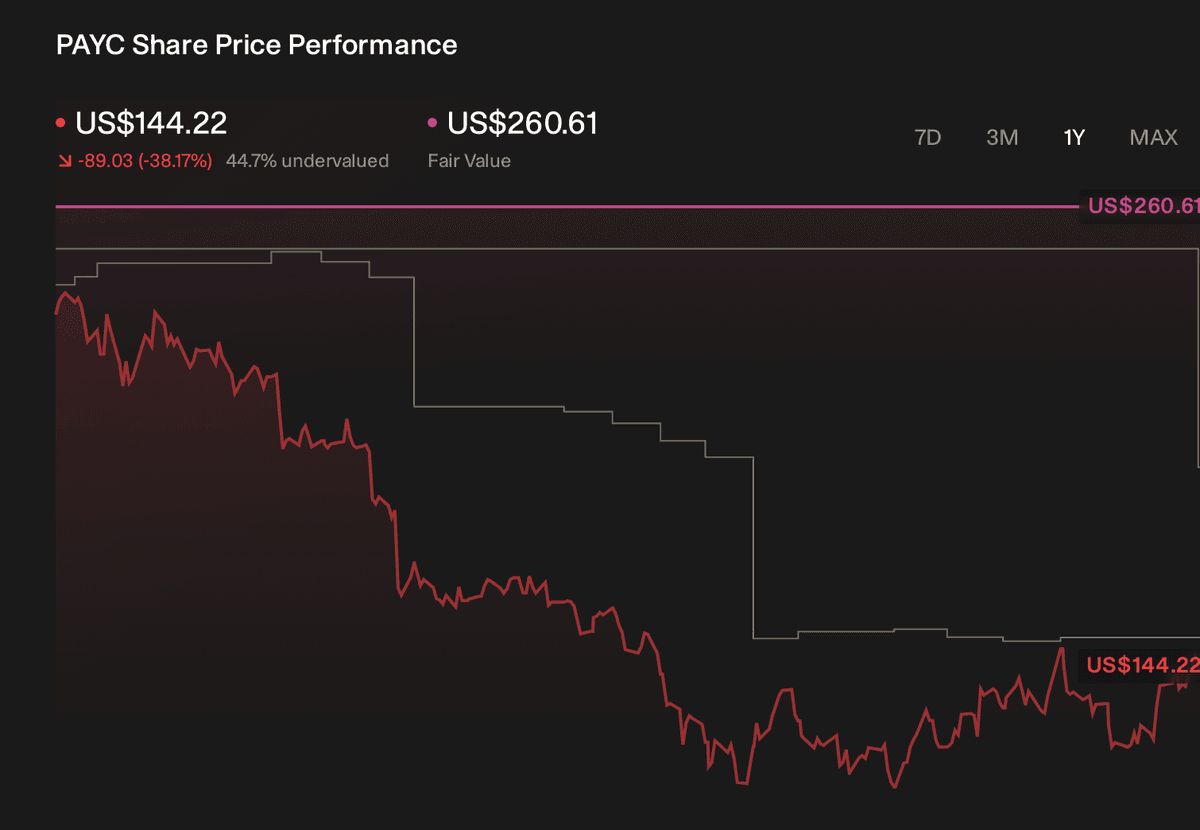
The company's narrative currently projects $2.6 billion in revenue and $582.4 million in earnings by 2029, with some fair value estimates suggesting the stock could be worth significantly more than its current price depending on execution.
Broader context
Paycom's expansion into asset management reflects a competitive environment where HCM platforms increasingly compete on breadth of automation rather than core payroll and benefits administration alone. As AI-driven HR tools proliferate, vendors face pressure to demonstrate tangible workflow consolidation that reduces administrative overhead and justifies platform costs.
The risk for Paycom lies in whether infrastructure and AI investments required to support these expanded capabilities will compress margins if customer adoption lags expectations. The company's ability to convert feature releases into measurable efficiency gains for clients will likely determine whether the asset management tool strengthens or dilutes its investment case.
These details were first reported by Simply Wall St.
This is an original analysis by the Omega editorial team. Source reporting: Automation Watch.
Want systems like this working for your business?
Book a Call
