FedEx and Amazon Scale Robotic Arm Deployments in Logistics Push
Both companies are expanding AI-powered automation to handle physically demanding warehouse tasks and boost network efficiency.
Two of the world's largest logistics operators are significantly expanding their use of robotic arm technology to automate traditionally labor-intensive warehouse operations.
FedEx announced in late July that it has deployed Dexterity's dual-armed Mech trailer loading systems at its Hagerstown Hub in Maryland. The systems use Foresight, an AI model that makes real-time decisions to optimize package placement during autonomous loading. FedEx loads tens of thousands of trailers daily across its U.S. network, a task that has historically required significant physical strength and endurance from workers.
The deployment represents more than a single-site pilot. FedEx executive Kawal Preet stated during the company's February investor day that the carrier aims to deploy automated trailer unloading and loading operations across thousands of dock doors in more than 20 U.S. hubs over the next few years.
Amazon doubles down on robotics
Amazon is pursuing an even more aggressive expansion timeline. CFO Brian Olsavsky disclosed on a July earnings call that the company plans to more than double its fleet of robotic arms in 2026. The e-commerce giant has deployed over 1 million robots across its fulfillment network since 2012.
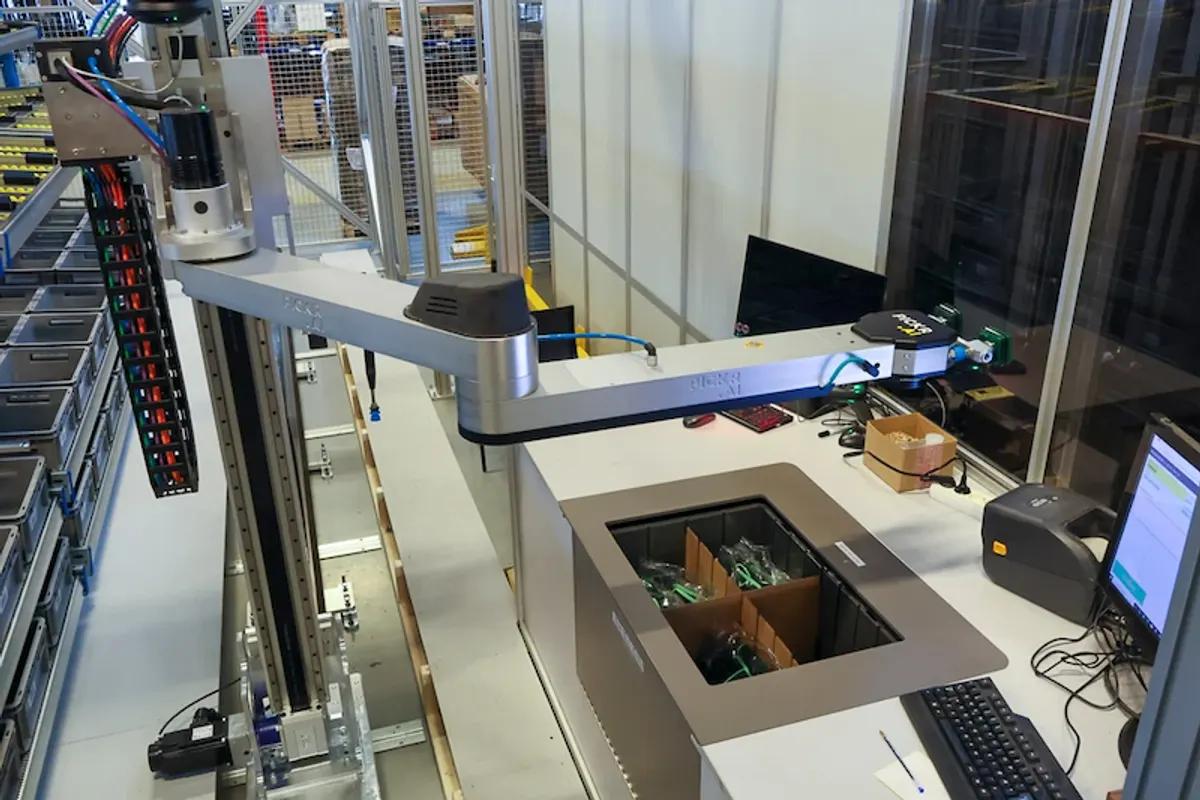
Amazon's robotic arm portfolio includes Cardinal, which lifts packages and places them in carts, and Sparrow, which moves products from containers to totes before packaging. Both systems leverage AI and computer vision to handle varied package types and sizes.
Why it matters
The simultaneous scaling by FedEx and Amazon signals that robotic arm technology has matured beyond experimental deployments into production-ready systems capable of handling high-volume logistics environments. This shift is reshaping the automation industry itself: non-automotive industries have recently surpassed automotive as the largest purchasers of industrial robots, according to Aaron Prather, director of market intelligence at the Association for Advancing Automation. Companies like FedEx and Amazon are driving this transition through continued automation installations across their extensive networks.
The technology addresses a persistent challenge in logistics operations. Trailer loading and unloading require workers to perform repetitive heavy lifting in confined spaces, contributing to high injury rates and turnover in warehouse roles. Automation can reduce physical strain while maintaining or improving throughput.
Industry-wide momentum
Other major logistics operators are making similar investments. The U.S. Postal Service installed a parcel robotic sorting system featuring a mechanical arm for pallet unloading at a Kansas distribution center in 2023. DHL announced plans last year to deploy over 1,000 additional units of Boston Dynamics' Stretch robot across its network.
Dexterity founder and CEO Samir Menon characterized the Hagerstown deployment as "an important milestone in demonstrating how physical AI can operate reliably in a high-volume logistics environment, creating a blueprint for network expansion."
These details were first reported by Supply Chain Dive.
This is an original analysis by the Omega editorial team. Source reporting: Automation Watch.
Want systems like this working for your business?
Book a Call