Purdue Tests Remote Nuclear Reactor Control Across Three States
A July demonstration linked a research reactor in Indiana with Idaho National Laboratory and Microsoft Azure to adjust power automatically in real time.
First U.S. Demonstration of Remote Automated Reactor Control
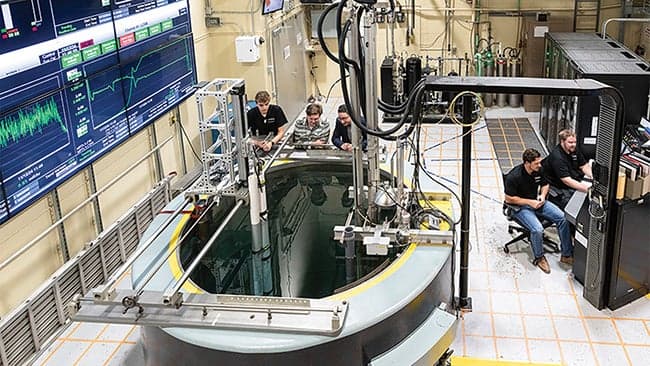
Researchers at Purdue University have completed the first U.S. experiment in which a nuclear reactor's power was adjusted remotely and automatically in real time. The July demonstration connected Purdue's PUR-1 research reactor with Idaho National Laboratory (INL) and a Microsoft Azure cloud system, creating a control loop spanning Indiana, Idaho, and Virginia.
The experiment tested whether reactor measurements could travel to remote computing systems, generate control instructions, and return quickly enough to influence the reactor's physical behavior—all while the reactor's own safety systems retained ultimate authority. According to Stylianos Chatzidakis, the Purdue assistant professor who led the work, the milestone shows remote monitoring and control are technically feasible, though he emphasizes this was a controlled experiment, not operational deployment.
Why It Matters
Next-generation small modular reactors and microreactors are expected to rely on digital instrumentation and control systems that could enable centralized monitoring of reactor fleets from a single location. The Purdue demonstration offers early evidence that such architectures can function across geographic distances while maintaining safety boundaries. The work also addresses a practical question: whether reactors could respond fast enough to supply power to large data centers, where demand can swing by 100 megawatts in short intervals.
Building on a Fully Digital Platform
PUR-1, a 64-year-old teaching reactor, was converted in 2019 to the first fully digital instrumentation and control system licensed by the U.S. Nuclear Regulatory Commission. That conversion, funded by the Department of Energy, gave researchers a platform to test control architectures expected in future SMRs and microreactors.
In 2023, Chatzidakis and his team completed what Purdue describes as the first live digital twin of a U.S. reactor. The twin uses real sensor data from PUR-1 to run experiments on a high-fidelity digital copy without affecting the operating core. In 2025, the team added quantum-secure communications to the remote-access framework, drawing interest from a United Nations working group examining quantum threats to critical infrastructure.
How the Three-Site Loop Worked
During the July experiment, INL provided the use case and ran analytics from its high-performance computing systems. Microsoft Azure hosted the cloud environment, and the University of Illinois Urbana-Champaign assisted with data handling. The distributed system calculated instructions for moving an auxiliary control rod at PUR-1, with signals passing through INL's DeepLynx platform, the cloud, and PUR-1's digital twin.
From Idaho, researchers used the loop to fine-tune reactor power and reduce small fluctuations without manual control-rod manipulation on site. The use case simulated a reactor supplying a data center, testing whether the system could respond to rapid demand changes.
One early challenge was determining which of the thousands of data points collected per second actually mattered. Transmitting everything would create latency; transmitting too little would leave remote models without sufficient context. Researchers had to define priority signals, sampling rates, and metadata before integrating data streams with INL's databases and computing systems.
The loop also had to account for network latency and the time required for plant hardware to respond. Signals traveled between sites, software processed them, and reactor motors executed instructions before updated measurements could return through the system. Chatzidakis said integrating three sites, multiple software stacks, and the full path from reactor sensors to remote models and back was the main technical challenge.
Remote Monitoring First, Autonomy Decades Away
Chatzidakis sees remote monitoring as the nearer-term application. A single control room might monitor five or six SMR modules at one site, while a utility headquarters could aggregate operating data from 100 small modular reactors nationwide. That architecture could allow operators to compare reactor performance and use AI and physics-based models to interpret data difficult to process in real time.
Autonomous operation is a different proposition. Chatzidakis said traditional reactors will continue to have human operators. His group is instead looking 30 to 40 years ahead toward specialized microreactors where permanent staffing may be impractical—such as reactors on the moon. For such applications, the team is exploring reinforcement-learning models to determine whether they could support semi-autonomous control while remaining inside safety constraints. Any deployment would require NRC approval.
Purdue's work aligns with DOE's Genesis Mission, which includes autonomous nuclear operation among its research challenges. In July, DOE selected INL's Prometheus effort—a 32-partner project applying AI across reactor design, licensing, manufacturing, construction, and operations—for a $60 million Phase II award over three years, subject to appropriations.
Purdue plans to continue testing the architecture and is building a second digital twin in a new full-scale reactor control room for research on SMRs and other advanced reactor technologies.
Details of the demonstration were first reported by POWER Magazine.
This is an original analysis by the Omega editorial team. Source reporting: Automation Watch.
Want systems like this working for your business?
Book a Call