Constrained Output Scoring Cuts SLM Inference Time by 30%
A practical technique for small language models eliminates parsing errors and speeds up narrow automation tasks like ticket routing and document tagging.
The Hidden Bottleneck in Small Language Model Deployment
Production AI workloads rarely involve frontier reasoning. Most enterprise automation centers on unglamorous but critical tasks: routing support tickets, extracting form fields, tagging documents, and flagging records for review. These jobs share three traits—constrained input, fixed output space, and massive call volume—that make small language models (SLMs) the natural fit.
A model that runs on a single GPU or even CPU can return answers in milliseconds at a fraction of the cost of large language model API calls. Yet teams routinely sabotage this advantage by treating small models like chatbots, writing conversational prompts and generating free-form text that must be parsed with regular expressions. When a forward pass takes ten milliseconds, everything wrapped around it becomes the performance ceiling.
Why It Matters
Constrained output scoring transforms small language models from unreliable text generators into deterministic classifiers. For enterprises running millions of classification tasks daily—customer service routing, document processing, compliance flagging—this technique eliminates an entire class of production errors while delivering measurable speed gains. The approach makes SLMs viable for latency-sensitive workflows where API calls to frontier models would create unacceptable delays or costs.
The Problem with Free-Form Generation
Consider a ticket routing system with three categories: billing, technical, and account. The standard approach asks the model to write an answer, generates several tokens sequentially, then searches the resulting string for a recognizable label.
This pattern fails on two fronts. First, it's slow—each output token requires its own forward pass, so requesting eight tokens costs roughly eight times the compute of a direct answer. Second, it's unreliable. A small model might respond with "Sure! This looks like a billing issue" or "Billing/Account" or invent a category entirely. Every malformed response demands fallback logic or a retry.
Constrained Scoring: The Solution
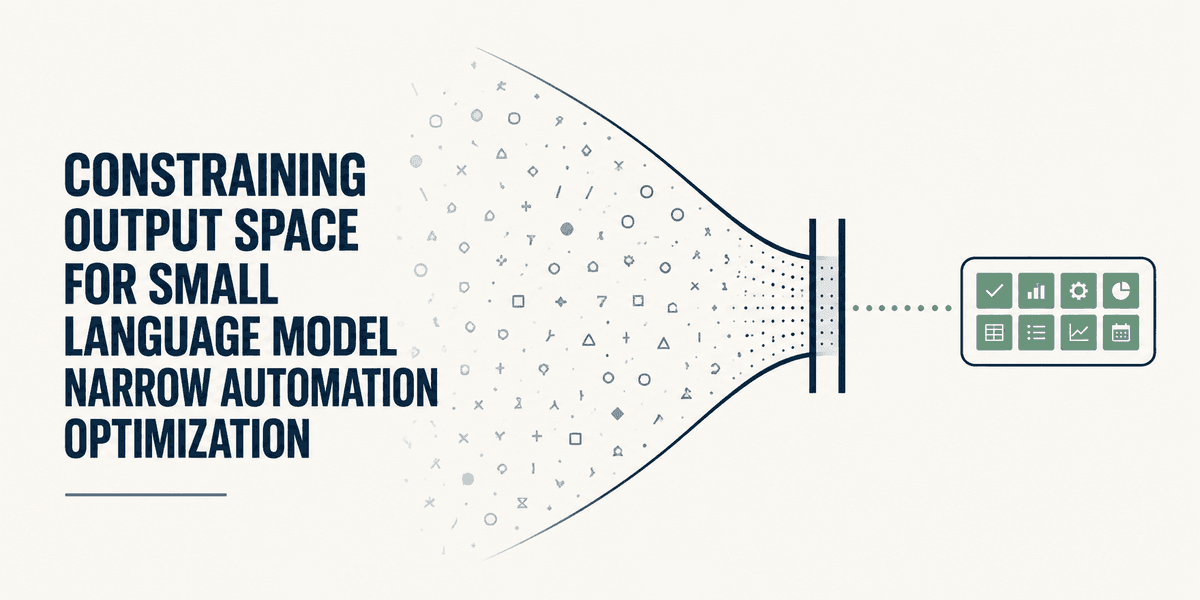
The fix: stop generating and start scoring. Run one forward pass, read the model's next-token probability distribution, and restrict the decision to token IDs corresponding to valid labels. The answer becomes structurally impossible to get wrong, and you receive a calibrated confidence score automatically.
In benchmark tests using Qwen2.5-0.5B-Instruct on 600 support tickets, the constrained approach completed in roughly 30% less time than free-form generation while reducing unparseable outputs to zero. The free-form method took 134 seconds; constrained scoring finished faster with perfect structural accuracy.
Implementation Details
The technique reads logits[0, -1, :] to access the model's unnormalized distribution over the next token. Indexing that vector at the first token IDs of each valid label and taking argmax makes out-of-vocabulary answers impossible.
Applying softmax over the restricted logits provides a confidence threshold. Responses below a chosen threshold—say, 0.6—can route to human review rather than flowing downstream with low confidence.
Tokenization requires care. Most byte-level BPE tokenizers treat " billing" and "billing" as distinct tokens. Encode the variant the model would actually emit after your prompt. If two labels share a first token, either rename them to single distinct tokens or score full label sequences instead.
From Compromise to Obvious Choice
A half-billion parameter model becomes a practical production option for narrow automation once the surrounding code stops treating it like a generic chatbot. With an enforced output contract, the small model transitions from compromise to optimal solution for high-volume classification tasks.
These implementation details were first reported by Matthew Mayo at KDnuggets, who demonstrated the technique using open-source tools and provided working code examples.
This is an original analysis by the Omega editorial team. Source reporting: Automation Watch.
Want systems like this working for your business?
Book a Call