CJ Logistics to Deploy Humanoid Robots at Warehouses This Year
South Korean logistics giant partners with ROBOTIS to introduce robots for packaging tasks, joining global automation push driven by labor shortages.
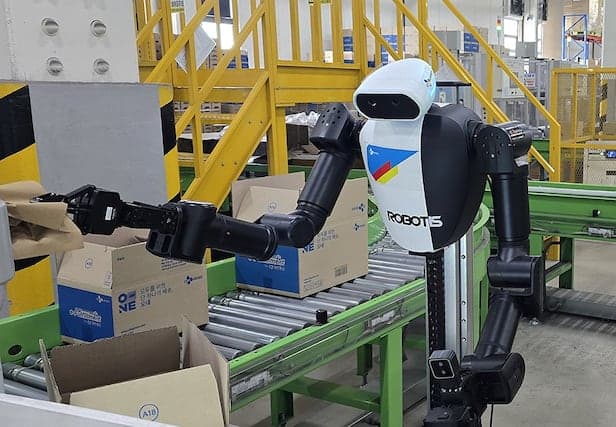
CJ Logistics advances humanoid robot deployment
CJ Logistics is preparing to introduce humanoid robots at its logistics centers before the end of 2026, according to industry sources. The South Korean logistics company is working with domestic robotics firm ROBOTIS to address technical issues identified during pilot testing conducted late last year.
The initial deployment will be modest: two to three humanoid robots at one or two facilities. These machines will handle what appears to be a straightforward task—placing cushioning material into shipping boxes—but the work demands precision and speed. Robots must handle boxes of varying sizes, position them on work surfaces without collisions, and insert protective materials without causing damage.
"Ultimately, our goal is to train Humanoid Robots to make judgments on their own like people and deploy them to high-risk tasks such as loading and unloading parcels," a CJ Logistics representative stated. The company plans to gradually expand both the number of robots and the range of tasks they perform.
Global logistics automation accelerates
CJ Logistics enters a competitive field where international players have already achieved significant milestones. U.S. robotics company Figure AI demonstrated its Figure 03 humanoid robots sorting approximately 250,000 parcels over 200 hours in a live-streamed demonstration in May. These robots manipulated boxes and plastic-wrapped packages, rotated items to position invoices correctly, and navigated tangled parcels by adjusting their posture and reach.
Amazon has deployed Agility Robotics' Digit humanoid robot at warehouse locations since 2023 for tasks including empty box removal and repetitive pick-and-place operations. The e-commerce giant also uses tactile robots designed to prevent item damage and multi-armed systems for simultaneous picking and organizing. According to the New York Times, Amazon anticipates doubling sales by 2033 without hiring the 600,000 additional workers that growth would traditionally require, crediting robotic automation for the efficiency gains.
In South Korea, LG CNS is working to introduce humanoid robots at LX Pantos facilities, where they would receive items from shuttle robots and load them onto sorting equipment. Coupang is testing Rainbow Robotics' RB-Y1 humanoid robot, with Chairman Bom Kim stating last year that the company would pursue operational transformation through AI automation and humanoid robotics.
Why it matters
The logistics industry faces a structural labor challenge that humanoid robots are positioned to address. Daniel Diez, chief business officer at Agility Robotics, told Business Insider that every country the company visits—including Germany, Korea, Japan, and the United States—reports severe shortages of workers willing to perform monotonous, repetitive physical tasks. Bipedal robots can integrate into existing facilities without requiring infrastructure redesigns, making them economically attractive for brownfield deployments.
Last-mile delivery remains distant goal
While warehouse automation advances rapidly, replacing human delivery drivers presents greater obstacles. JD.com Chairman Liu Qiangdong predicted that robots would eventually handle parcel delivery, making drivers "virtually unnecessary." The Chinese e-commerce company has prepared retraining programs to transition its 700,000 frontline workers into robot maintenance roles, and autonomous delivery robots already operate in suburban Chinese cities.
However, industry observers view full driver replacement as unrealistic in South Korea in the near term. Technical challenges include damage risks when robots travel on public roads, regulatory barriers around autonomous vehicles, and anticipated resistance from labor organizations. "Robots replacing delivery drivers in Korea is still a long way off," according to a parcel industry official.
These details were first reported by Automation Watch.
This is an original analysis by the Omega editorial team. Source reporting: Automation Watch.
Want systems like this working for your business?
Book a Call