AI
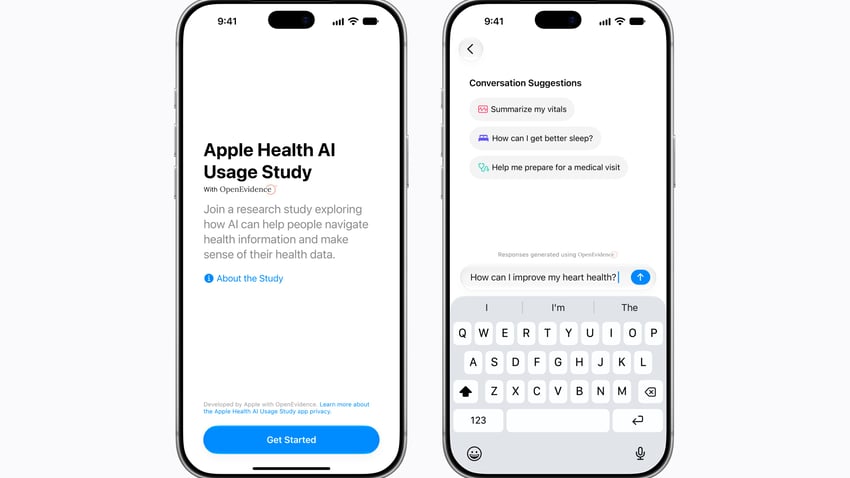
Apple Launches 200,000-Person Study on Health AI Chatbot Use
The tech giant will partner with OpenEvidence to examine trust, comprehension, and clinical handoffs as consumer adoption accelerates.
Key takeaways
- Apple will recruit 200,000 U.S. participants for a 12-month study examining how consumers use AI chatbots for health information and care decisions.
- The study partners with OpenEvidence, which provides AI responses grounded in peer-reviewed literature from NEJM, JAMA, Nature, and other clinical sources.
- Participants can optionally share HealthKit data and clinical records for personalized responses, with privacy protections including on-device processing and data de-linking.
- Researchers will track trust factors, comprehension, health actions, and whether AI preparation improves patient-provider interactions through baseline and monthly surveys.
- Study data will not be used to train AI models, and the app includes safety guardrails to detect concerning questions and direct users to appropriate resources.
Apple has opened enrollment for a large-scale research initiative examining how Americans use AI chatbots to manage their health, as roughly one in three U.S. adults now turn to these tools for medical information.
The Apple Health AI Usage Study aims to recruit 200,000 participants across the United States to track interactions with conversational health AI over periods of up to 12 months. The virtual study, conducted through a dedicated app separate from Apple's existing Health platform, targets adults 21 and older who own iPhone 15 Pro or later models running iOS 26 or newer.
Why it matters
While consumer adoption of health AI has surged—particularly among younger adults—fundamental questions about comprehension, trust, and clinical safety remain unanswered. Research shows a significant gap between AI's technical accuracy and patients' ability to safely apply that information. Apple's study could provide the first large-scale data on how these tools actually influence care-seeking behavior and patient-provider interactions, informing both product design and regulatory approaches across the industry.
Partnership with clinical AI platform
Apple selected OpenEvidence, a clinical decision support tool used by physicians, to power the study's AI responses. The startup's platform draws from peer-reviewed literature and clinical guidelines through partnerships with The New England Journal of Medicine, JAMA, Nature, Cochrane, and the National Comprehensive Cancer Network.
Participants can ask everyday health questions and receive answers with links to clinical sources. The app allows users to rate responses and indicate what information proved useful or inadequate.
Privacy architecture and data sharing
The study incorporates optional data sharing from Apple's HealthKit—including resting heart rate, activity, and sleep metrics—to enable personalized responses. Participants who have imported clinical records into the Health app can separately consent to share lab results with the study.
Apple emphasized privacy protections throughout the design. User queries are processed on-device first to remove identifying information, then sent to a secure environment managed by a third-party contractor where they're de-linked from participant IDs before reaching OpenEvidence. Study data will not be used to train AI models, the company confirmed.
Research objectives and clinical guardrails
The study, overseen by an independent review board, will examine factors driving user trust, response quality, comprehension levels, and resulting health actions. Researchers also plan to evaluate how AI chatbots complement traditional healthcare and facilitate handoffs to physicians.
Participants will complete baseline and monthly surveys, plus questionnaires after healthcare appointments to assess whether AI preparation improves patient empowerment and provider interactions. The app includes safety features designed to detect concerning questions and direct users toward appropriate clinical resources.
"At Apple, we believe responsible innovation starts with scientific rigor and clinical grounding," said Sumbul Desai, Apple's vice president of Health and Fitness. "Conducting a dedicated research study is the most thoughtful way to understand how people engage with, comprehend, and evaluate health AI in everyday life."
The initiative builds on Apple's 2019 Research app launch and subsequent medical studies using Apple Watch for mobility, cardiovascular health, hearing, and women's health tracking. Details of the study were first reported by Fierce Healthcare.