AI
Apple Launches 200,000-Person Study on Trust in Health AI
The tech giant will test whether conversational AI with medical citations and personal health data helps users prepare for doctor visits.
Key takeaways
- Apple opened a U.S. research study accepting up to 200,000 participants to examine trust and comprehension in conversational health AI powered by OpenEvidence.
- Participants can optionally share HealthKit data to test whether personal health context improves AI response relevance and understanding.
- Apple pledged study data will not train AI models, though user identifiers may be collected and linked for analytics purposes.
- The app provides health information with peer-reviewed citations but explicitly does not offer medical advice, diagnosis, or treatment.
- Enrollment requires an iPhone 15 Pro or later running iOS 26, limiting participation to Apple Intelligence-enabled devices.
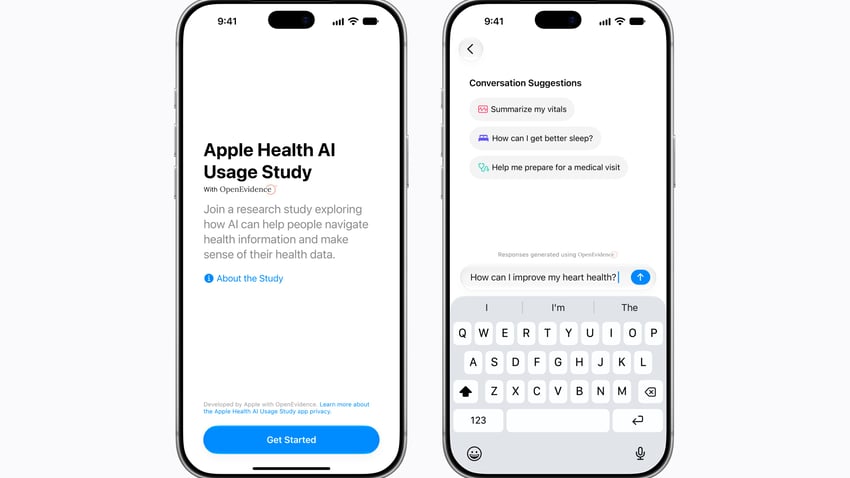
Apple has opened enrollment for a large-scale research study examining how people interact with conversational health AI, the company announced November 15, 2026. The Apple Health AI Usage Study will accept up to 200,000 U.S. participants and aims to measure trust, response quality, comprehension, and whether AI-generated health information influences everyday health decisions.
The initiative is explicitly framed as research rather than a product launch. Apple stated the findings will inform how the company and others design health AI systems responsibly.
How the Research Works
The study app runs on AI technology from OpenEvidence, a platform Apple says is widely used by healthcare professionals and draws from peer-reviewed medical literature including The New England Journal of Medicine, JAMA, and Nature. Participants can ask general health questions and receive explanations with linked clinical citations supporting each answer.
Personalization is optional. Users can choose to share health metrics through HealthKit—such as resting heart rate, activity levels, sleep patterns, or lab results—allowing researchers to assess whether personal context improves the relevance and clarity of AI responses. The app can help users understand symptoms, contextualize their health data, prepare questions for medical appointments, and develop personalized exercise or meal plans.
Apple acknowledged that large language models in consumer health applications sometimes produce incomplete or unclear answers, positioning that limitation as a rationale for studying clearer communication methods.
Eligibility and Privacy Framework
Enrollment is limited to people aged 21 and older in the United States who own an iPhone 15 Pro or later running iOS 26 or newer—devices capable of running Apple Intelligence. The study app is free and available in English.
Apple has committed that study data will not be used to train AI models. Participants control whether to share HealthKit metrics or survey responses, and the company says it has implemented security measures to protect study data and participant confidentiality.
However, the App Store privacy label indicates that user identifiers may be collected and linked to identity for analytics and app functionality, while diagnostics and performance data may be collected without identity linkage.
Clinical Boundaries
The app includes guardrails designed to detect concerning questions and direct participants to healthcare providers or other resources when appropriate. Neither the app nor the study provides medical advice, diagnosis, or treatment. Users are instructed to consult medical professionals about health concerns and to verify information independently.
Robert M. Wachter, M.D., professor and chair of UCSF's Department of Medicine, noted a gap between tools used by patients and clinicians. "When patients and doctors draw on versions of the same trustworthy tools, patients arrive prepared, conversations improve, and next steps happen seamlessly," he said.
Why It Matters
This study addresses a fundamental question for health AI deployment: whether cited, conversational answers combined with personal health context actually help people understand their health and prepare for medical care. By measuring trust and comprehension alongside technical response quality, Apple is testing whether AI can bridge the gap between consumer health information and clinical conversations—without crossing into diagnosis or treatment. The scale of the study and the explicit no-training commitment signal an industry attempt to build evidence for responsible health AI design before widespread consumer rollout.
The details were first reported by Unite.AI.