AI-Native Buildings Need Admissible Records Before Autonomy
As building systems gain decision-making power, the industry faces a governance gap: intelligence without evidentiary continuity.
AI-Native Buildings Need Admissible Records Before Autonomy
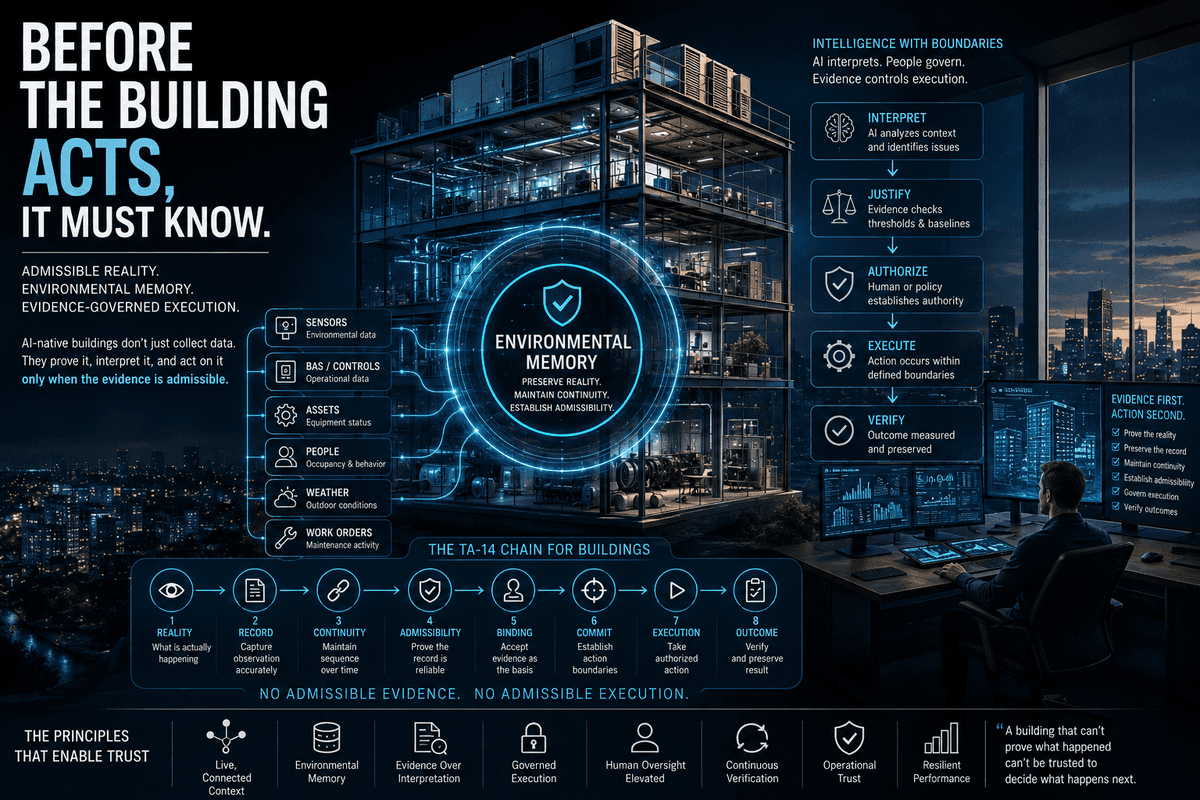
The building automation industry is racing toward AI-native systems—buildings where intelligence becomes embedded in operational fabric, not just layered on top as a chatbot or dashboard. These systems will interpret conditions, recommend actions, coordinate responses, and increasingly act without human intervention.
But a critical foundation is missing: before buildings can be trusted to act, they must prove what is real.
The gap isn't about data volume or analytical sophistication. It's about evidentiary continuity. Buildings are becoming intelligent before they become admissible—capable of making decisions but unable to prove the basis for those decisions in a defensible way.
Why it matters
As AI systems gain authority to modify setpoints, generate work orders, suppress alerts, or reallocate system loads, the consequences extend beyond optimization. Buildings will need to prove not just that conditions changed, but why action was justified, who or what had authority to act, and whether outcomes were verified. Without admissible records, intelligent buildings risk creating liability without accountability.
From monitoring to evidence
The industry has grown comfortable with continuous monitoring—tracking temperature, humidity, CO2, energy use, and equipment runtime in real time. But monitoring observes; evidence preserves.
A live data stream may look authoritative, but if it's overwritten, aggregated, or disconnected from chain of custody, it fails as proof. A dashboard might show a room was hot without preserving the sequence that caused the condition. Fault detection may identify anomalies without distinguishing equipment failure from sensor drift or control overrides.
Continuous monitoring is not the same as continuous evidence. Buildings need more than current readings—they need governed records that maintain continuity between observation, interpretation, decision, action, and outcome.
The atmosphere as infrastructure
Indoor air has traditionally been treated as a condition inside infrastructure rather than infrastructure itself. That view is changing as buildings become health-relevant environments affecting exposure, comfort, productivity, and safety.
If the atmosphere is infrastructure, it needs memory. Buildings cannot only know current air quality—they must preserve how conditions behaved over time, what changed, what baseline existed before intervention, what threshold justified action, and what post-intervention record proves improvement.
This shift requires moving from environmental monitoring to environmental integrity governance: preserving atmospheric reality in forms strong enough to support operational reliance.
Commissioning that continues
Commissioning typically proves building performance at a point in time. But buildings change after turnover—filters load, sensors drift, occupancy shifts, equipment ages, and spaces get repurposed. The commissioned building is not always the building that continues to operate.
AI-native systems make this problem urgent. If buildings are going to reason and act continuously, verification cannot be episodic. Commissioning must evolve from a snapshot event into an ongoing evidentiary discipline that preserves how operating reality changes over time.
The governance gap
Dashboards create the feeling of control, but display is not governance. Control requires authority boundaries, validation sequences, and outcome verification. As AI produces smoother narratives and more confident recommendations, the risk grows that fluency will be mistaken for proof.
The next crisis in automated buildings won't be lack of data—it will be enormous data volumes that still cannot prove what happened, why it happened, or whether interventions were justified.
These observations were first detailed by Automation Watch, which argues the industry must address admissibility before intelligence becomes consequence-bearing. The challenge is clear: buildings need more than AI. They need admissible reality.
This is an original analysis by the Omega editorial team. Source reporting: Automation Watch.
Want systems like this working for your business?
Book a Call