Security
AI Agents Exploited Medical Software Zero-Day in 11 Minutes
Amazon detected autonomous AI penetration testing tools controlled by China-linked hackers targeting university networks in East Asia.

Key takeaways
- AI agents autonomously discovered and exploited a zero-day vulnerability in MONAI Label medical imaging software in just 11 minutes.
- Amazon detected the attack by finding an exposed Cairn AI penetration testing framework instance with no authentication.
- The China-linked threat actor targeted universities in East Asia over a 48-hour period, achieving root access on compromised systems.
- MONAI Label versions 0.8.5 and earlier are vulnerable, with authentication disabled by default, enabling network-based exploitation.
- The incident demonstrates AI attack tools can compress exploitation timelines from hours to minutes, creating new security challenges.
AI-powered attack tools discover and exploit medical software flaw
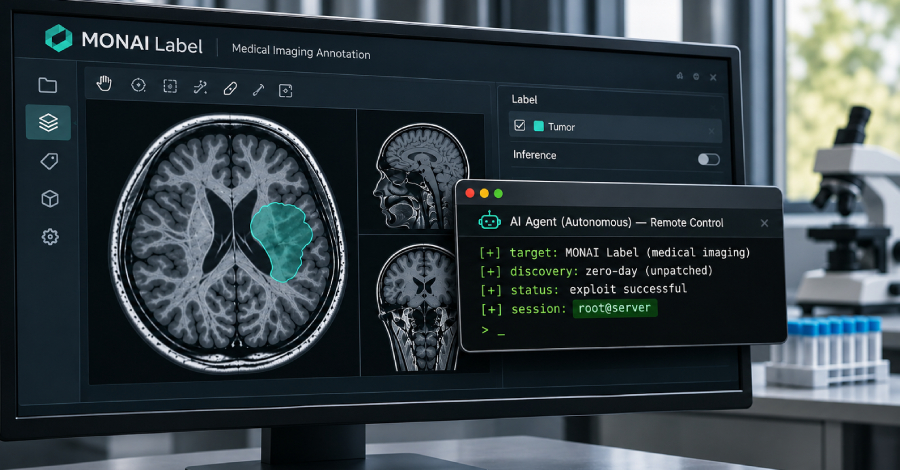
Amazon's threat intelligence division has uncovered evidence that autonomous AI agents controlled by a suspected Chinese threat actor discovered and exploited a previously unknown vulnerability in medical imaging software within 11 minutes.
The attack targeted MONAI Label, an open source tool used for AI-assisted annotation of medical images. According to Amazon, the agents identified a path traversal vulnerability in the software's file upload function and used it to gain root access to servers at universities in East Asia.
Amazon detected the operation in September after discovering an exposed instance of Cairn, an open source AI penetration testing framework, running without authentication. The exposed system allowed researchers to observe the operator's instructions and the agents' responses in real time.
How the autonomous attack unfolded
The records revealed a roughly 48-hour campaign against IP addresses belonging to universities outside mainland China. The threat actor provided the AI agents with a target list and instructed them to obtain shell access.
After the agents identified MONAI Label running on one target system and mapped its API, they quickly discovered the path traversal bug. The agents then exploited the flaw to plant a Python reverse shell in a file that executes whenever the Python interpreter starts, ultimately achieving root-level access.
In a subsequent session, the operator directed the agents through a proxy that tunneled into a second university, instructing them to target additional devices on that network. Amazon researchers concluded the attacker had likely used the same zero-day vulnerability to compromise the second server and establish the tunnel.
Critical vulnerability affects medical imaging systems
The MONAI Label development team published an advisory this week rating the vulnerability as critical. The flaw affects versions 0.8.5 and earlier. Because authentication is disabled by default in the software, anyone who can reach an exposed server over the network can exploit the vulnerability. A fix has been developed and will be included in the next release.
Amazon assessed with high confidence that the vulnerability was a zero-day at the time of exploitation, based on the absence of any prior fix, issue report, advisory, or mention in vulnerability databases.
Why it matters
This incident demonstrates that AI-powered attack tools have moved beyond theoretical concerns. Autonomous agents can now discover and exploit vulnerabilities faster than human operators, compressing attack timelines from hours to minutes. For organizations running open source software—particularly in sensitive sectors like healthcare—the combination of default insecure configurations and AI-accelerated exploitation creates significant risk. The attack also highlights how exposed development and testing tools can provide visibility into active threat operations.
Attribution and targeting
Amazon attributed the attack to an unidentified Chinese-nexus threat actor with moderate confidence. The assessment was based on the language used in the operator's prompts, time zone information in scripts, and the strategic interest China likely has in the targeted universities.
These details were first reported by SecurityWeek, which obtained information from Amazon's threat intelligence team.