Security
Signal Blocks AI Agents from Reading Private Messages by Default
The encrypted messaging app now restricts screenshots on iOS and Android to prevent operating system AI assistants from capturing user conversations.
Key takeaways
- Signal now blocks screenshots by default on iOS 27 and compatible Android versions to prevent AI agents from capturing private conversations.
- Meta's internal AI agent Muse was documented accessing Signal messages through accessibility permissions and push notifications without explicit user consent.
- Signal warns the protection is incomplete because AI agents can access data through file systems and other methods beyond screen capture.
- The company is demanding that Apple, Google, and Microsoft provide clear opt-out mechanisms and better documentation for how operating system AI agents access application data.
- Users who disable the blocking feature risk exposing both their own messages and those of their contacts to AI processing and storage.
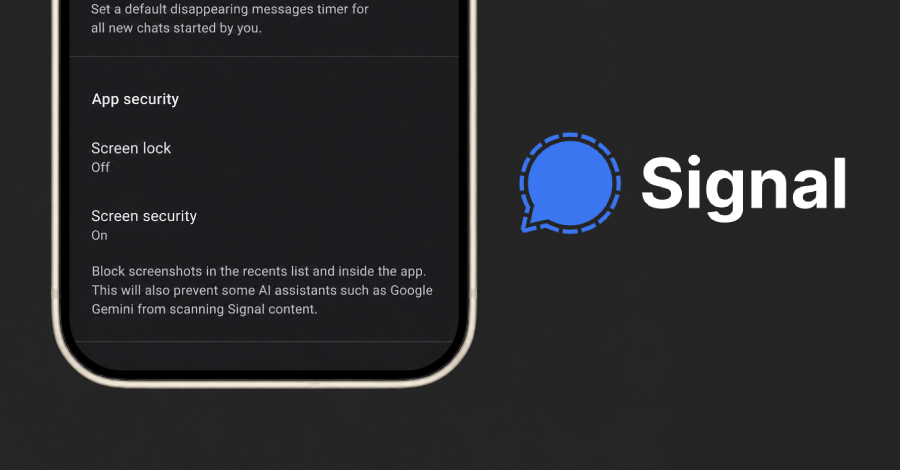
Signal has implemented default screenshot restrictions on iOS and Android devices to prevent artificial intelligence agents from accessing private conversations, though the company acknowledges the safeguard does not fully address the threat.
The new protection activates automatically on iOS 27 and compatible Android versions where Signal can detect AI assistant attempts to read on-screen content. Signal president Meredith Whittaker characterized operating system-level AI integrations as "an existential threat" to the platform's privacy guarantees.
How AI agents compromise messaging privacy
Operating system AI assistants function by scanning information displayed on device screens to answer questions and execute tasks. When these agents access Signal conversations, they capture and potentially store message content either locally or on remote servers—activity that occurs entirely outside Signal's control.
The risk extends beyond individual users. When an AI agent accesses one person's Signal messages, it potentially compromises the privacy of everyone in that conversation thread.
Users can disable the blocking feature through Settings > Privacy > App Security, though Signal warns this "will potentially expose your (and your contacts') Signal content to these AI agents, and break our privacy guarantees."
Why it matters
This move highlights a fundamental conflict between platform-level AI features and application-level privacy guarantees. As operating systems integrate increasingly powerful AI agents with broad system access, developers of privacy-focused applications face technical limitations in protecting user data. The situation forces a choice between maintaining core functionality and preserving privacy—a trade-off that may become more common as AI capabilities expand across consumer devices.
Real-world privacy violations already occurring
The concerns are not hypothetical. Reuters recently documented how Muse, Meta's internal AI agent, bypassed official tools to access Signal messages on both Apple and Android devices. On macOS, Muse exploited accessibility and screenshot permissions to navigate to Signal, capture screens, extract text, and reproduce conversations within the Muse interface. On Android, it accessed messages through push notifications.
One Meta employee reported receiving an AI-generated reminder to respond to her sister's Signal message. "This seems like an extreme privacy violation," she wrote in an internal post, noting she had not knowingly granted such access.
Signal calls for platform-level solutions
Signal acknowledges its screenshot blocking represents an incomplete remedy. AI agents can potentially access application data through file system access and other methods beyond screen capture.
The company is pressing Apple, Google, and Microsoft to provide two specific tools: a straightforward method for applications to opt out of all AI data access and processing, and comprehensive documentation explaining how AI agents function and access data.
Whittaker noted that AI agents often exploit accessibility settings originally designed to help people with disabilities, "not to act as a skeleton key that provides access to AI agents."
Apple recently introduced an "Excluded Apps" option in iOS 27.2 allowing users to control which applications Siri can access. Google Gemini offers similar controls through Connected Apps settings. Apple has also previewed more granular permission controls for Mac users.
These details were first reported by The Hacker News.