XPeng Activates Automated Production Line for IRON Humanoid Robot
The Chinese EV maker aims for mass production by late 2026 and commercial deliveries in 2027, applying automotive manufacturing discipline to humanoid robotics.
XPeng Brings Automotive Manufacturing to Humanoid Robots
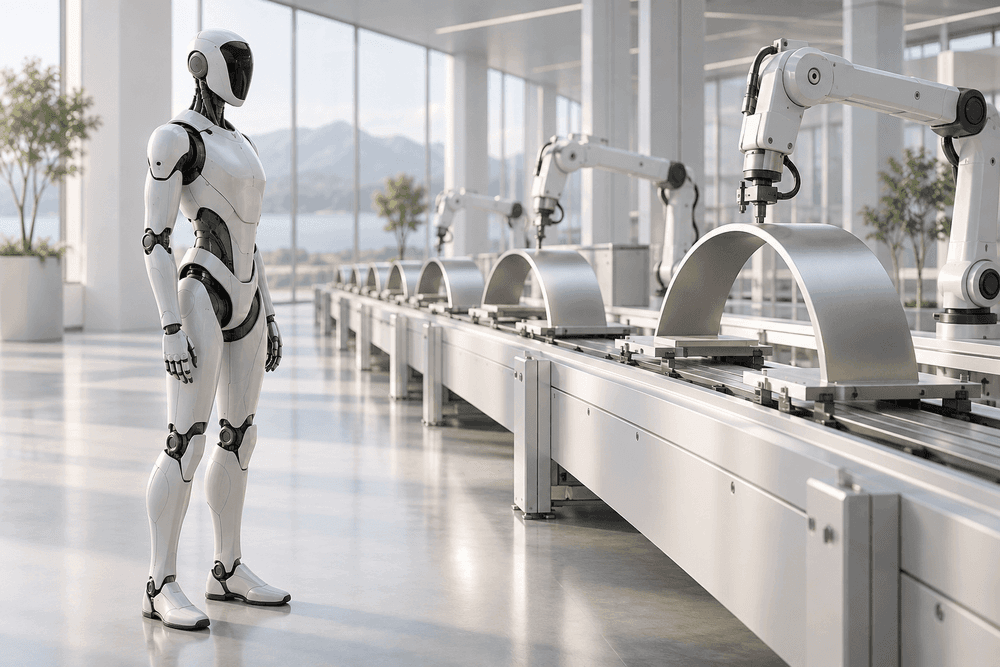
Chinese electric vehicle manufacturer XPeng has activated an automated production line for its IRON humanoid robot at a facility in Guangzhou, marking the company's transition from research prototypes to factory-scale manufacturing. The line features more than 80% automation in core processes, and a completed IRON unit walked off the assembly line under its own power—a demonstration intended to show the robot's autonomous mobility rather than reliance on remote control for staged demonstrations.
According to details first reported by PanDaily, XPeng is applying the same quality systems, supply-chain management, and AI tooling it developed for electric vehicle production to precision robot manufacturing. Chairman and CEO He Xiaopeng acknowledged the company built the production line without an existing industrial template, describing the commissioning as an early step toward establishing a new product category.
Production Timeline and Deployment Strategy
XPeng has set a target of volume manufacturing by the end of 2026. The company plans to deploy initial production units internally—in its own retail stores and campus facilities—before pursuing broader commercial distribution. An official product launch and customer deliveries in both domestic and international markets are scheduled for 2027.
The company has not disclosed production line capacity, per-unit manufacturing costs, or consumer pricing. The walk-off demonstration represents a process milestone rather than the beginning of customer shipments.
Hardware Specifications and Onboard Intelligence
The next-generation IRON humanoid, unveiled in November 2025, incorporates 76 degrees of freedom across its body and 21 in each hand. The design uses a flexible lattice structure intended to balance human-like appearance with safety requirements for operation in shared spaces.
For onboard processing, IRON relies on three of XPeng's proprietary Turing AI chips, which together deliver approximately 2,250 TOPS of effective compute performance. This processing budget is designed to run XPeng's Physical AI foundation stack—including vision-language models and vision-language-action control modules—directly on the robot. The architecture aims for low-latency inference and tighter data locality while reducing dependence on continuous teleoperation.
Why It Matters
XPeng's move to automated production represents a strategic bet that automotive manufacturing expertise can accelerate humanoid robotics from lab demonstrations to commercial products. The company is testing whether disciplined supply chains and quality systems from high-volume car production can solve the yield, consistency, and cost challenges that have kept humanoid robots largely in research labs. Success would validate a manufacturing-first approach to embodied AI, while failure would underscore the gap between building vehicles and building general-purpose robots that must operate safely around humans.
Near-Term Challenges
The immediate test for XPeng will be whether it can meet its year-end 2026 volume targets while navigating yield learning curves and parts availability. The company must also demonstrate that IRON can perform useful work in its planned store and campus deployments, moving beyond the symbolic achievement of a robot walking off a production line.
Details of XPeng's automated production line and timeline were first reported by PanDaily.
This is an original analysis by the Omega editorial team. Source reporting: Automation Watch.
Want systems like this working for your business?
Book a Call