Why Modular Manufacturing Beats Faster Changeovers
An industrial automation designer argues the answer to factory flexibility isn't speed—it's designing interfaces before building hardware.
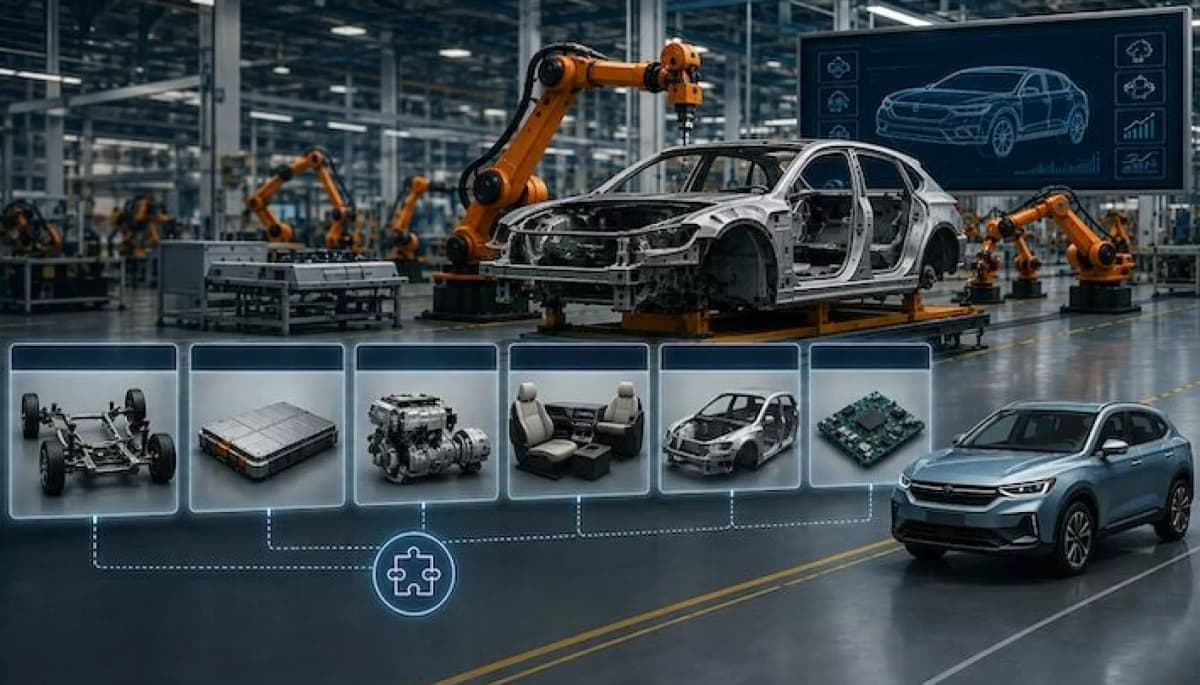
The architectural solution to factory flexibility
When Henry Ford switched from the Model T to the Model A in 1927, the changeover shut his plant for six months and cost the equivalent of $4.5 billion in today's dollars. Nearly a century later, most manufacturers still treat flexibility as an optimization problem—cutting changeover times, adding programmable equipment—rather than an architectural one.
Riddhi Padariya, an Industrial Automation & Control Systems Designer, makes the case that true modularity requires a fundamentally different approach: defining the interfaces between system components before designing the hardware itself. Writing in Automotive Manufacturing Solutions, Padariya argues that without this discipline, "modularity" becomes cosmetic.
The test is straightforward: Can you remove one production unit, replace it with an equivalent from a different build, and resume operations without rewriting supervisory code? If not, the system isn't truly modular.
Why it matters
Modularity frontloads the hardest design decisions, but companies that get it right see 20 to 50 percent schedule compression in modular construction, according to McKinsey research cited in the piece. More importantly, modular systems localize change—upgrades, repairs, and product variants happen at the module level rather than requiring factory-wide retooling. The economic advantage compounds over a facility's lifetime.
Product and process modularity work together
Padariya distinguishes between product modularity—building products from interchangeable components like EV battery packs or smartphone cameras—and process modularity, which organizes production into standalone, flexible stations. Firms pursuing both approaches together see stronger new-product performance and better cost outcomes than those pursuing either alone.
Framework Computer, founded in 2020, demonstrates the principle. The company designed its laptop around published interfaces: socketed mainboards, swappable USB-C expansion cards, and replaceable batteries and screens. Customers can configure machines from common modules, upgrade without replacing the entire device, and perform repairs through module swaps. Third parties can design compatible components against the open specifications. The manufacturing benefits follow directly: fewer distinct assemblies, reusable test procedures, and product variants created through configuration rather than redesign.
Software as the reusable module
Padariya's experience at Tesla illustrates both the opportunity and the cost of ignoring modularity. On Megapack general assembly, vision logic was rewritten for each designated station—same problem, new code, new bugs every time. After consolidating the logic into one reusable Structured Text vision library in Beckhoff TwinCAT with standard interfaces, the code now runs across multiple factories. Each new station inherits years of debugging rather than repeating it.
The counterexample: Tesla's Model 3 and Model Y battery module lines used Allen-Bradley, Siemens PLCs, Fanuc robots, and Keyence inspection systems with no shared contracts. Every cycle-time improvement had to be re-derived station by station. The lines were eventually rebuilt in software to handle different module types on the same equipment, generating recurring savings in the millions per quarter—but much of that effort existed only because the original architecture was heterogeneous.
The implementation sequence
Padariya outlines a specific sequence for implementing modularity: understand the system deeply enough to draw boundaries, define mechanical, electrical, data, and safety interfaces before detailed design, put those interfaces under governance, build software as versioned libraries, engineer the first unit as a template, and align the organization to the architecture.
The ISA-101 standard for human-machine interfaces codifies this approach: write the HMI philosophy once, derive the style guide, build validated templates, and assemble every screen from the toolkit. A single pump faceplate template—carrying speed, control mode, motor current, and fault state—can deploy to every pump in a plant. Five hundred pumps, one interface.
The details were first reported by Automotive Manufacturing Solutions in an article by Riddhi Padariya.
This is an original analysis by the Omega editorial team. Source reporting: Automation Watch.
Want systems like this working for your business?
Book a Call