Vision AI Becomes Critical Safety Layer for Construction Robotics
As autonomous equipment moves from pilots to active job sites, site-wide perception systems are emerging as the bridge between human workers and machines.
Vision AI Becomes Critical Safety Layer for Construction Robotics
Construction automation is accelerating. Autonomous earthmoving equipment, robotic layout systems, and inspection drones are transitioning from controlled pilots to active job sites. The global construction robotics market is projected to reach $3.66 billion by 2030, according to Grand View Research.
Yet the industry faces a fundamental challenge: How do autonomous machines and human workers safely share the same dynamic environment?
Consider a typical scenario. An autonomous compactor follows its programmed route while an inspection drone surveys overhead. A worker steps into the compactor's path to retrieve a dropped tool. Nothing has malfunctioned—the machine is executing its task exactly as programmed. But the job site has changed in seconds, and safe operations now depend on recognizing that change before it becomes an incident.
Why it matters
OSHA's "Fatal Four" hazards—falls, struck-by, electrocution, and caught-in/between incidents—account for roughly 58-59% of U.S. construction deaths. Struck-by incidents alone kill over 100 workers annually, most involving vehicles or moving equipment. As autonomous machines proliferate, the transition zone where humans and robots work together becomes the highest-risk area. Individual robot sensors can't solve this problem because they only see their immediate surroundings.
Individual robots can't see the whole site
Every autonomous machine already uses perception systems—cameras, lidar, radar, GPS, and onboard AI—to navigate and detect obstacles. These systems excel at understanding the machine's immediate environment.
Construction sites, however, demand broader awareness. Workers move between trades, materials are relocated, and equipment is redirected throughout the day. No single robot can understand everything happening across an entire site, regardless of how advanced its sensors are.
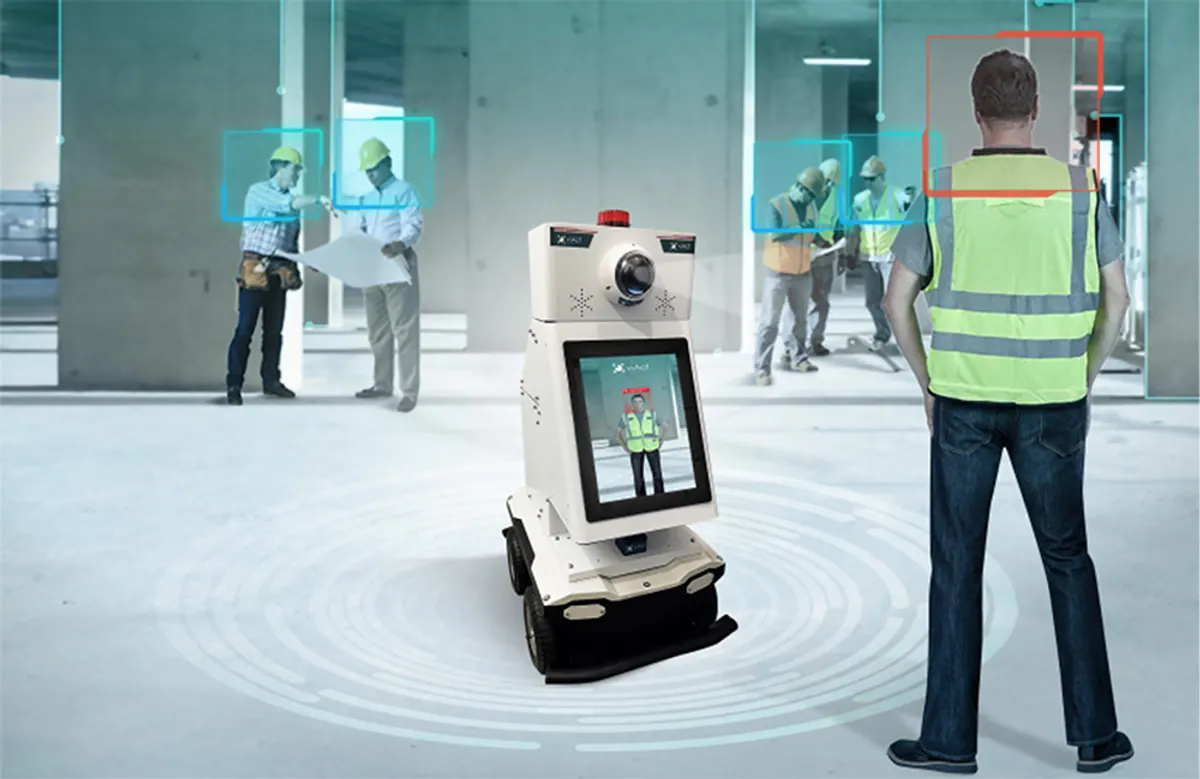
Vision AI addresses this gap by functioning as a site-wide perception layer. Rather than being embedded in individual machines, it continuously analyzes live video from existing CCTV cameras, temporary site cameras, inspection drones, body-worn cameras, and increasingly lidar feeds. This creates a common operational picture of how workers, vehicles, equipment, and autonomous machines interact in real time.
A new category of hardware is emerging to extend this capability. Autonomous mobile patrol units like viBOT move continuously through zones that fixed cameras don't reach and drones can't sustain ground-level presence in—basements, tunnels, and areas that shift week to week. These systems extend the vision AI layer into blind spots rather than adding another isolated sensor.
From detection to coordinated decision-making
Next-generation vision AI systems combine computer vision with agentic AI that interprets context, reasons across multiple data sources, and recommends or triggers actions in real time.
Instead of one camera flagging a worker entering a restricted zone, AI can correlate live video, equipment location, drone imagery, and site activities to understand broader operational context. Processing at the edge—close to cameras and sensors—enables hazard identification within seconds without relying on cloud connectivity.
Centralized operations dashboards give supervisors a single, live view of the entire site. Rather than monitoring dozens of camera feeds independently, they can understand interactions between workers, robots, vehicles, and equipment as they unfold.
This approach is reflected in evolving safety standards like ANSI/RIA R15.08, developed to address autonomous mobile robots in dynamic environments beyond earlier standards that assumed fixed guide paths.
These details were first reported by The Robot Report in an article by Gary Ng, co-founder and CEO of viAct.
This is an original analysis by the Omega editorial team. Source reporting: Automation Watch.
Want systems like this working for your business?
Book a Call