Universal Robots Launches PolyScope X for AI-Ready Automation
New control software combines JavaScript architecture and ROS 2 support to enable adaptive robotic systems that evolve beyond fixed programming.
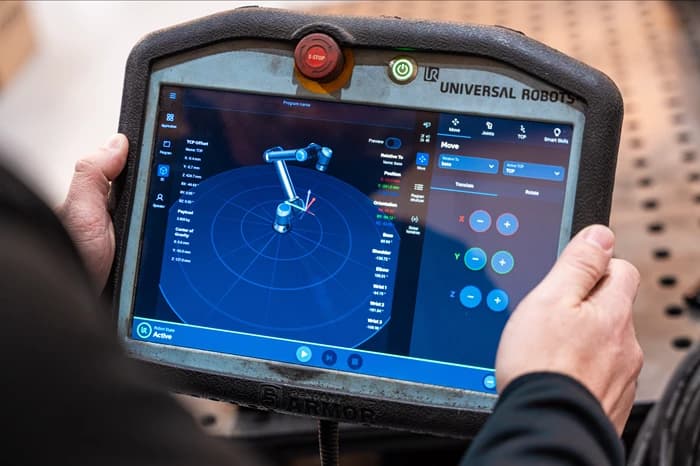
Universal Robots has introduced PolyScope X, a modernized control software platform designed to support what the company calls "physical AI" — robotic systems that can be configured, adapted, and improved continuously rather than locked into fixed automation routines.
The platform represents a technical departure from traditional industrial robot programming. PolyScope X is built on a JavaScript foundation with containerized applications and native Robot Operating System 2 (ROS 2) integration, creating an architecture that can accommodate AI-assisted applications and vision-guided tasks alongside conventional motion control.
Technical architecture and deployment features
The software combines graphical node-based programming with guided workflows, aiming to reduce the technical barrier for initial deployment while preserving access to deeper scripting capabilities for complex applications. This dual-layer approach addresses a persistent challenge in industrial automation: making robots accessible to operators without programming expertise while still supporting advanced use cases that require custom logic.
Universal Robots positions the platform as a shift from standalone robot cells to connected, evolving robotic environments. The containerized application model allows for modular updates and the addition of new capabilities without overhauling entire systems — a design choice that aligns with modern software deployment practices but remains relatively uncommon in industrial control systems.
Why it matters
Industrial automation has traditionally required significant upfront programming and integration work, with limited ability to adapt once deployed. PolyScope X's architecture suggests a move toward systems that can incorporate new AI models, vision algorithms, or operational logic as they become available — potentially reducing the total cost of ownership and extending the useful life of robotic installations. For manufacturers evaluating automation investments, this represents a bet on flexibility over fixed functionality.
Industry context and deployment base
Universal Robots says the platform draws on insights from more than 100,000 real-world robot deployments accumulated over two decades. That installed base provides the company with operational data on failure modes, common application patterns, and integration challenges — information that presumably informed PolyScope X's design priorities.
The emphasis on "physical AI" reflects broader industry momentum toward robots that can handle variability in parts, lighting conditions, or task sequences without manual reprogramming. While the term itself is marketing language, the underlying technical capabilities — vision integration, adaptive motion planning, and over-the-air updates — represent concrete advances in how industrial robots operate.
Details on PolyScope X were first reported by Automation Watch through Modern Machine Shop.
This is an original analysis by the Omega editorial team. Source reporting: Automation Watch.
Want systems like this working for your business?
Book a Call