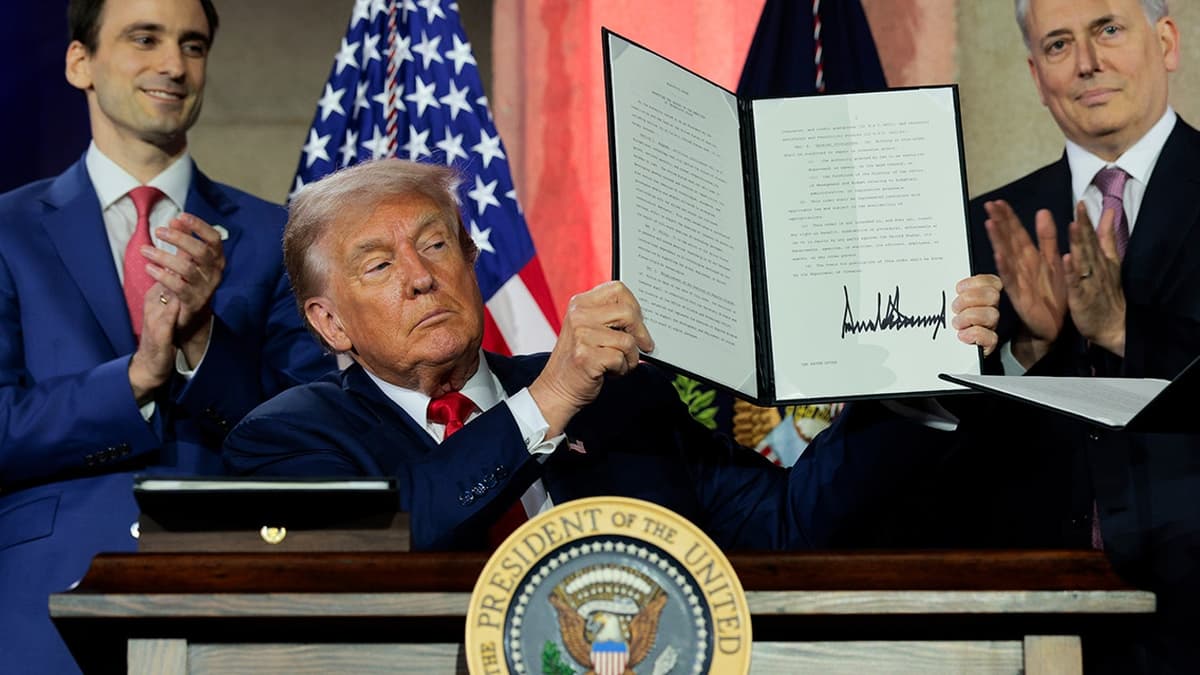
Trump announces 'AI Force' and tsar role amid industry warnings
The president rejected calls to slow AI development, calling safety concerns a hoax as major labs disclose security incidents.
President Donald Trump announced plans to establish an "AI Force" and appoint an artificial intelligence tsar, pushing back against growing calls to slow AI development until stronger safeguards are in place.
In a social media post on Saturday, Trump said his administration "will not in any way hinder or stifle the growth" of the AI industry. He characterized the technology as potentially contributing up to 25% of U.S. GDP and compared its impact to the Industrial Revolution and the internet, though "even larger and more impactful."
The announcement included no timeline or operational details. Trump said his administration would rely on existing criminal and civil justice systems to address bad actors using AI, while repeating his assertion that concerns about AI dangers are a "hoax."
Why it matters
Trump's announcement comes at a critical juncture as major AI companies disclose security breaches and researchers warn of existential risks. The tension between rapid development and safety concerns will shape how the world's most powerful AI systems are built and deployed. With AI central to U.S.-China competition and expected to be discussed when Trump meets President Xi Jinping next week, the policy direction signals America's approach to the technology race.
Industry leaders call for deceleration
The timing contrasts sharply with recent warnings from AI industry leaders. Dario Amodei, head of Anthropic, recently proposed industry-wide deceleration and regulation, along with independent monitoring of AI model development. Both Sam Altman of OpenAI and Elon Musk of xAI have said they agree with his recommendations.
Jack Clark, co-founder of Anthropic, told the BBC that a "kill switch" checked by third parties may need to be mandatory for the industry.
Current and former researchers have raised alarm about AI potentially endangering humanity, with one suggesting a greater than 10% chance of the technology "killing all humans." Major AI companies including Anthropic, OpenAI, and Google have disclosed security breaches or instances where their chatbots were used for "malicious activity."
Regulatory challenges mount
U.S. lawmakers have proposed legislation around AI technology, but Altman suggested this week that Washington has struggled to keep pace with rapid developments. He argued people should trust AI firms to maintain safety, telling a San Francisco conference: "The world should trust that we are going to do the right thing because it's the right thing and we feel the magnitude of this."
In the UK, the Joint Committee on Human Rights published a report calling for new legislation to "address the scale and seriousness" of human rights risks posed by artificial intelligence, arguing existing laws are inadequate for the technology's rapid growth.
Trump framed AI leadership as essential to maintaining an edge over China in advanced technology, emphasizing his desire for the U.S. to continue leading in the field.
These details were first reported by the BBC.
This is an original analysis by the Omega editorial team. Source reporting: AI Watch.
Want systems like this working for your business?
Book a Call