AI Agent Governance Shifts From Audit Logs to Provable Authority
As autonomous systems delegate tasks across enterprise infrastructure, organizations need real-time authorization frameworks that can verify what agents were permitted to do—not just what they did.
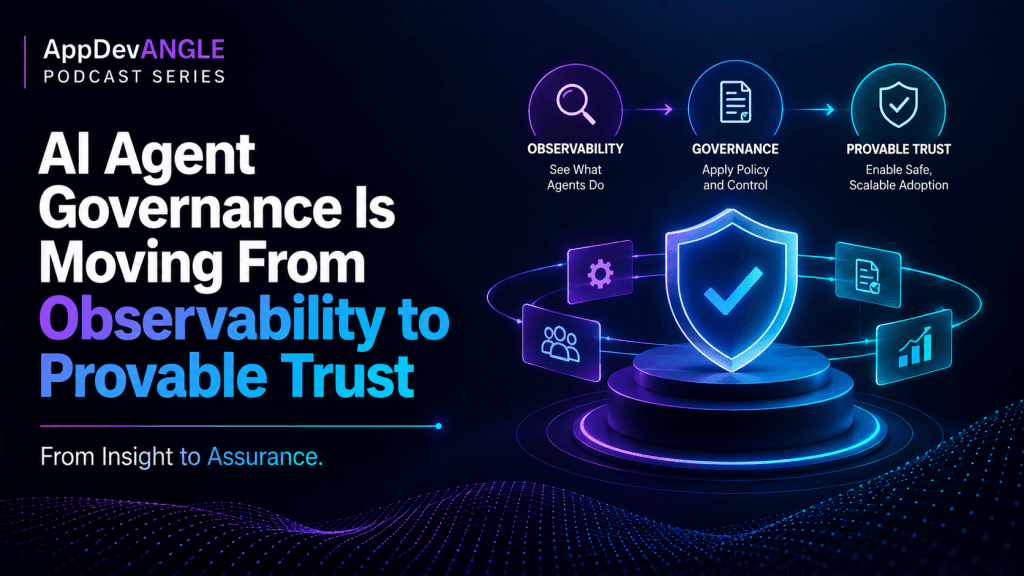
The authorization gap in agentic AI
Enterprise AI governance faces a fundamental architectural challenge as autonomous agents move into production: traditional audit logs can show what an agent did, but they cannot prove what it was authorized to do at each step in a multi-agent workflow.
That distinction becomes critical when agents delegate tasks to other agents, invoke APIs, and pass authority across systems at machine speed. According to Sudeep Goswami, CEO of Traefik Labs, and Andreas Prins, sovereignty strategy lead at SUSE, the governance model must shift from retrospective visibility to real-time, contextual authorization—with cryptographic proof.
"When you have an agent that is handing a task to another agent, that authority should shrink and not leak out," Goswami explained in a recent AppDevANGLE podcast episode.
Why it matters
Regulated enterprises deploying agentic AI cannot rely solely on identity credentials or post-event logs. As agent proliferation accelerates—one executive discovered 8,000 agents in a single engineering organization—organizations need governance architectures that enforce policy in context, verify authorization chains, and produce tamper-evident records. Without this shift, autonomous systems risk becoming ungovernable at scale.
Context replaces credentials
Traditional access control models were built around human users and predefined service accounts. Agentic systems introduce machine-to-machine delegation chains where a single credential cannot answer whether an agent is permitted to take a specific action in a given context.
Goswami compared the problem to physical access: an employee badge may grant building entry but not financial approval authority. AI governance requires the same contextual logic—policies that evaluate not just identity, but task, environment, delegation history, and operational conditions.
Prins drew a parallel to the evolution of CI/CD pipelines, where organizations codified approvals and security checks directly into automated workflows. "We go through that same thinking again," he said. "Let's rethink, and more importantly, let's articulate as code."
Enforcement at the gateway layer
Policy definition alone is insufficient. Enterprises need enforcement mechanisms at the points where agents interact with applications and infrastructure—typically the gateway layer.
Goswami argued that governance systems must capture both allowed and denied actions. Proof that guardrails blocked unauthorized requests can be as valuable as evidence of successful task completion. Repeated denials also create a feedback loop, revealing poorly designed workflows or gaps in policy frameworks.
Cryptographic evidence and sovereign infrastructure
Conventional logs present a trust problem: the system generating the evidence can also modify it. Goswami compared this to a vehicle odometer controlled by the owner—there's no independent verification.
Cryptographic signing can make tampering detectable, but enterprises also need third-party verification mechanisms to confirm records remain unaltered. For regulated industries, this distinction matters: organizations may need to prove not only what an agent did, but that the evidence itself is trustworthy.
Sovereignty adds another layer. Research cited in the conversation found that 47% of organizations operate across mixed connected and disconnected environments, while 11% deploy generative AI in air-gapped infrastructure. For defense, healthcare, financial services, and government workloads, governance controls and verification systems may need to run entirely within customer-controlled environments.
"The moment you become dependent on a third-party SaaS service that you don't control or it's not in your own soil, then all bets are off," Goswami said.
An ecosystem approach
No single vendor can deliver sovereign AI governance alone. An enterprise stack includes models, compute infrastructure, Kubernetes, gateways, policy engines, observability systems, and evidence layers. Traefik Labs and SUSE are addressing different parts of this architecture—SUSE provides underlying infrastructure and open-source technologies, while Traefik delivers gateway and agent governance capabilities.
The goal, Goswami said, is to enable "a high degree of secure and scalable adoption of agentic workflows in the enterprise" by embedding governance into the architecture rather than treating it as a separate security function.
The details were first reported by SiliconANGLE in a conversation with Goswami and Prins on the AppDevANGLE podcast.
This is an original analysis by the Omega editorial team. Source reporting: AI Watch.
Want systems like this working for your business?
Book a Call