Trump announces AI Force agency and czar appointment
President proposes new federal structure to oversee artificial intelligence development while resisting calls for regulatory slowdown.
Trump unveils AI Force proposal
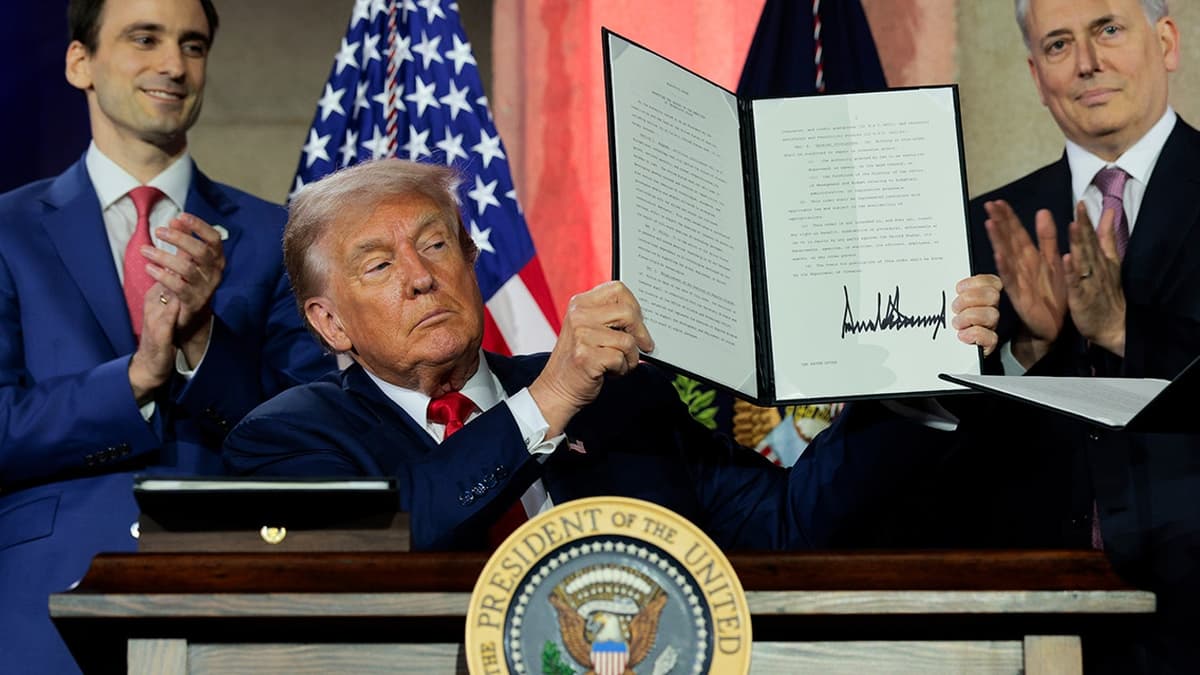
President Trump announced plans Saturday to establish an "AI Force" and appoint a new "AI Czar" to oversee artificial intelligence development, according to The Hill. In a Truth Social post, Trump compared the proposed agency to the Space Force he created during his first term, though he provided no details about its structure or specific responsibilities.
The president called concerns about inadequate federal AI guardrails a "hoax" and said he would not allow the technology's "decimation" as U.S. companies compete globally, particularly with China. Trump emphasized his administration would not "hinder or stifle the Growth of this incredible Industry" but would instead "cherish it, help it, and watch over it."
Why it matters
The announcement signals a fundamental split in how the U.S. government will approach AI governance. While researchers and tech CEOs increasingly call for safeguards and even slowdowns in AI development, Trump's proposal prioritizes acceleration over regulation. This creates uncertainty for companies navigating compliance requirements and for international partners seeking coordinated AI policy frameworks.
Czar role remains undefined
For the new AI Czar position, Trump stated that "Only High I.Q. individuals need to apply" but offered no further details about qualifications or responsibilities. The role represents a second iteration after venture capitalist David Sacks previously served as AI and cryptocurrency czar before stepping down earlier this year as a special government employee.
Industry leaders seek slowdown
The timing of Trump's announcement contrasts sharply with recent calls from AI industry leaders for more cautious development. Anthropic CEO Dario Amodei has advocated for a global slowdown in AI advancement, a position supported by OpenAI CEO Sam Altman and Elon Musk of SpaceX, SpaceXAI, and Tesla.
Trump has consistently rejected proposals for new federal restrictions, arguing that slowing AI development could undermine America's competitive position in the global AI race. His administration has emphasized accelerating technology development while relying on existing criminal and civil justice systems to address potential problems.
"We will also be looking for BAD, and we can do that, very easily, with our already existing Criminal and Civil Justice System," Trump wrote in his Truth Social post.
Regulatory approach remains unclear
The president's announcement leaves fundamental questions unanswered about how the AI Force would operate, what enforcement powers it might have, and how it would coordinate with existing federal agencies already involved in AI policy, including the Commerce Department, the National Institute of Standards and Technology, and various regulatory bodies.
The details were first reported by The Hill.
This is an original analysis by the Omega editorial team. Source reporting: AI Watch.
Want systems like this working for your business?
Book a Call