Standardize Before You Automate: Lessons From a Million Robots
Amazon's decade-long deployment reveals that process maturity and sequencing discipline matter more than the technology itself.
The expensive mistake most warehouses make
Warehouse operators facing throughput pressure routinely invest in goods-to-person systems, automated storage and retrieval, and robotic picking—only to discover they've built a faster, more expensive version of their existing problems. Industry practitioners call this outcome "automating the mess."
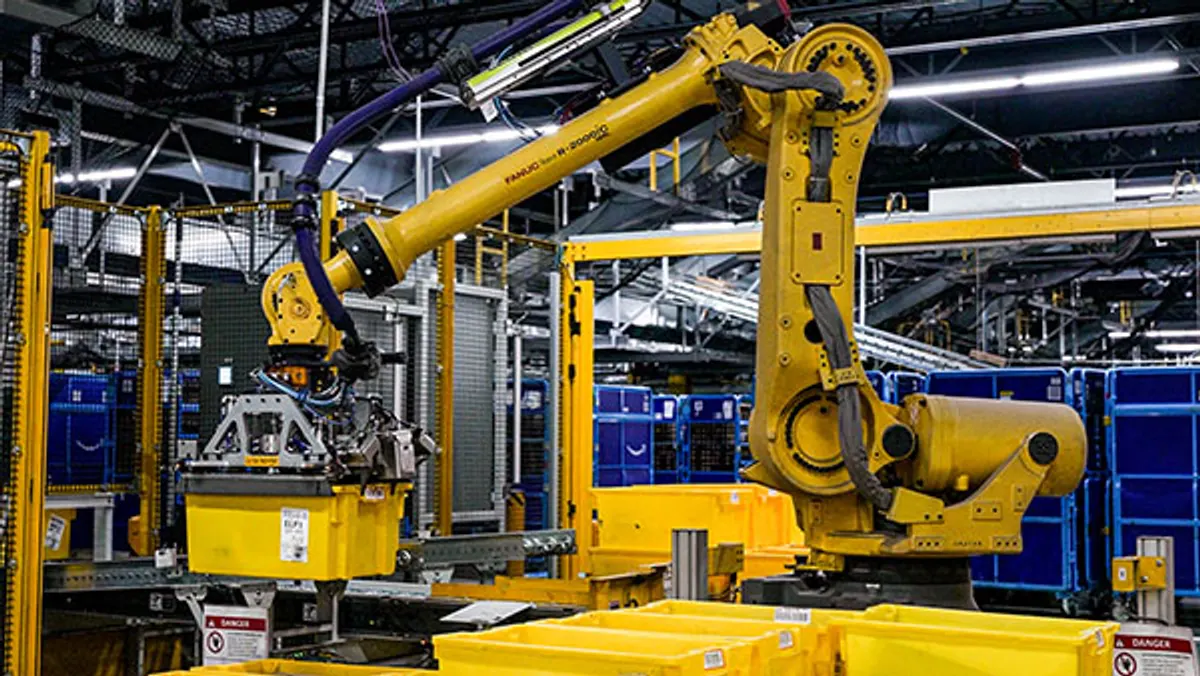
The world's largest automation deployment offers a corrective. Amazon's fulfillment network has grown from acquiring Kiva Systems in 2012 to operating more than one million robots in 2025, approaching the size of its 1.2-million-person workforce. Because Amazon documents its deployments in detail, the trajectory provides a longitudinal case study in automation sequencing that applies even to operations with a fraction of Amazon's scale and capital.
According to Neal McGuckin, a senior operations leader with experience in Middle East and North Africa e-commerce fulfillment and time-definite airfreight cargo, the decisive variable in warehouse automation is rarely the technology itself—it's the maturity of the process being automated and the order in which capability is built.
Why it matters
Most automation failures stem from three predictable patterns: specifying equipment against unmeasured processes, automating physical movement when information flow is the real constraint, and attempting monolithic end-to-end transformation. Amazon's program avoided all three through deliberate sequencing that smaller operators can replicate without matching Amazon's capital or scale.
Standardize the unit of work first
The foundational move behind Kiva's goods-to-person model wasn't robotic—it was standardizing the unit of work. The original drive units moved standardized shelving pods to stationary workers, transforming an unbounded picking problem into a bounded transport problem. The Sequoia system, now scaled to hold more than 30 million items at Amazon's Shreveport facility, stores products in uniform totes that robots retrieve and present at ergonomic workstations.
This lesson extends beyond robotics: containerization, unit-load discipline, and consistent work measurement determine whether automation is even specifiable. Operations that cannot express work in standardized, machine-addressable units cannot determine what a robot is worth. Most brownfield operations struggling with automation fail at this foundational step, not with the technology.
Software coordination unlocks hidden value
A striking feature of Amazon's recent progress comes from software rather than machinery. In 2025, Amazon introduced DeepFleet, an AI model that functions as a traffic controller for the robotic fleet. The system reportedly improved fleet travel efficiency by roughly 10 percent with no new physical equipment.
In less automated environments, accelerating the feedback loop—giving supervisors timely visibility of shortages, overages, and exceptions paired with revised standard work—routinely delivers a substantial share of the benefit attributed to physical automation at a fraction of the cost and lead time. Informational automation deserves evaluation as its own investment category and should be exhausted before committing material handling capital.
Deploy narrow systems, not monolithic ones
Amazon's fleet comprises a portfolio of narrow, task-specific machines: one sorts packages, another lifts heavy cartons, another consolidates items, another moves carts to outbound docks. Each automates a sub-task whose variability has been engineered out, and each can fail without stopping the building. Even Amazon's humanoid robot pilots have been confined to narrow, low-criticality tasks like moving empty totes.
This approach—automating narrow, stable, high-volume, ergonomically poor sub-tasks while leaving judgment-intensive work with informed people—may represent the stable optimum in deadline-driven, high-mix operations rather than a transitional state toward full automation.
The stress test
Before any automation investment, operations should apply a simple test: if the process cannot run acceptably in manual mode with good information, automation will institutionalize its weaknesses rather than cure them. The transferable lesson from Amazon's program is the sequencing discipline—standardize the unit of work, automate transport around that standard, extend mechanization task by narrow task, then automate the orchestration layer—not the shopping list.
These insights were detailed in Supply Chain Management Review by Neal McGuckin, a Doctor of Business Administration candidate at Edinburgh Business School researching supply chain risk management, with operational experience at Amazon MENA, IAG Cargo, and Emirates Flight Catering.
This is an original analysis by the Omega editorial team. Source reporting: Automation Watch.
Want systems like this working for your business?
Book a Call