Spatial Biology Automation Reaches Pharma-Scale Throughput
New robotic protocols process hundreds of tissue samples daily, closing the gap between research techniques and industrial drug discovery pipelines.
Spatial Biology Automation Reaches Pharma-Scale Throughput
Spatial biology has long promised to reveal where proteins and RNA molecules sit within tissues, but moving from a handful of research samples to the hundreds required for pharmaceutical drug discovery has remained a stubborn bottleneck. That gap is now closing through targeted automation strategies that focus on the specific steps limiting daily throughput rather than attempting to automate entire workflows at once.
Why it matters
Pharmaceutical companies need spatial data from hundreds of samples across drug discovery programs to validate biomarkers and understand tissue biology at scale. Manual processing introduces operator variability and cannot meet these volumes. Automation that reaches pharma-scale throughput transforms spatial biology from a research curiosity into a production tool for industrial drug development.
Robotic Sample Processing Delivers Hundreds of Samples Daily
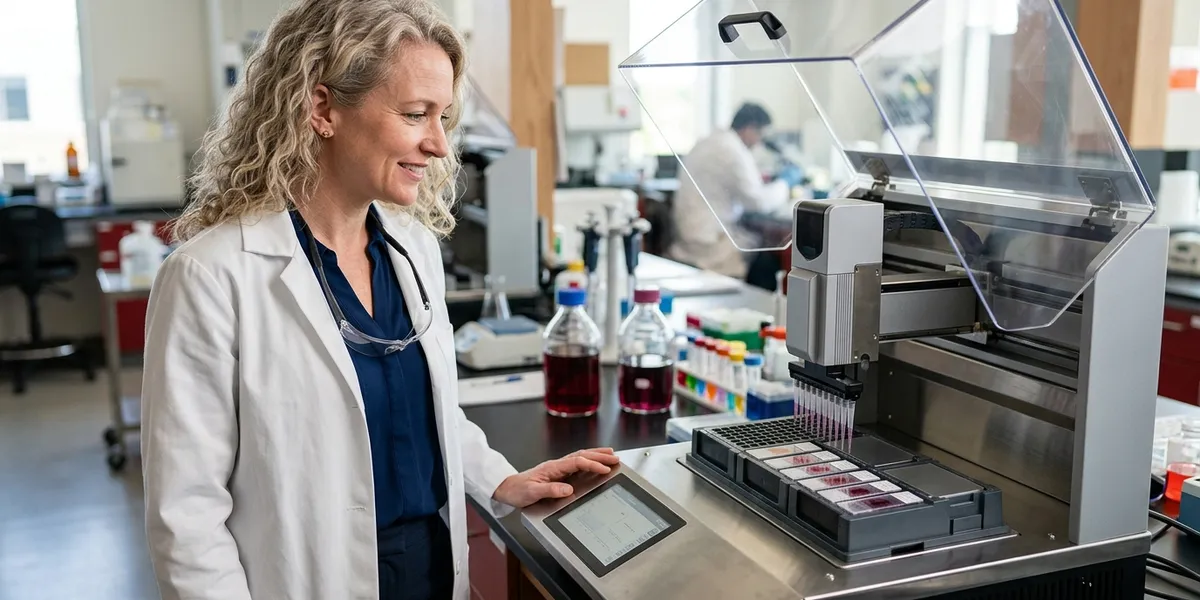
Researchers working with deep visual proteomics—a method combining whole-slide imaging, machine learning, laser microdissection, and mass spectrometry—developed a robotic protocol using automated single-cell dispensing platforms. This system now prepares hundreds of tissue samples per day, supporting workflows that exceed 100 proteomes daily, according to Drug Discovery News.
The breakthrough came from identifying the precise bottleneck: sample handling immediately after laser microdissection. Rather than automating the entire multi-step protocol simultaneously, the team automated only the step that actually limited throughput. This targeted approach proved more tractable and delivered immediate results.
A separate effort automated spatial transcriptomics library construction using the Agilent Bravo Liquid Handling Platform, a robotic workstation already common in genomics laboratories. This strategy increased throughput and consistency while reducing hands-on time compared to manual protocols. Critically, building on hardware many labs already own for other applications lowers adoption barriers compared to purpose-built spatial-specific systems.
Open-Source Approaches Address Cost Barriers
A 2025 study introduced PRISMS, an open-source automated multiplexing pipeline using liquid handling robots with thermal control for rapid, automated staining of RNA and protein samples. The researchers explicitly cited high costs of proprietary instrumentation and specialized reagents as limiting broad adoption of spatial techniques.
This open approach matters for standardization specifically. A proprietary automated platform standardizes workflows only among labs that can afford it. An open, documented protocol on widely available hardware creates a more realistic path toward cross-site standardization because more facilities can actually implement it.
The Industrialization Roadmap
Three practical steps emerge from these automation efforts:
First, identify the specific bottleneck step before attempting wholesale automation. The deep visual proteomics example succeeded by targeting post-microdissection sample handling rather than the entire workflow.
Second, prefer standard, already-adopted platforms where feasible. Building on hardware labs already operate for other genomics work reduces both cost and training barriers.
Third, treat cross-site standardization as a distinct milestone, not an automatic byproduct of automating one site. An automated protocol that works reliably at the site that built it has not yet demonstrated it will perform identically elsewhere.
Computational pipeline automation—turning raw images and sequencing output into analyzed results—presents its own scaling challenge that requires separate attention beyond physical sample processing.
These details were first reported by Drug Discovery News.
This is an original analysis by the Omega editorial team. Source reporting: Automation Watch.
Want systems like this working for your business?
Book a Call