Rockwell Automation Embeds AI Vision Tools Into Quality Systems
The industrial automation giant integrated AI-driven visual inspection across its Plex platform, but near-term growth still hinges on customer capital spending.
Rockwell pushes deeper into AI-driven manufacturing
Rockwell Automation announced in early August 2026 that it had integrated its Plex Quality Management System with FactoryTalk Analytics VisionAI, extending AI-powered visual inspection capabilities across existing camera infrastructure. The integration aims to improve anomaly detection, traceability, and inspection history for manufacturers already using Rockwell's ecosystem.
The company also embedded new AI agents into Plex Connected Worker and its Reporting and Analytics modules, signaling a broader strategy to weave artificial intelligence into manufacturing execution and operational decision-making tools.
According to details first reported by Simply Wall St, Rockwell raised its 2026 guidance to approximately $9.0 billion in sales and diluted earnings per share between $12.72 and $13.02. The upgraded outlook has supported the stock's premium valuation, though the company's investment case still depends heavily on execution against that guidance.
Why it matters
For industrial automation buyers, AI-enabled quality inspection represents a practical application that can run on legacy camera hardware without requiring full system overhauls. That lowers the barrier to adoption and could accelerate software revenue growth. However, Rockwell's near-term performance remains tied to customer capital expenditure cycles and geopolitical uncertainty—factors that can delay orders regardless of product innovation. The AI integration strengthens the long-term narrative but does not eliminate execution risk in the current environment.
Analyst projections and competitive pressure
Rockwell's internal narrative projects $10.3 billion in revenue and $1.8 billion in earnings by 2029, implying 5.5% annual revenue growth and a roughly $700 million increase in earnings from the current $1.1 billion baseline. Some optimistic analysts have penciled in higher figures—around $10.9 billion in revenue and $2.1 billion in earnings by 2029—if the company's AI push successfully counters competitive threats from lower-cost and open-source automation platforms.
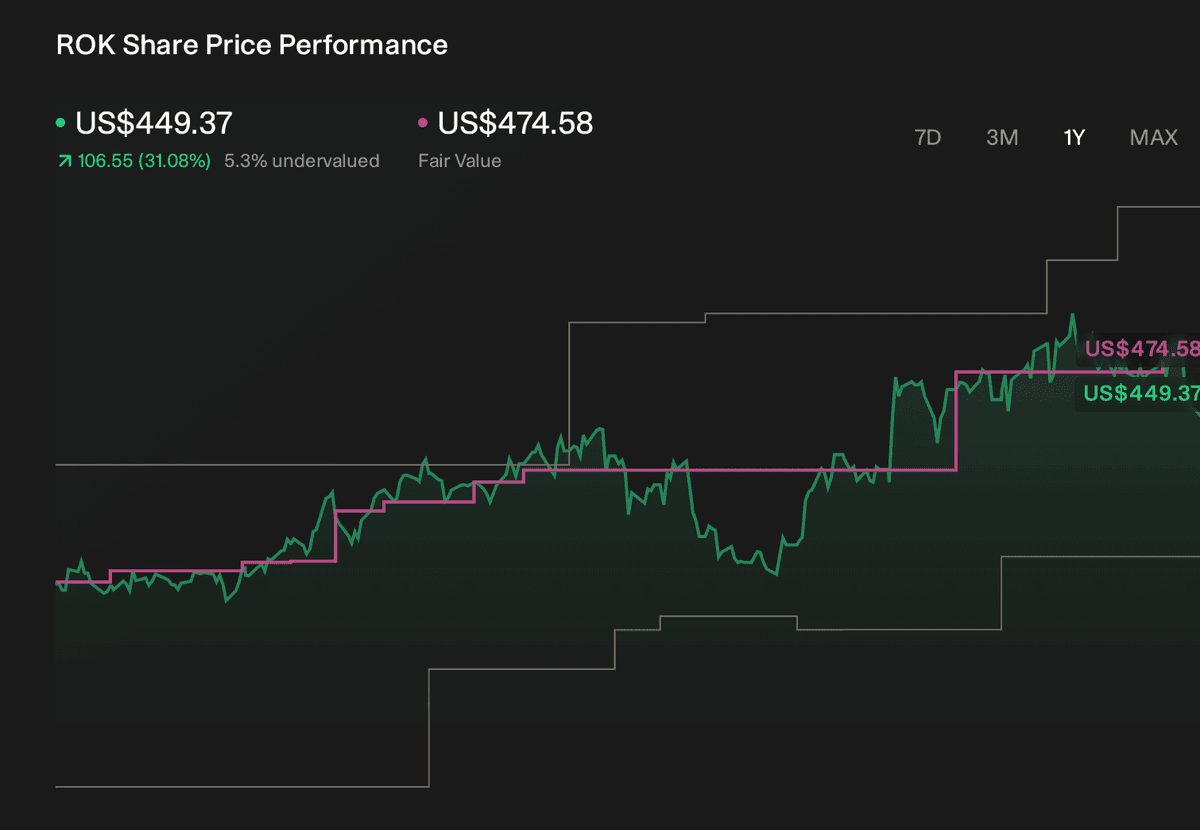
Simply Wall St's analysis suggests a fair value estimate of $474.58 per share, representing approximately 6% upside from current levels. Alternative valuation scenarios explored by analysts show a range of outcomes, with some models indicating the stock could be worth 20% less than its current price if growth assumptions prove too aggressive.
Investment considerations
Investors evaluating Rockwell must weigh whether demand for AI-enabled manufacturing tools will pull enough customers into the company's ecosystem to justify its valuation. The upgraded 2026 guidance and new AI product integrations support the growth story, but persistent delays in customer capital spending and geopolitical risks remain the primary near-term headwinds.
The details in this analysis were first reported by Simply Wall St.
This is an original analysis by the Omega editorial team. Source reporting: Automation Watch.
Want systems like this working for your business?
Book a Call
