Robot Orders Hit 18,000 Units as WCS Becomes Automation Bottleneck
North American warehouse operators are discovering that control software, not robot capability, determines whether automation scales or stalls.

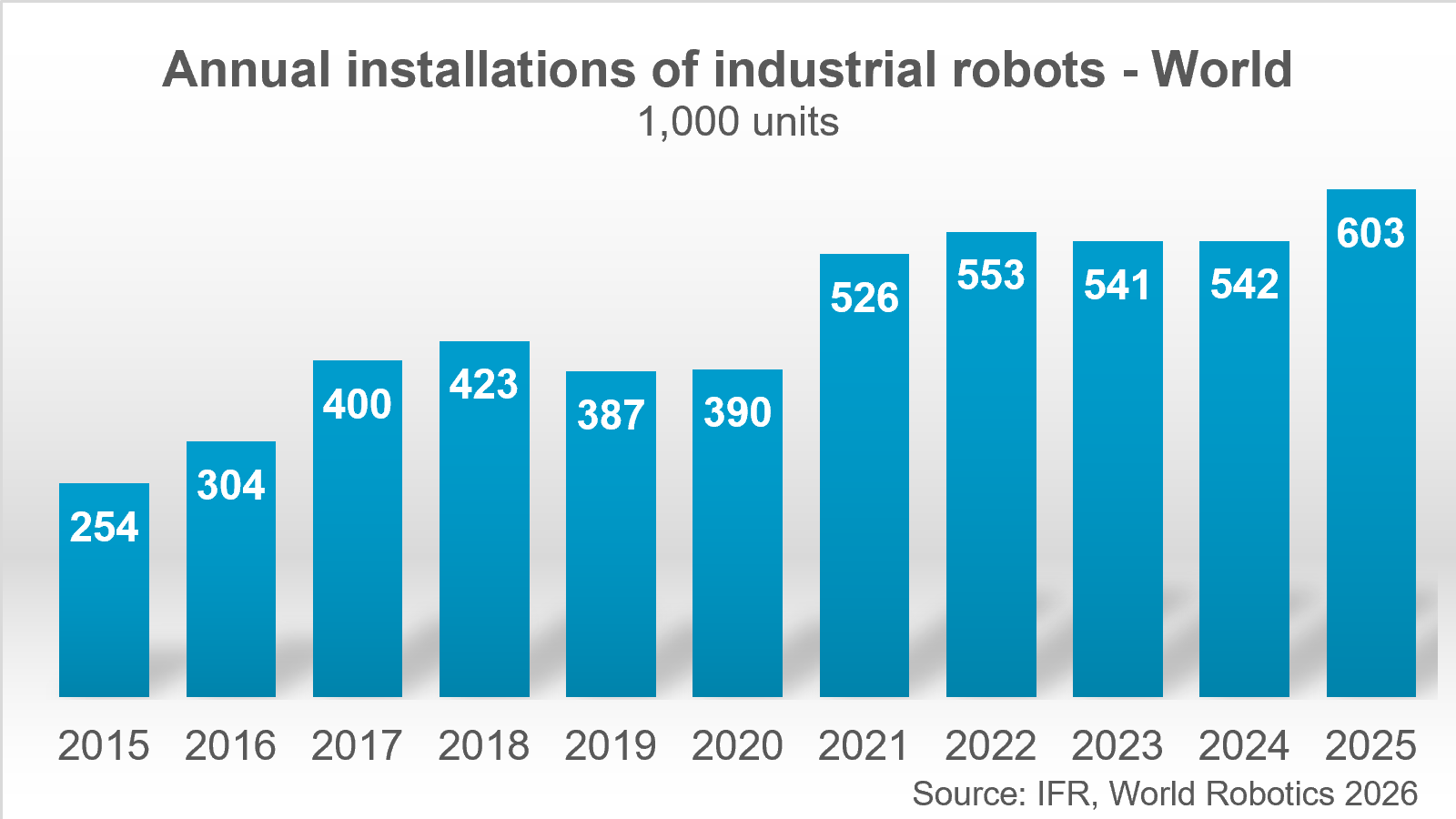
North American companies ordered nearly 18,000 robots valued at approximately $1.2 billion during the first half of 2026, according to data from the Association for Advancing Automation cited by The Wall Street Journal. While unit orders increased roughly 2% year-over-year, the value of those orders climbed 7%, signaling a shift toward more sophisticated systems that demand heavier integration work.
The gap between unit and dollar growth reveals what's actually landing on warehouse floors: not single-vendor turnkey stacks, but mixed automation environments where shuttles, conveyors, sorters, and mobile robots must coordinate across inbound, storage, picking, packing, and sortation. That coordination challenge is pushing warehouse control systems from a supporting role into the primary operational layer.
Why it matters
As robot deployments accelerate, the limiting factor in automation ROI is shifting from capital expenditure to software orchestration. Facilities that treat WCS as an afterthought risk creating automation islands that require manual intervention whenever the warehouse management system schedule conflicts with what robots can physically execute. For operators planning 2027 projects, this means procurement conversations must specify control architecture, data interfaces, and responsibility boundaries before equipment arrives—not after go-live when throughput targets are missed.
WCS emerges as the coordination layer for mixed fleets
Logistics Business reported on August 18, 2026 that warehouse control systems are increasingly positioned as the "nerve centre" for real-time decision-making across automated subsystems. Once a facility runs multiple automation types, coordination and exception handling become the throughput constraint, not theoretical robot speed.
For operations leaders, this creates a procurement challenge: buying robots without defining the control layer can leave sites dependent on manual workarounds when automation subsystems compete for resources or when a blocked lane triggers cascading delays. A WCS-centric design consolidates that complexity into a governed layer with measurable KPIs for queue time, equipment utilization, and recovery behavior.
AI moves closer to execution, raising governance questions
Logistics Business also described on August 19, 2026 how logistics operators are adopting AI incrementally, starting with planning, forecasting, and slotting recommendations that sit outside the material flow. But in automation-heavy warehouses, AI systems that prioritize work, flag anomalies, or adjust batching logic quickly become part of the execution loop.
The governance question becomes architectural: does that logic live inside the WMS, the WCS, a robot fleet manager, or as a separate service? Operators need deterministic handoffs and audit trails, especially when AI outputs affect work release, exception routing, or recovery after faults. A related August 17, 2026 Logistics Business article on AI-assisted cargo theft detection underscores the same constraint—AI outputs must connect to workflows that operators can explain during incident review and customer communications.
What this means for 2027 automation projects
The A3 figures indicate the robot pipeline remains strong heading into 2027. That means projects will be judged less on whether robots function and more on how quickly sites reach stable operations after deployment. For operators managing high SKU churn, promotional volume spikes, or multi-client 3PL environments, stabilization time often represents the largest hidden cost.
In RFPs for AMRs, shuttles, or goods-to-person systems, operators should require clear architecture diagrams naming the WMS, WCS, and any fleet managers, then ask which layer owns work release, prioritization, and exception routing. Integrators should commit to measurable recovery behaviors: how the system drains queues after faults, what happens when a station goes down, and how quickly the automation layer can re-route work without manual re-planning. If AI is proposed for slotting, batching, or risk scoring, insist on audit trails and defined human override mechanisms that integrate with WCS and WMS workflows rather than living in separate dashboards.
These details were first reported by The Wall Street Journal and Logistics Business.
This is an original analysis by the Omega editorial team. Source reporting: Automation Watch.
Want systems like this working for your business?
Book a Call