Quanta Cuts Commissioning Time 30% With Digital Twin Strategy
The electronics manufacturer connects engineering and production through unified simulation, achieving 95% traceability and 15% efficiency gains.
Quanta Cuts Commissioning Time 30% With Digital Twin Strategy
Quanta Computer Group has achieved a 30% reduction in on-site commissioning time by validating production processes virtually before installing physical equipment. The global electronics manufacturer, working with Siemens and Techman Robot, built a unified digital backbone that connects engineering design directly to factory execution.
The approach addresses a core challenge in modern electronics manufacturing: coordinating complex products across dozens of departments, thousands of components, and multiple production sites while maintaining traceability over 15-year product lifecycles. Quanta's automotive electronics division manages programs involving more than 30 departments, over 400 documents, upwards of 4,500 components, and 30-plus suppliers.
Why it matters
Manufacturers traditionally treat engineering and production as separate activities, discovering integration problems only after equipment is installed. By validating manufacturing processes digitally first, companies can identify issues that would otherwise cause costly production delays, equipment modifications, and scrap. The measurable results—30% faster commissioning, 15% higher efficiency, 95% data consistency—demonstrate that digital thread integration delivers concrete operational value beyond theoretical benefits.
Building a Connected Digital Foundation
Howard Tsai, Senior Director of Quanta's Automotive Division, told Automation Watch that the breakthrough came from creating a shared digital foundation rather than improving isolated software tools. The solution connects the engineering Bill of Materials, manufacturing BOM, and Bill of Process into a single digital thread using Siemens Teamcenter as the backbone.
This integration enables teams to work from a trusted source of information where every engineering revision remains fully traceable. When engineers make changes—such as adding a larger capacitor to a circuit board—they can immediately determine whether the modification blocks an inspection camera's field of view, resolving issues in minutes during simulation rather than after production begins.
Virtual Validation Before Physical Installation
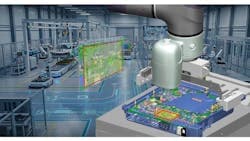
Quanta uses Siemens Process Simulate software to create virtual models of products and manufacturing processes. Engineers simulate robot motion, evaluate reachability, verify safety zones, optimize cycle times, and confirm inspection coverage before commissioning equipment.
Dr. Kolja Zakrzewski, Head of Strategy Electronics & Semiconductors at Siemens, explained that this approach allows manufacturers to validate production digitally before execution begins. Techman Robot's collaborative robots and AI vision technology then translate these validated processes into flexible shop-floor operations.
Orchestrating Execution With Low-Code Workflows
Workflow Canvas serves as a low-code orchestration platform connecting robots, cameras, PLCs, machines, and IT systems into unified manufacturing workflows. Engineers use drag-and-drop tools to create standardized workflows with version control and repeatable deployment across production lines.
Real-time production data flows back into the digital twin, keeping virtual models aligned with actual performance. Robot positions, timestamps, and execution data synchronize with Manufacturing Execution Systems and dashboards for complete traceability.
Measured Business Impact
Beyond the 30% commissioning time reduction, Quanta achieved 15% higher end-to-end efficiency through digital process integration, 25% less documentation effort through partial auto-generation, and up to 95% data consistency from engineering changes through production work instructions.
Tsai noted that the transformation extends beyond metrics: "By using digital twins, scaling across factories becomes more predictable. Looking ahead, this is how we industrialize innovation globally." Quanta plans to open a new factory in Germany with first production in summer 2026, deploying digitally validated processes and standardized workflows across global operations.
The details were first reported by Automation Watch.
This is an original analysis by the Omega editorial team. Source reporting: Automation Watch.
Want systems like this working for your business?
Book a Call
