Physical AI Solves the Shoebox Problem in Warehouse Automation
Two-piece shoeboxes have resisted robotic handling for years, but adaptive AI systems are finally cracking the case.
The Shoebox Challenge
Warehouse robots excel at moving pallets and standardized containers, but a common item in fashion fulfillment has proven unexpectedly difficult to automate: the two-piece shoebox. Despite representing roughly 20 percent of all fashion ecommerce merchandise, shoeboxes have remained largely manual operations in distribution centers.
The problem isn't complexity—it's variability. Most shoeboxes consist of a base and a loose-fitting lid that can shift or separate during handling. Slight differences in how the lid overlaps the base, the box's orientation, or friction between components create unpredictable behavior. Warehouses process hundreds of shoebox designs with continuously changing inventory, and traditional suction-cup grippers struggle with this inconsistency.
The obvious solution—elastic bands to secure the lid—has been rejected by major shoe manufacturers and retailers. Following customer trials and surveys, these companies found that banding methods damage the user experience and brand perception. Many now explicitly prohibit distribution partners from using bands on their products.
Why it matters
The shoebox problem illustrates a fundamental shift in warehouse automation strategy. Rather than forcing products to conform to rigid robotic systems, the industry is developing adaptive robots that handle real-world variability—a capability essential as retailers demand greater flexibility across thousands of SKUs with constantly changing assortments.
Physical AI as the Solution
The emerging answer lies in what the industry calls Physical AI: robotic systems that combine perception, reasoning, and manipulation to adapt in real time. These robots must determine an object's identity, position, stability, and optimal grasp points within fractions of a second while maintaining human-level throughput.
Modern AI vision systems create detailed three-dimensional representations of each object, evaluating size, orientation, and physical characteristics before planning a grasp. Machine learning models select the most appropriate gripping strategy, while tactile sensors verify success. When conditions change unexpectedly, the robot reassesses and adapts rather than failing.
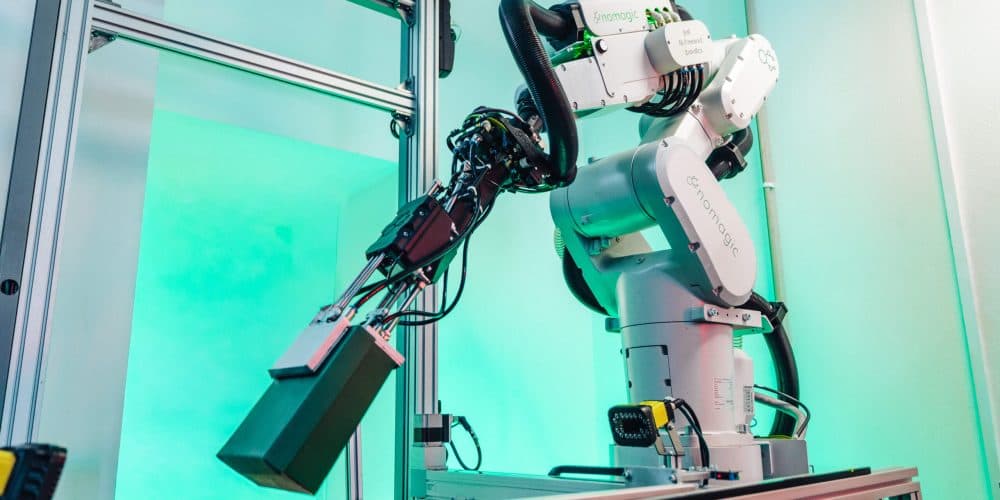
Nomagic recently introduced a Shoebox Picker specifically designed for two-piece boxes. The system uses AI-based perception with specialized end-of-arm tooling that evaluates each shoebox individually, adjusting its grasp according to dimensions, lid configuration, and orientation. The solution handles approximately 98 percent of shoebox SKUs at rates up to 450 units per hour, according to Oscar Cutts, Business Development Manager at Nomagic.
Broader Implications
While shoeboxes may appear to be a niche application, they represent a larger trend in warehouse automation. As Physical AI matures, robots are becoming capable of handling increasingly diverse products without requiring every object or facility to conform to automation constraints.
This capability becomes critical as fashion ecommerce operations face constant product assortment changes, seasonal demand swings, and customer expectations for rapid fulfillment across vast SKU counts. Automation systems designed for narrow, predictable item sets struggle in these dynamic environments.
The details were first reported by Logistics Business in an article by Cutts.
This is an original analysis by the Omega editorial team. Source reporting: Automation Watch.
Want systems like this working for your business?
Book a Call
