PentesterFlow Brings Human-Approved AI Agents to Pentesting
New open-source CLI tool automates reconnaissance through reporting while requiring analyst sign-off on every sensitive command.
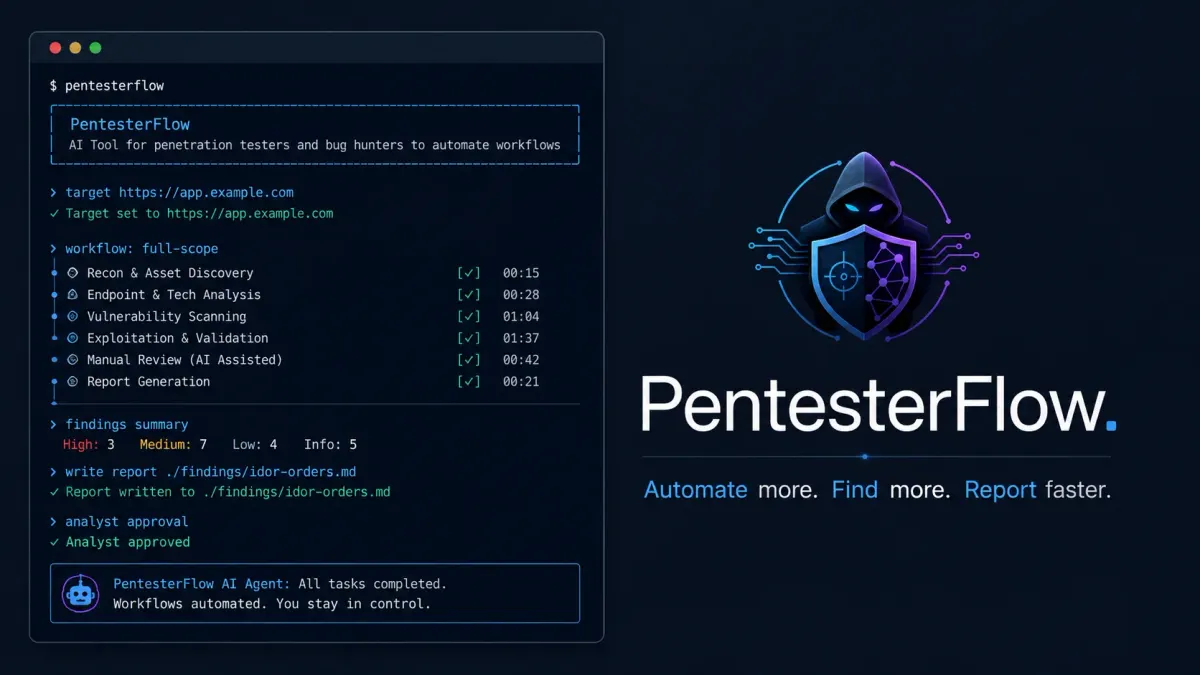
Human-in-the-loop design addresses autonomous AI trust gap
PentesterFlow, a newly released open-source command-line tool, brings agentic AI capabilities to penetration testing while maintaining strict analyst oversight throughout the workflow. The tool automates reconnaissance, enumeration, validation, and reporting tasks but requires explicit human approval before executing any sensitive commands against target systems.
According to Automation Watch, which first reported on the release, PentesterFlow addresses critical weaknesses common in autonomous security tools: hallucinated findings, poor context retention, and unreliable tool integration. The platform connects to local or hosted large language models, plans actions against scoped targets, and executes real offensive-security tools—but only after a security engineer grants permission.
Built-in skills and evidence-based validation
The tool ships with pre-built capabilities for common vulnerability classes including IDOR (Insecure Direct Object Reference), SSRF, SSTI, JWT flaws, GraphQL issues, race conditions, subdomain takeover, and deserialization bugs. A demonstration showed PentesterFlow loading a web vulnerability skill, testing an orders API, and automatically confirming a high-severity IDOR vulnerability with evidence written directly to a Markdown report.
Confirmed findings include proof-of-concept details, impact assessments, remediation guidance, and copy-pasteable curl commands for reproduction. The tool integrates with Burp Suite through a companion bridge, allowing testers to send captured traffic into the CLI and import validated findings back as Burp issues.
Continuous local learning without model retraining
A distinguishing feature is PentesterFlow's local Continuous Learning System, which stores user preferences, successful workflows, coverage gaps, and lessons from failed assumptions in project-specific and personal intelligence files. This system improves future sessions without retraining the underlying language model. Secrets are automatically redacted before disk writes, and duplicate memories are deduplicated before reaching the model.
The platform supports multiple model backends including Ollama, LM Studio, Kimi, Groq, Gemini, DeepSeek, OpenRouter, and OpenAI-compatible APIs. Installation works via shell script on macOS and Linux or PowerShell on Windows, with SHA-256 checksum verification for the standalone binary.
Why it matters
As organizations explore AI-assisted security testing, the trust gap around autonomous agents running commands on production systems remains a major barrier to adoption. PentesterFlow's mandatory approval gates and transparent evidence trails offer a middle path: automation that accelerates pentesting workflows without sacrificing the judgment and accountability that only human analysts can provide. For security teams evaluating agentic tools, this design philosophy may prove more practical than fully autonomous alternatives.
Safety controls and lab mode
PentesterFlow enforces permission-gated tool execution and blocks catastrophic shell command patterns by default. For isolated lab environments, the tool offers a "YOLO mode" that auto-approves actions. The developers explicitly state the tool is intended for authorized security work only, given its ability to execute shell commands and make live HTTP requests once approvals are granted.
Details on PentesterFlow were first reported by Automation Watch. The tool is available now on GitHub.
This is an original analysis by the Omega editorial team. Source reporting: Automation Watch.
Want systems like this working for your business?
Book a Call