Nvidia Revenue Forecast Hits $400B as AI Shift Reshapes Chip Cycle
The GPU giant expects 70% growth in fiscal 2028 while expanding from processors into financing, software, and complete data center systems.
Nvidia is projecting approximately $400 billion in revenue for its current fiscal year ending January 2027, representing an 85% increase from the prior year, according to details first reported by Calcalistech. The company expects another 70% revenue jump in fiscal 2028, with management stating that chip supply and production capacity—not customer demand—will remain the primary constraint.
The forecast reinforces expectations that AI infrastructure spending will sustain momentum through at least 2027, potentially breaking the traditional three-to-five-year cyclicality that has historically governed semiconductor markets. Nvidia reported second-quarter fiscal 2027 revenue of $96.2 billion, up 106% year-over-year, and projects approximately $108 billion for the third quarter.
Why it matters
Nvidia's trajectory illustrates how concentrated AI infrastructure investment has become—and the financial engineering required to sustain it. The company now holds $99 billion in equity stakes across AI model makers and infrastructure firms, plus $25 billion in future investment commitments. In August 2026, Nvidia established financing platforms with six major institutions designed to raise over $500 billion from third parties specifically to fund AI infrastructure purchases. This positions Nvidia not merely as a chip supplier but as a capital provider shaping which companies can afford to build at scale, raising questions about circular financing dynamics in the AI ecosystem.
From chips to complete systems
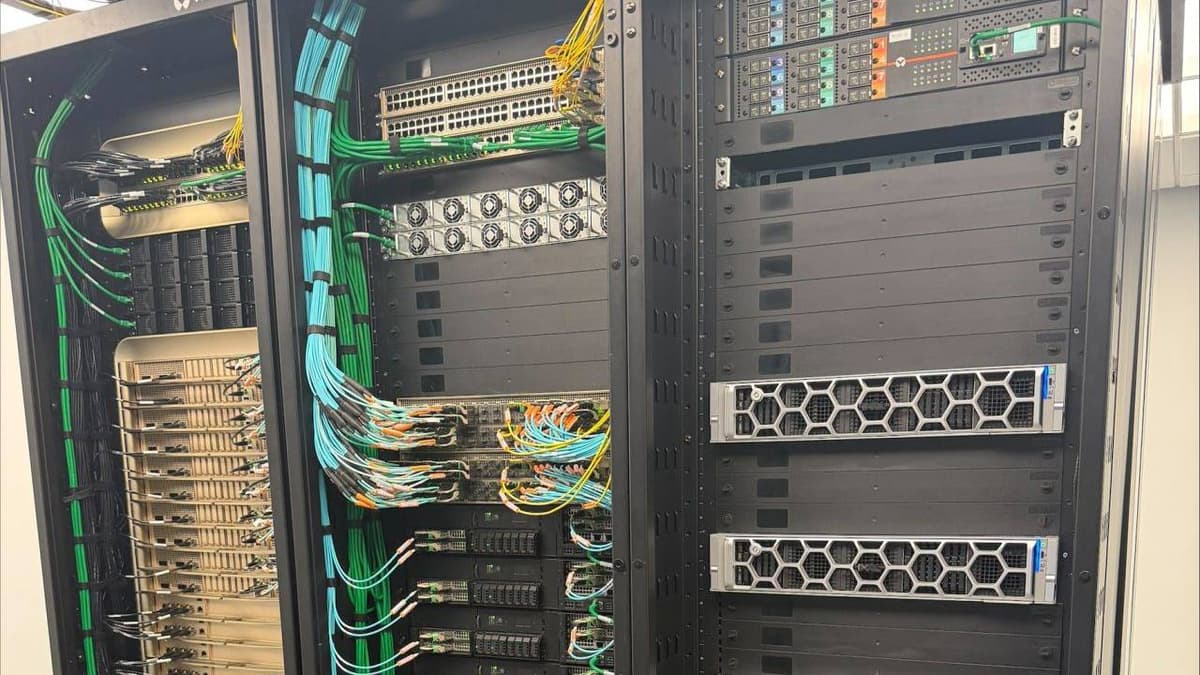
Nvidia has systematically expanded beyond GPU processors into communications, networking, storage, software, and integrated computing systems. The 2020 Mellanox acquisition brought data center networking capabilities. In December 2025, Nvidia acquired substantial portions of Groq's LPU architecture for $13 billion plus $4 billion in future payments, targeting inference workloads—running trained models rather than training new ones.
Most recently, Nvidia announced an $11.9 billion cash acquisition of Hugging Face, adding model libraries, developer communities, and runtime capabilities. These moves position Nvidia across more layers of the AI stack as data center workloads gradually shift from model training toward inference operations.
The company's Vera Rubin architecture, which began commercial shipments in August 2026, integrates processors, AI accelerators, memory, and communications into unified systems optimized for both training and inference. Nvidia expects Vera Rubin deployments to accelerate through fiscal 2028.
Revenue concentration and margin pressure
Approximately 92% of Nvidia's revenue comes from data center infrastructure. The three largest direct customers accounted for 44% of first-half revenue, with 62.4% originating from U.S.-headquartered companies. Nvidia segments its data center business into hyperscale customers (cloud providers and large internet firms) and ACIE (AI Clouds, Industrial & Enterprise). In the second quarter, hyperscale revenue reached $48.7 billion, up 13% sequentially, while ACIE grew 25% to $40.3 billion.
Gross margins stood at 75% in the first two quarters but are expected to decline to 71-72% in the fourth quarter, primarily due to sharp increases in memory component costs. High-bandwidth memory (HBM) prices have risen substantially amid supply constraints, with three manufacturers—SK Hynix, Samsung, and Micron—dominating production. HBM shipments are expected to grow 50-60% in 2027, still insufficient to meet full demand.
Based on projected 72% gross margins and 70% revenue growth, Nvidia could generate approximately $370 billion in net income for fiscal 2028, yielding a forward price-to-earnings ratio near 14 at the current $5.24 trillion market valuation.
Competitive and efficiency risks
Investors face uncertainty around several factors: potential slowdowns in data center construction later this decade, intensifying competition in inference chips particularly from Google, and development of custom AI processors by Nvidia's largest customers. Additionally, rapid improvements in computing efficiency could reduce hardware demand growth relative to AI usage growth.
Nvidia employs approximately 42,000 people globally, including 6,000 in Israel following the Mellanox integration. The company's Israeli operations span communications, chips, software, and systems engineering.
These details were first reported by Calcalistech.
This is an original analysis by the Omega editorial team. Source reporting: AI Watch.
Want systems like this working for your business?
Book a Call