Navy Deploys First Nvidia DGX GB300 AI Supercomputer
Naval Postgraduate School installation will train military officers on AI applications from ocean modeling to adversarial testing.
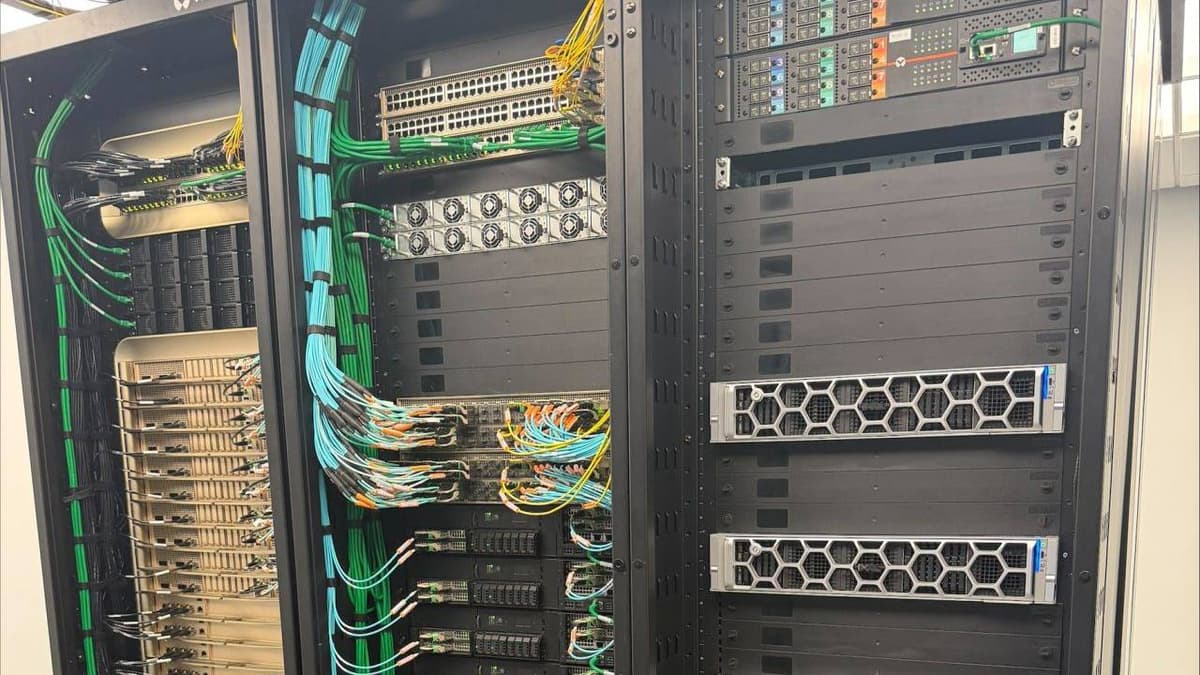
The Naval Postgraduate School in Monterey, California, has activated the first Nvidia DGX GB300 supercomputer deployed within the U.S. military, according to details first reported by Military.com. The installation gives students, faculty and approved research partners access to advanced computing infrastructure for defense applications spanning weather and ocean modeling, cybersecurity, disaster response and operational analysis.
The system combines 72 Nvidia Blackwell Ultra graphics processing units with 36 Nvidia Grace central processing units, allowing researchers to divide large computing jobs among many processors and handle different parts simultaneously. Nvidia donated the DGX GB300 and supplied the computing platform and software, while DDN provided high-performance data infrastructure, VAST Data contributed a data-management platform, and Vertiv supplied physical infrastructure including racks, cooling and power equipment.
Why it matters
Many NPS students are military officers and defense professionals who will return to operational positions across the Navy, Marine Corps and Joint Force. Their hands-on experience with this system will help them understand where AI performs well, where it fails, and how its limitations may affect military decisions in real-world scenarios.
The data infrastructure challenge
Graphics processing units can perform many calculations simultaneously, enabling faster model training. But those processors require a steady flow of information from storage systems. Delays in loading training data, saving progress or retrieving information leave expensive processors idle.
"Whoever has the most data, and is able to process it the fastest, generally has an advantage," said Kevin Delane, President and Chief Revenue Officer of DDN, in an interview with Military.com. "There's always a bottleneck when you look at all areas of the compute stack. First is to get the data in. Second is to be able to disperse that in the network. And then the third is you have to be able to store and bring data back as fast as possible."
DDN's infrastructure includes cybersecurity features that protect stored information, maintain access and alert users when data appears corrupted or compromised. Researchers must still verify information sources, test model behavior, control access and monitor performance.
Research applications
NPS researchers plan to use the system for environmental and ocean modeling, autonomous maritime systems, mission planning and decision support, disaster response and scientific simulation. They may also build digital twins—detailed computer representations used to study how vessels, facilities or operating environments behave under different conditions.
The school also intends to train large AI models, adapt language models for naval planning and intelligence, create synthetic training data, study fleet tactics with multiple AI agents, and test systems against adversarial attacks. Poor or deliberately corrupted information can cause AI models to learn false patterns, making data integrity essential.
Operational constraints ahead
The DGX GB300's computing components can draw roughly 135 kilowatts at peak use and rely on liquid cooling. Ships and expeditionary units face tighter limits on power, space and connectivity, meaning technology developed at NPS may require smaller hardware and additional engineering before operational deployment.
"With each kind of wave of technology, we're able to process more and more information and data in a smaller footprint," Delane said.
Defense Department guidance calls for continuous monitoring, validation and verification throughout an AI system's operational life, with emphasis on data integrity, system resilience, security and performance under realistic operational conditions.
These details were first reported by Military.com.
This is an original analysis by the Omega editorial team. Source reporting: AI Watch.
Want systems like this working for your business?
Book a Call