AI
NVIDIA Cosmos Generates Training Data From Two Text Prompts
New blueprints and AI agents automate dataset curation, augmentation, and synthetic generation for autonomous vehicles, robotics, and visual inspection.
Key takeaways
- NVIDIA Cosmos Data Factory generates training-ready datasets for physical AI using two text prompts and AI agent orchestration.
- The platform cuts dataset costs by up to 45x and accelerates rare-event data creation by 60x compared to traditional collection methods.
- Five blueprints cover autonomous vehicle scenarios, image attribute augmentation, video transformation, rare event generation, and defect creation.
- Early users report 24% better anomaly recall, 85% less manual engineering effort in optical inspection, and 90% fewer physical test drives.
- Six composable skills—including Auto Labeling, AnomalyGen, and Curation—enable developers to build custom data generation workflows.
Building physical AI training datasets just got dramatically simpler
NVIDIA has released Cosmos Data Factory, a platform that transforms dataset creation for physical AI from a months-long manual process into a two-prompt workflow. The system addresses a persistent bottleneck: capturing rare defects, nighttime incidents, and edge cases is expensive and time-consuming, while preparing raw footage for training requires disconnected tools and extensive human curation.
Cosmos Data Factory comprises five cloud-native blueprints and six composable skills that handle data curation, processing, and synthetic generation. Frontier AI agents orchestrate these components, enabling what NVIDIA calls "prompt-to-data" workflows without human steering at each step.
How the two-prompt system works
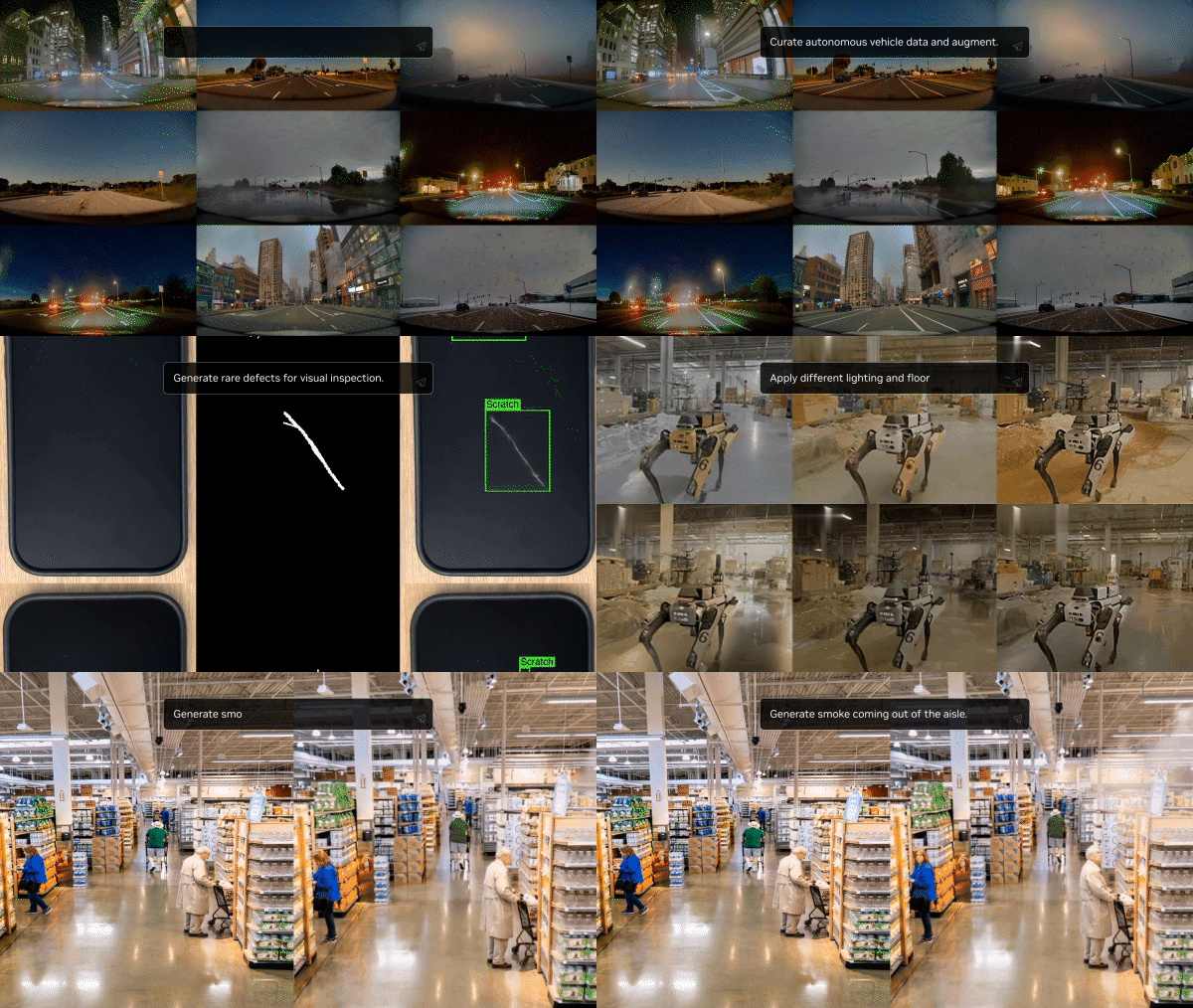
Developers first configure the environment with a setup prompt that clones the orchestration repository and runs preflight checks. The second prompt specifies the actual data generation task—whether searching driving scenarios, augmenting person images with different clothing, transforming videos across weather conditions, generating rare events like fires or collisions, or creating defect images for visual inspection.
The platform handles five distinct use cases. For autonomous vehicle training, it searches large video databases, applies style transfer to create rainy or foggy variants while preserving layout and motion, then validates physical plausibility. For retail or security applications, it generates person-crop variations with controlled attribute changes and auto-labels results for search and re-identification tasks.
Rare event generation addresses a critical gap: models need to recognize incidents like stalled vehicles or equipment failures, but real examples may take years to collect or be dangerous to stage. Cosmos uses a source image to generate video clips of specified events while maintaining the original viewpoint, then validates and auto-labels the output.
Performance and cost metrics
NVIDIA measured throughput on a cloud server with eight RTX PRO 6000 Blackwell GPUs at roughly $40 per hour. The results show substantial advantages over traditional data collection:
- Autonomous vehicle scenarios: $2.66 per clip versus $125 for fleet-captured footage—45 times cheaper
- Image attribute augmentation: $0.023 per annotated pair versus $0.25 for purchased data—10 times cheaper
- Defect image generation: dataset assembly dropped from two months to one day—a 60-fold speedup
- Event video generation: 384 annotated clips daily at $2.50 each, creating training examples without staging dangerous incidents
These figures cover compute only; source preparation, storage, and review add additional costs.
Why it matters
Physical AI systems—autonomous vehicles, inspection robots, warehouse automation—require training data that reflects real-world variability and edge cases. Traditional approaches force teams to choose between incomplete datasets and prohibitively expensive data collection programs. By converting training gaps into controllable compute workloads, Cosmos Data Factory makes it economically feasible to generate the long-tail scenarios that determine whether AI systems handle unusual conditions safely. Early adopters report improving anomaly recall by 24 percent, reducing manual engineering effort in optical inspection by 85 percent, and cutting physical test drives by 90 percent.
Six core skills enable custom workflows
Beyond the reference blueprints, developers can use six underlying skills independently: Auto Labeling for detection and tracking, AnomalyGen for defect creation, Augmentation for visual variations, Curation and Retrieval for finding relevant clips, Simulation for rendering from 3D scenes, and Orchestration for managing distributed execution. Cosmos Curator now supports multicamera video, IMU, GPS, and initial lidar inputs. Cosmos Dataset Search, released under Apache 2.0 license, combines metadata and semantic understanding through multi-embedding retrieval.
The platform and blueprints are available now through NVIDIA's developer portal, as detailed by NVIDIA in a technical blog post.