AI
Sandia's VASt AI Model Predicts Metal Alloy Properties From Electron Fingerprints
Machine learning framework trained on electron distribution, not elements, accurately forecasts high-entropy alloy behavior with minimal data.
Key takeaways
- Sandia's VASt model predicts metal alloy properties using only tens of training samples, not hundreds or thousands like conventional machine learning approaches.
- The system learns from electron distribution patterns rather than elemental composition, allowing faster predictions and extrapolation to untested element combinations.
- The model identified that vanadium increases ductility while tungsten increases strength in high-entropy alloys, suggesting practical design guidelines.
- Researchers are validating predictions experimentally and determining whether the electron-based approach works equally well for all alloy types.
- The framework could eventually enable engineers to design materials with specific properties on demand rather than constraining designs to available materials.
AI learns chemistry differently to accelerate materials discovery
Researchers at Sandia National Laboratories have developed a machine learning model that predicts the properties of complex metal alloys with unusual efficiency — requiring only tens of training samples instead of the hundreds or thousands typically needed.
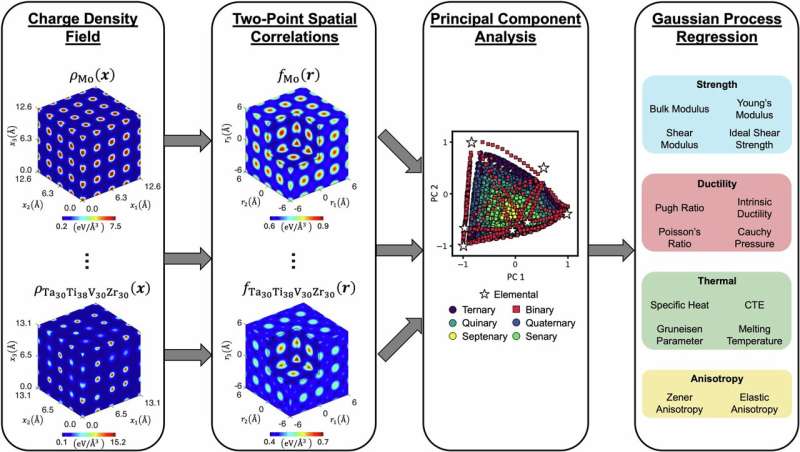
The model, called VASt (Voxelized Atomic Structure), takes a fundamentally different approach to understanding materials. Rather than learning relationships between chemical elements, it recognizes alloys by their unique electron distribution patterns. That design choice allows the system to discover performance characteristics more quickly and extrapolate to new element combinations it has never encountered.
Computational materials scientist Matthew Barry and his team reported their findings in June in the journal npj Computational Materials, according to details first reported by TechXplore. The research focuses on high-entropy alloys — complex mixtures of metals that can maintain strength at extreme temperatures where conventional materials fail.
Why it matters
Material constraints have historically limited engineering innovation. This research points toward a future where designers could consult a comprehensive alloy database to find or create materials with precisely the properties their applications demand, rather than adapting designs to available materials. For Sandia's nuclear weapons work, the implications are particularly significant: designers could theoretically develop exotic materials tailored to future stockpile requirements.
Training on electron swarms instead of periodic table entries
The key innovation lies in how VASt was taught to understand chemistry. When atoms combine into metal crystals, their electrons form collective patterns around the structure — concentrating more heavily in some regions than others. Replace one element with another, and the entire electron distribution shifts.
VASt learns to recognize these electron fingerprints. By training on electron behavior rather than elemental composition, the model sidesteps calculations it would otherwise need to perform, making it faster and more data-efficient.
In their June paper, the researchers demonstrated practical applications of this approach. The model revealed that vanadium increases ductility (a material's ability to bend without breaking) while tungsten increases strength. This insight suggests a design principle: add enough tungsten to achieve required strength, then maximize vanadium content to prevent cracking.
From theory to application
Barry developed the framework as a graduate student at Georgia Tech, where he completed his doctorate in 2023, working with collaborators from NASA. Since joining Sandia, he has focused the approach on high-entropy alloys specifically.
The research concentrated on thermo-mechanical properties — how materials respond to heat and physical stress. The team believes their electron-based training method enabled them to identify trends more readily and extend predictions to metals not included in training data.
Important questions remain. The researchers are working to validate predictions through physical experiments and determine whether the electron-based approach works equally well for all alloy types or has specific advantages with high-entropy materials. Barry noted the model should theoretically generalize across the periodic table, though that capability hasn't been tested yet.
The details were first reported by TechXplore.