Nvidia Builds Safety Software for Humanoid Robots in Workplaces
The chipmaker's Halos platform aims to let robots make split-second decisions and physically interact with humans without stopping work.
Nvidia targets workplace safety barrier for humanoid robots
Nvidia has introduced software and hardware designed to solve one of the biggest obstacles facing humanoid robots: working safely alongside people without constantly stopping.
The company announced its Halos software platform Monday, adapted from autonomous vehicle technology, to give robots better environmental awareness and decision-making capabilities. The system runs on Nvidia's IGX Thor hardware and allows machines to assess situations in real time rather than simply halting when humans are nearby.
Current safety protocols require robots to stop or slow down whenever contact with a person becomes possible. That approach reduces productivity and prevents collaborative tasks like handing objects to workers or assisting with heavy lifting.
"If you think about safety in the context of a traditional robot, it is basically you need to put it in a cage or you need to have sensors which can detect there's an obstacle and the robot comes to a stop," Amit Goel, a senior director of product management at Nvidia, told Bloomberg. "But that is not enough for a humanoid robot."
Why it matters
Barclays projects humanoid robotics will generate $200 billion in revenue by 2035, but the technology cannot scale if machines must constantly pause around people. Nvidia's approach addresses a fundamental tension: robots need enough strength to perform useful work, yet must operate safely in shared spaces. Solving this problem unlocks deployment across warehouses, manufacturing, retail, healthcare, and construction—each representing multi-billion-dollar markets.
Technology enables context-aware decisions
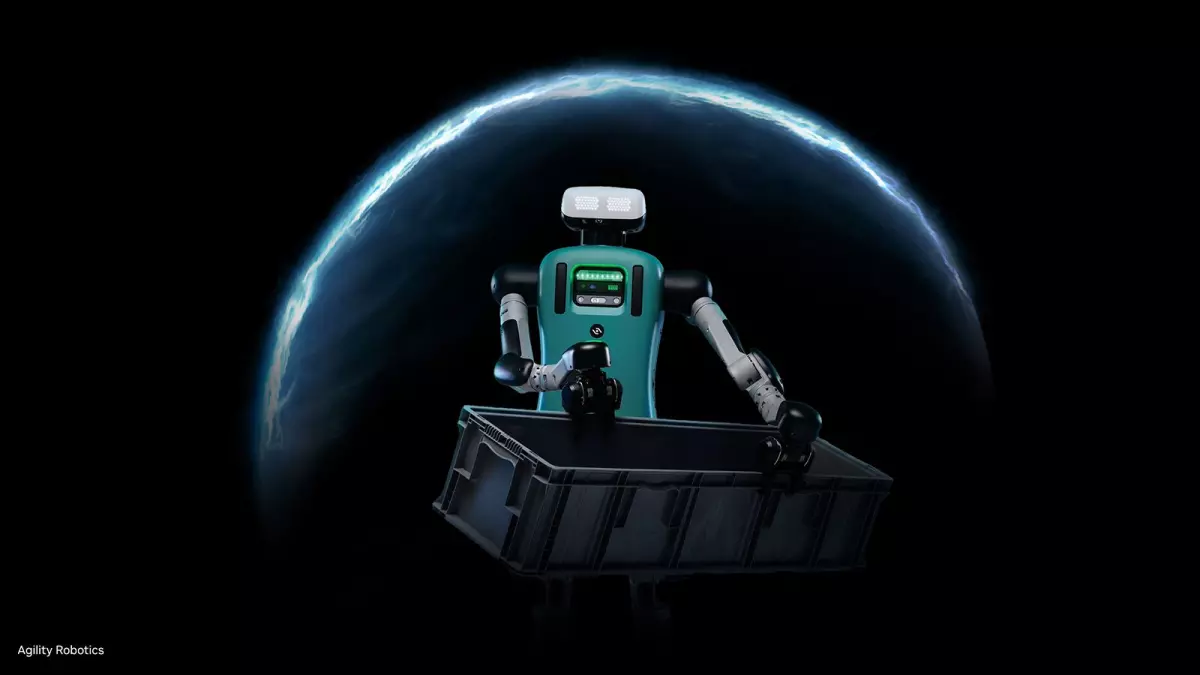
The Halos platform will power robots including Agility Robotics' Digit humanoid, which has already been deployed at Toyota manufacturing facilities in Canada. The system connects robots to external sensors throughout a facility, allowing an autonomous forklift to access warehouse cameras and see around corners before deciding whether to maintain speed or slow down.
Pras Velagapudi, chief technology officer of Agility Robotics, explained that humanoid constraints differ fundamentally from autonomous vehicles. "Safety design has to be much more advanced because you need to actually reason about, based on what you're seeing in the environment, what things you can and can't touch, move, or exert force on," he said.
Robots must exert significant force to perform meaningful work, making it impossible to simply design machines too weak to cause harm. The technology must instead enable intelligent decisions about when and how to apply force.
Nvidia expands beyond data center chips
The world's most valuable company generates most revenue from AI data center chips but has been expanding into robotics and other fields, often providing technology at no cost to broaden AI adoption.
To accelerate deployment, Nvidia created a testing lab where robot manufacturers and customers can conduct safety evaluations before seeking regulatory certification. Nvidia engineers will perform pre-inspection work and assist with engineering modifications as needed.
Velagapudi said the industry will develop in stages, starting with structured warehouse and logistics environments before expanding to more complex settings. "We're starting in warehouse and logistics, which is one of the most structured environments, but already has many billions of dollars worth of addressable market," he noted. Home care robots will come later, built on lessons learned from factory deployments.
These details were first reported by Ian King for Bloomberg.
This is an original analysis by the Omega editorial team. Source reporting: AI Watch.
Want systems like this working for your business?
Book a Call