Mobile Manipulators Tackle Warehouse Tasks Fixed Automation Can't
Combining mobility and dexterity, these robots address labor-intensive workflows like truck unloading and piece picking without sacrificing flexibility.
A new automation category emerges
Supply chain leaders face a persistent challenge: the most labor-intensive warehouse tasks—truck unloading, piece picking, mixed-case handling—remain stubbornly manual. Traditional fixed automation delivers efficiency but demands rigid workflows and substantial capital investment. As labor shortages intensify and fulfillment complexity grows, operations need systems that can handle variable work without sacrificing adaptability.
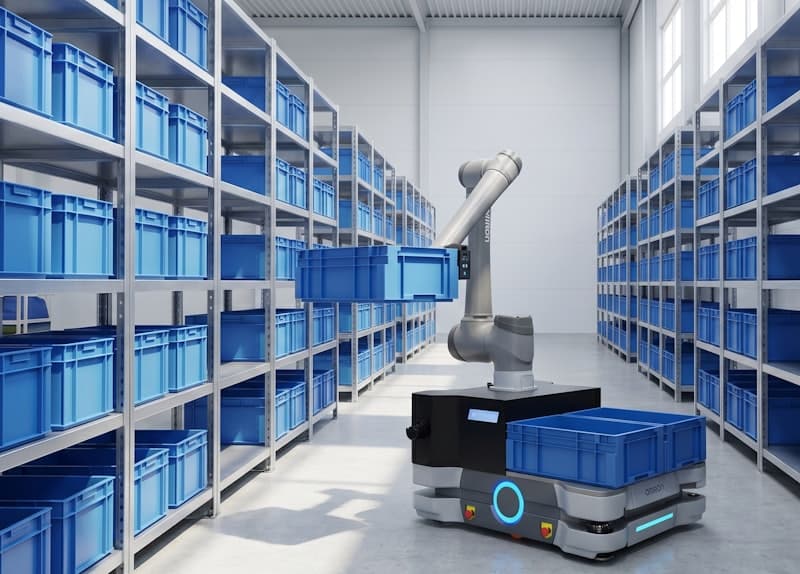
Mobile manipulators represent a distinct approach. These systems combine autonomous mobile robots with collaborative robotic arms, creating machines that can navigate warehouse floors while physically interacting with their environment. Using machine vision and real-time motion planning, they perceive unstructured spaces and make decisions on the fly—moving to where work exists, identifying objects, and acting on them.
Why it matters
This technology addresses a critical automation gap. While conveyors and fixed robotic cells excel at predictable, high-volume processes, they cannot easily adapt to changing demands or handle the variability inherent in tasks like unloading mixed containers. Mobile manipulators bring automation to workflows previously considered too complex or unpredictable, without requiring the operational rigidity of traditional systems.
Where the technology delivers value
The strongest applications involve workflows requiring both movement and manipulation. In piece picking, robots travel through zones to build orders dynamically, providing flexibility during demand spikes. For truck unloading—one of the most physically demanding warehouse tasks—mobile manipulators can enter trailers, identify cases, and unload autonomously, improving safety and consistency.
Replenishment operations benefit from consolidated workflows: a single robot transports goods and places them correctly, eliminating handoffs. Mixed-case palletizing, which demands adaptability and precision, becomes feasible as vision technology and manipulation capabilities advance.
Deployment realities and constraints
Mobile manipulators offer deployment advantages over fixed systems. Organizations can start with pilot programs, move robots between workflows as priorities shift, and reprogram units as requirements evolve. This incremental scalability proves particularly valuable in environments with fluctuating demand.
Yet challenges persist. Meeting return-on-investment targets requires careful evaluation. In highly complex environments, these systems may not match the speed or fine dexterity of skilled human workers. Successful deployment often demands process redesign rather than simply inserting robots into existing workflows. Integration with warehouse management systems and control infrastructure requires thoughtful orchestration.
The humanoid distraction
While humanoid robots generate significant attention following high-profile announcements, practical constraints limit their near-term warehouse impact. Current systems face power consumption challenges, operating only a fraction of a standard shift per charge. Safety standards for bipedal robots remain under development, unlike the established guidelines for wheeled mobile robots.
The underlying AI and perception technologies driving humanoid development will likely enhance wheeled mobile manipulators first, delivering capability gains without added complexity.
Augmentation over replacement
Organizations deploying mobile manipulators typically assign them repetitive, physically demanding tasks, enabling employees to focus on quality improvement, exception management, and process optimization. The technology functions as workforce augmentation rather than replacement—a helping hand that handles what humans prefer not to do.
As capabilities, reliability, and affordability improve, the most effective operations will blend human judgment with robotic consistency in hybrid environments where each handles what it does best.
These details were first reported by ERT Solutions in Supply & Demand Chain Executive.
This is an original analysis by the Omega editorial team. Source reporting: Automation Watch.
Want systems like this working for your business?
Book a Call
