Meta Tests Robots for Data Center Maintenance Tasks
Trials at Iowa and Ohio facilities involve cable swapping, server restarts, and hardware reseating, though machines remain slower than human technicians.
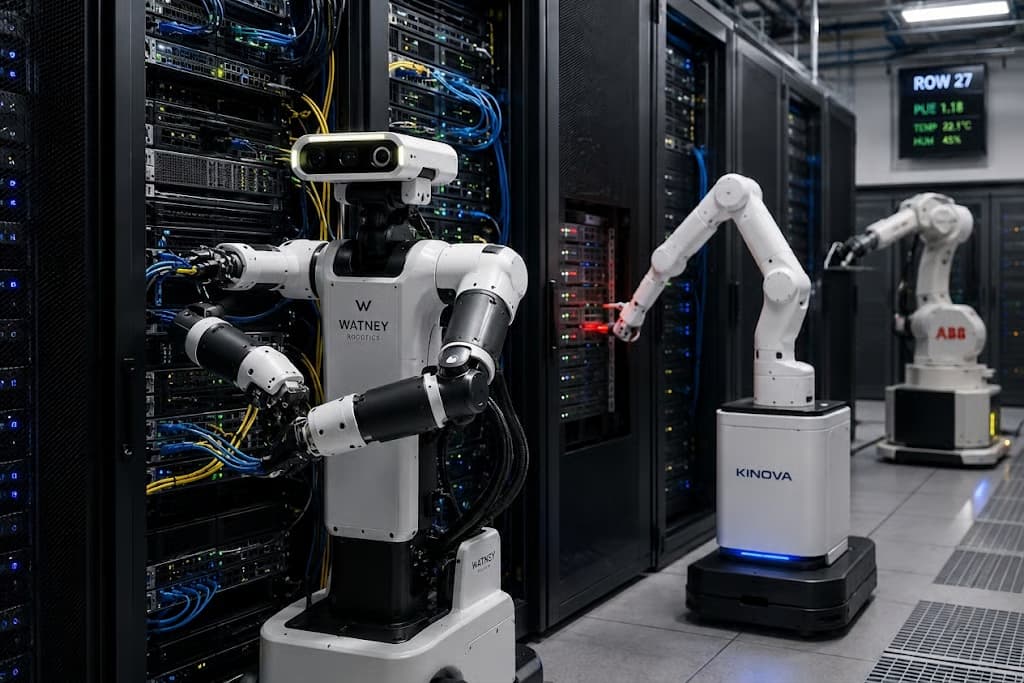
Meta is conducting trials of robotic systems designed to perform physical maintenance work inside its data centers, marking a shift from software automation to machines handling hands-on technical tasks.
The company is testing robots from Watney Robotics, Kinova, and ABB at facilities including its Altoona, Iowa campus and the Prometheus data center in New Albany, Ohio, according to reporting by WIRED based on interviews with current and former Meta employees. The machines are being evaluated for tasks such as swapping network cables, restarting servers, reseating hardware components, and cutting power to equipment.
Current capabilities and limitations
At the Altoona site, Meta has deployed two dual-armed Watney robots for cabling work since June 2025. The systems operate under supervision and remain slower than human technicians. One Meta worker told WIRED that a successful cable-swapping system could eventually handle up to 80% of the workload in certain roles.
Meta is also testing a Kinova Gen3 robotic arm for server power-cycling operations, while ABB machines at the Ohio facility handle component reseating. One simpler device has been developed to remotely press power buttons on equipment like Mac Minis to perform restarts.
The technology faces significant constraints. Meta's inventory robots struggle with corners and cables, and their grayscale cameras cannot distinguish between green and red equipment indicators. Workers report battery-recharging downtime and the need to manually move some machines between buildings. Meta has acknowledged internally that current robots are not equipped for the intensive cabling required by Nvidia GB300 systems.
Why it matters
Meta is building data center capacity at enormous scale to support its AI infrastructure. If robots become reliable enough for routine physical maintenance, the company could expand facilities without proportionally increasing technician staffing. This represents a fundamental shift in how automation affects IT operations—moving beyond software tasks to the physical maintenance of the infrastructure that powers AI systems themselves. The experiments also highlight a broader question for the data center industry: whether the next wave of productivity gains will come from machines maintaining the hardware, not just running the workloads.
From inventory to maintenance
Robots are not entirely new in Meta's data centers. The company previously demonstrated autonomous machines for moving heavy server racks and tracking inventory, systems now operating at multiple sites according to people familiar with the projects. But the current trials push automation closer to actual maintenance work.
Eric Xu, a senior robotics manager at Meta, stated at a conference last year that deploying robots in data centers was among the company's long-term goals, including for incident response, environmental monitoring, and preventive maintenance, according to WIRED.
Helen Oleynikova, CEO of Exclaim Robotics, told WIRED that the industry has seen "a lot of pilots and demos, but no provable working solution." Data centers contain tightly packed equipment where small mistakes can disrupt expensive computing infrastructure, making the replacement of technicians more complex than simply providing a robot with an arm.
Meta has stated it needs more skilled workers and has launched training programs aimed at producing thousands of electrical, mechanical, and plumbing workers annually. The robots remain slower, limited, and dependent on human oversight.
These details were first reported by WIRED.
This is an original analysis by the Omega editorial team. Source reporting: Automation Watch.
Want systems like this working for your business?
Book a Call
