LLNL Deploys AI-Driven Autonomous Labs for National Security Manufacturing
Lawrence Livermore researchers are combining robotics, machine learning, and automated experimentation to compress timelines from materials discovery to production.
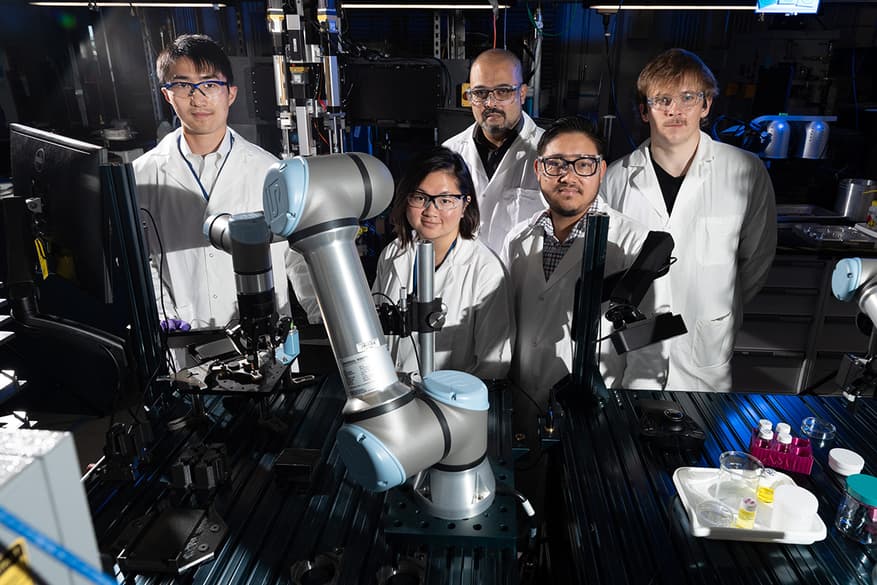
LLNL Deploys AI-Driven Autonomous Labs for National Security Manufacturing
Lawrence Livermore National Laboratory is building AI-powered autonomous laboratories designed to accelerate the path from materials discovery to production—a capability researchers say is critical for maintaining U.S. competitiveness in manufacturing technologies tied to national security.
The work, conducted in partnership with the Department of Energy and National Nuclear Security Administration, centers on combining robotics, machine learning, and automated experimentation to compress development timelines. Chris Spadaccini, who leads LLNL's Materials Engineering Division, framed the effort in terms of strategic urgency: in the national security space, moving from concept to deployment on timescales that match evolving global threats is mission-critical.
Why it matters
Advanced manufacturing for defense and energy applications involves extraordinarily long qualification cycles—designing materials, validating suppliers, developing processes, inspecting components, and scaling to production. Each stage introduces delays that can stretch timelines by months or years. Autonomous labs that use AI to guide experimentation and robotics to execute tasks could fundamentally compress those cycles, giving the U.S. a faster innovation loop in strategically important technologies.
Beyond automation: systems that learn and adapt
Spadaccini drew a key distinction between automation and autonomy. Automated labs execute pre-programmed tasks in a fixed workflow. Autonomous labs go further: they use AI to collect data, analyze results, and determine what experiment to run next. That learning layer, he said, is what allows these systems to navigate complex design spaces more intelligently than humans working manually.
Aldair Gongora, a staff engineer leading Project ARMOR, described the approach as adding AI reasoning to the traditional scientific cycle of design, build, test, and learn. The goal is not to replace scientists but to handle repetitive tasks and free researchers to focus on interpreting results and designing higher-level experiments—similar to how high-performance computing expanded what computational scientists could tackle.
Searching impossibly large design spaces
Mason Sage, a staff robotics engineer working on both ARMOR and the APEX alloy development project, explained why autonomy matters for materials discovery. The number of possible alloy combinations is so vast that running one experiment per second since the birth of the universe would not come close to exploring the full design space. Machine learning algorithms can reason across dozens of variables simultaneously in hyper-dimensional space, searching more strategically than human intuition allows.
But technical challenges remain. Most scientific equipment was designed for human workflows, not robotic ones. Sage said LLNL teams have had to write custom software and retrofit legacy equipment to enable communication between lab instruments and autonomous systems—painstaking work that is essential to closing the loop between AI, robotics, and physical experiments.
Real-time inspection and end-to-end integration
One near-term application is in-process inspection. LLNL researchers are applying machine learning to images captured during 3D printing to inspect structures layer-by-layer in near real time. What once required minutes of manual review per image now happens in milliseconds. Spadaccini identified inspection and qualification as one of the biggest bottlenecks in manufacturing workflows, and a prime target for AI.
Connecting all these capabilities into fully autonomous pipelines remains a longer-term challenge. Cybersecurity and safety are especially critical when AI controls physical systems handling expensive or sensitive materials. Cindy Gonzales, acting director of LLNL's Data Science Institute, emphasized that these systems must be secure by design, with human oversight remaining essential.
The work aligns with DOE's Genesis Mission, which aims to connect AI, computing, data, and scientific infrastructure to accelerate discovery. Brian Giera, associate program director for data science, AI, and manufacturing, said the convergence of affordable robotics and AI models capable of structured lab tasks has created an inflection point. National labs are uniquely positioned to capitalize on it, he said, because they combine subject-matter expertise, specialized equipment, computational capability, and mission-driven problems that commercial AI companies typically lack.
Details of the research were first reported by Lawrence Livermore National Laboratory.
This is an original analysis by the Omega editorial team. Source reporting: Automation Watch.
Want systems like this working for your business?
Book a Call
