LinkedIn Reports 40% Drop in AI Slop Post Reach
The platform's crowdsourced feedback system has logged over one million reports since launching in late July.
LinkedIn's AI content problem shows signs of improvement
LinkedIn has reported a significant decline in the reach of low-quality AI-generated content on its platform, with suspected posts now receiving 40% fewer views compared to several weeks ago. The professional networking site attributes this shift to its community-driven feedback system launched in late July.
Hari Srinivasan, LinkedIn's chief product officer, shared the update in a recent platform post, noting that more than one million users have clicked the "seems like AI slop" button on suspected posts and comments since the feature went live on July 30.
Community feedback over automated detection
LinkedIn's approach deliberately relies on human judgment rather than automated AI detection tools. When the company introduced the feedback mechanism, Srinivasan emphasized the importance of authentic human assessment over algorithmic classification.
"We want members to get feedback from real humans on what sounds authentic - not just have an AI detector review it and get it wrong," he explained at the time.
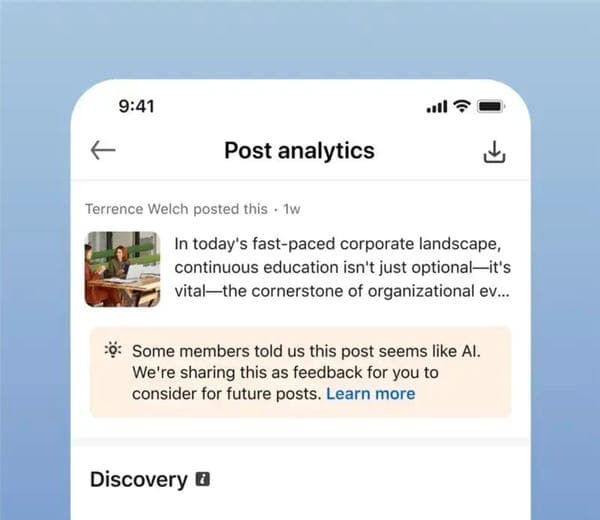
The platform now surfaces community feedback directly to content creators through Post Analytics when a post receives sufficient reports. This notification aims to help users understand how their content is being received by the community.
Safeguards and good faith assumptions
LinkedIn has implemented protective measures to prevent abuse of the reporting system. The company says it has built safeguards to protect users from having their content unfairly targeted by other members.
Srinivasan framed the initiative as assuming good intent from users. "I know I'm increasingly conscious on how to not sound like AI & the goal is to provide helpful feedback," he wrote.
Why it matters
The 40% reduction in reach for AI-generated content represents a measurable shift in how professional networks are managing synthetic content. As generative AI tools become more accessible, platforms face pressure to maintain authentic human discourse without resorting to blanket bans or automated filters that may produce false positives. LinkedIn's human-centered approach offers an alternative model that other platforms may watch closely, particularly as the line between AI-assisted and AI-generated content continues to blur in professional contexts.
Broader platform responses
LinkedIn's moves come as other platforms refine their positions on AI-generated material. Both Substack and YouTube have recently updated their policies regarding synthetic content as tools like Anthropic's Claude and OpenAI's ChatGPT become more widespread.
The effectiveness of AI-generated content on LinkedIn was recently demonstrated when Business Insider's Katie Notopoulos tested Cringebot 3000, a tool designed to replicate LinkedIn's characteristic "thought leadership" style. Her AI-generated posts received significantly more engagement than her typical content.
With the latest changes, such AI-generated posts may now face reduced distribution and trigger feedback notifications to their authors.
These details were first reported by Business Insider.
This is an original analysis by the Omega editorial team. Source reporting: AI Watch.
Want systems like this working for your business?
Book a Call