John Deere's GUSS to Deploy Ouster Lidar in Autonomous Orchard Machines
The agricultural automation subsidiary will integrate Rev8 digital lidar sensors to navigate dense orchards where GPS alone falls short.
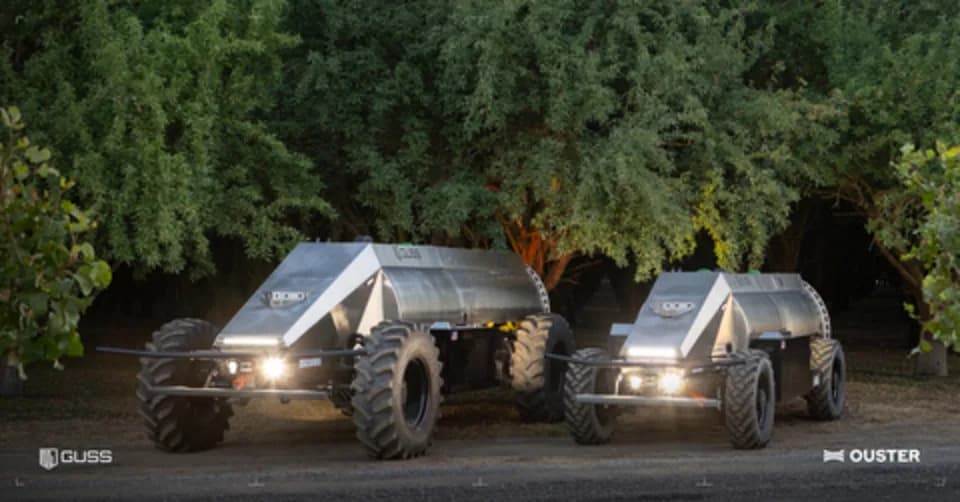
John Deere subsidiary embraces advanced sensing for precision agriculture
GUSS Automation, the autonomous agriculture subsidiary wholly owned by John Deere, plans to integrate Ouster's Rev8 OS0 digital lidar sensors into its next-generation autonomous orchard machine fleet. The deployment addresses a fundamental limitation in high-value crop environments: traditional GPS systems cannot deliver the centimeter-level precision required to safely navigate dense orchards and vineyards.
Ouster announced the planned integration in August 2026, positioning the Rev8 platform as a solution for agricultural duty cycles that demand enterprise-grade perception capabilities. The sensors will equip GUSS's driverless sprayers with an ultra-wide field of view, enabling detailed mapping of tree trunks, crop rows, and ground contours through dense 3D point cloud data.
Why it matters
Autonomous agricultural equipment has struggled with the unstructured complexity of orchard environments, where tight spacing between trees and variable terrain create navigation challenges that GPS alone cannot solve. By adding lidar-based perception, GUSS is addressing a key technical barrier to scaling autonomous operations in high-value crops—a market segment where labor shortages and precision requirements make automation particularly valuable for growers seeking operational flexibility.
Technical capabilities for outdoor agricultural work
The Rev8 architecture combines accurate 3D depth data with high dynamic range native color imaging and structural ruggedness designed for production deployments in unstructured outdoor settings. According to Ouster, the system's environmental resilience is engineered specifically for the demands of field operations.
For GUSS machines, the lidar integration supports both navigation and obstacle detection across varying lighting conditions—a critical requirement for equipment operating throughout the day in outdoor agricultural environments. The technology enables autonomous vehicles to perceive their surroundings with sufficient detail to operate safely among crops, equipment, and workers.
"Integrating advanced sensing technologies into our machines helps support reliable operation in complex orchard environments and provides growers with tools designed to improve productivity and operational flexibility," said Jason Brantley, Vice President of Production Systems, Small Ag & Turf at John Deere.
Expanding industrial robotics momentum
Ouster characterized the GUSS deployment as building on recent momentum in industrial robotics applications. The company positions its L4 Ouster Silicon-powered sensors as enabling autonomous systems to operate in complex outdoor environments where traditional sensing approaches prove insufficient.
The integration represents a convergence of autonomous vehicle technology and agricultural equipment, with John Deere leveraging its GUSS subsidiary to address automation challenges specific to specialty crop production. High-value crops present distinct operational requirements compared to row crop farming, demanding precision navigation in confined spaces and the ability to work around permanent plantings.
Details of the planned deployment were first reported by Ouster in a business announcement distributed through Business Wire.
This is an original analysis by the Omega editorial team. Source reporting: Automation Watch.
Want systems like this working for your business?
Book a Call
