John Deere Launches Hands-Free Baling System
The agricultural equipment maker combines existing tractor automation with baler technology to eliminate manual steering during hay collection.
John Deere integrates automation technologies for autonomous hay baling
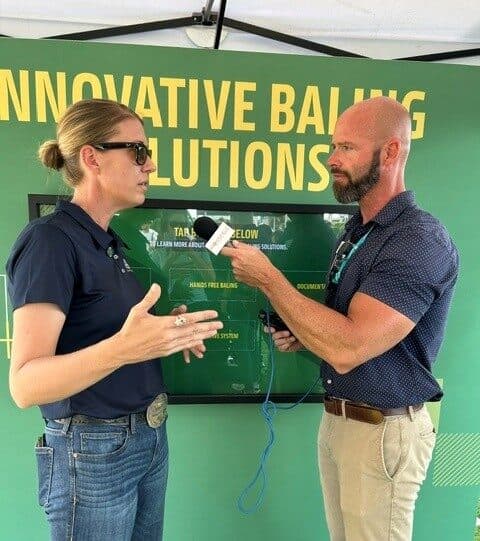
John Deere has introduced a hands-free baling system that combines multiple automation technologies to enable operators to collect hay without manual steering or intervention. The company demonstrated the capability at the Farm Progress Show near Boone, Iowa this week.
The system builds on Deere's weave automation technology, which launched last year, according to Kaylene Ballesteros, the company's hay and forage marketing manager. The new hands-free operation merges three distinct automation layers: tractor navigation systems, baler control functions, and the weave automation that coordinates movement patterns across fields.
How the technology works
The hands-free baling system integrates existing tractor automation features including auto-track for maintaining straight lines, auto-path for following predetermined routes, and auto-turn for executing turns at field edges. These navigation controls work in concert with the baler's own automation capabilities—specifically the baling gate that manages material intake and speed automation that adjusts forward velocity based on crop density.
Weave automation serves as the connecting layer, coordinating the tractor's movements with the baler's operations to create efficient collection patterns across the field. When all three technology sets operate together, the result is a baling process that requires no hands-on steering from the operator.
Why it matters
Hands-free baling addresses a persistent challenge in agricultural operations: the operator fatigue and inefficiency that comes from hours of repetitive steering during harvest. By automating the entire baling workflow, Deere enables operators to focus on monitoring equipment performance and crop quality rather than vehicle control. The technology also has implications for labor-constrained farms, potentially allowing less experienced operators to manage complex equipment or enabling one person to oversee multiple machines. As precision agriculture continues to evolve, integrated automation systems like this represent a practical step toward fully autonomous field operations.
Building on existing infrastructure
A key advantage of Deere's approach is that it leverages automation technologies already available on many of the company's tractors. Farmers who have invested in auto-track and related navigation systems can add the hands-free baling capability by upgrading their baler equipment and software, rather than replacing entire vehicle platforms.
The phased rollout—starting with weave automation in the previous year and now expanding to full hands-free operation—suggests Deere is taking an incremental approach to autonomous agriculture, allowing farmers to adopt new capabilities as their comfort level and operational needs evolve.
Details on pricing, availability, and compatible equipment models were not disclosed at the Farm Progress Show presentation. The information was first reported by Brownfield Ag News in coverage of the Iowa trade show.
This is an original analysis by the Omega editorial team. Source reporting: Automation Watch.
Want systems like this working for your business?
Book a Call