India's IT Outsourcing Giants Cut Jobs Despite Record Revenue
AI automation is fundamentally reshaping the economics of India's $315 billion technology services sector, with major firms shedding thousands of workers while profits climb.
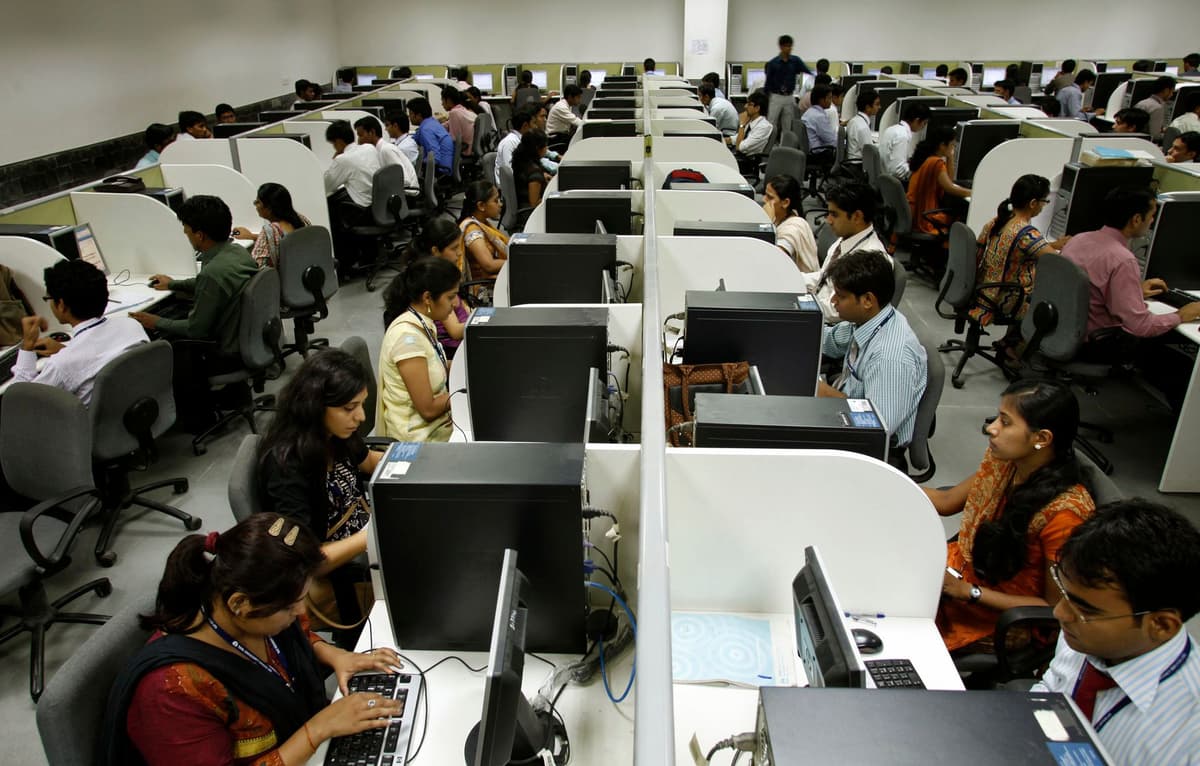
India's largest technology services companies are posting record revenues while simultaneously reducing their workforces, a trend driven by artificial intelligence that threatens to upend the business model that built the country's $315 billion outsourcing industry.
Tata Consultancy Services, India's biggest private employer, eliminated 12,200 middle and senior management positions last year while generating more than $30 billion in revenue and training 114,000 employees in AI skills. The pattern held across the sector's top five firms, which collectively shed 7,389 workers in fiscal year 2026 even as each company reported higher earnings, according to data compiled by Moneycontrol.
The shift marks a reversal from the previous year, when those same employers added 12,718 jobs. Industry-wide, net hiring additions of roughly 135,000 workers in fiscal 2026 barely exceeded the prior year's 133,000, despite revenue growing 6.1% to $315 billion, according to Nasscom, the sector's trade body.
Why it matters
India's outsourcing industry employs nearly six million people and contributes an estimated 12% of the country's GDP. The sector's entire business model has historically depended on billing clients for human hours, making it uniquely vulnerable as AI tools reduce the time required to complete the same work. What's happening in India offers an early preview of how AI could eliminate white-collar jobs faster than previous automation waves, particularly in economies built around labor arbitrage.
The collapse of hourly billing
Clients are fundamentally renegotiating how they pay for IT services. Companies that once locked in multi-year contracts at fixed hourly rates are now reopening those agreements within two years because AI has changed the underlying economics, according to HFS Research. Instead of paying for billable hours or the number of engineers assigned to a project, clients now demand payment tied to outcomes and want to share in the cost savings AI generates.
The productivity gains are substantial and immediate. Infosys management told analysts that clients running large customer service operations could cut costs by 20% to 40% using generative AI. Infosys CEO Salil Parekh reported that AI work accounted for 8.2% of total revenue by the first quarter of fiscal 2027, growing at a double-digit pace. Across the sector, AI contributed $10 billion to $12 billion in revenue for the first time, representing roughly 4% of total industry income.
Regional impact extends beyond India
The pattern is spreading across South Asia. Generative AI is driving approximately a 20% decline in monthly job postings for white-collar roles throughout the region, according to a World Bank study. The Philippines faces particularly acute pressure, where 1.9 million citizens work in call centers and back offices serving foreign companies. The IT and Business Process Association of the Philippines recently lowered its 2028 employment target from 2.5 million to between 1.85 million and 2.14 million workers, acknowledging that AI has begun automating entry-level tasks.
India's major IT companies have now lost more workers than they've hired for seven consecutive quarters, according to ICRA, an Indian credit rating agency. While industry executives predict new positions in AI engineering, machine learning, and data science will emerge, hiring data shows those roles haven't materialized at scale. Nasscom reports training more than two million professionals in AI skills, including 200,000 to 300,000 in advanced capabilities, but retraining serves the companies' AI business rather than guaranteeing displaced workers new positions.
Nasscom president Rajesh Nambiar acknowledged the fundamental tension at the organization's February 2026 forum, noting a "widening divergence between revenue and employment growth." For an industry that built its competitive advantage on affordable labor, AI now represents the cheapest form of work—potentially eliminating the cost arbitrage that transformed India's workforce in the first place.
These details were first reported by Quartz.
This is an original analysis by the Omega editorial team. Source reporting: AI Watch.
Want systems like this working for your business?
Book a Call