Inbolt and RoboDK Bridge CAD-to-Robot Gap at Different Stages
One automates offline programming and simulation; the other uses real-time vision to adapt trajectories during production.
Two approaches to robot deployment
Moving from CAD model to functioning robot cell remains a multistep challenge for manufacturers. Even when simulation and offline programming tools generate validated trajectories, physical deployment often reveals mismatches between the digital twin and the production environment—a robot mounted millimeters off-target, for instance, can require manual recalibration before work begins.
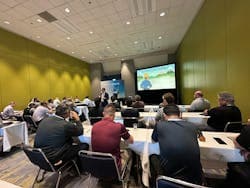
Two companies demonstrated contrasting solutions to this problem at Automate 2026 in Chicago. Inbolt and RoboDK both start with CAD geometry, but they address different friction points in the automation workflow.
Inbolt: vision-guided adaptation at runtime
Inbolt's new Robot Programming capability connects CAD-derived trajectories with real-time vision, allowing robots to adjust their motion based on actual part location during production. According to Albane Dersy, COO and co-founder, the system is designed to eliminate the iterative touchups that typically follow virtual commissioning.
"The problem is that the reality is never like the simulation software," Dersy said during the demonstration. "When you design your cell in a simulation software, it is roughly never going to match the reality."
The system generates robot trajectories automatically from a CAD model of the part. Once deployed, Inbolt's Vision Model—which learns a part's 3D geometry at the edge in 30 seconds to five minutes—locates the physical part and adjusts the robot's motion to execute the intended path despite variations in the production environment.
Dersy described the vision layer as "the missing bridge" between programming and reality. The capability currently supports FANUC, Universal Robots, and Yaskawa systems, with additional robot brands planned.
RoboDK: faster offline programming and validation
RoboDK takes a different approach, focusing on the pre-deployment phase. The offline programming and simulation platform imports CAD files, generates toolpaths and robot motions, performs collision checks, and produces programs for multiple robot brands.
Its RoboDK CAM module, introduced recently, is designed to move directly from CAD models to production-ready robotic machining. The company claims the software can reduce robotic machining deployment time by up to 40 percent.
"Basically, it removes the need to have CAM software," said Jonathan Lambert, Product Manager at RoboDK. "You can do everything you need for machining directly on RoboDK and then export it directly to your robot."
Why it matters
The distinction between these tools reflects a persistent gap in industrial robotics: simulation environments rarely capture every variable that affects real-world performance. RoboDK accelerates the programming and validation stage, helping engineers move faster from design to deployment. Inbolt addresses what happens after deployment, when physical conditions diverge from the model. Together, they illustrate how the CAD-to-robot workflow is being segmented into specialized software layers—one for planning, another for execution.
These details were first reported by Rehana Begg for Machine Design following demonstrations at Automate 2026.
This is an original analysis by the Omega editorial team. Source reporting: Automation Watch.
Want systems like this working for your business?
Book a Call