FANUC Executive: Stop Counting SKUs, Start Defining the Work
A robotics leader argues that successful high-mix automation depends on application analysis, not cobot marketing claims.
The SKU count myth
Manufacturers wrestling with high-mix, low-volume production often cite their SKU counts as barriers to automation. Jerry Perez, executive director of global accounts at FANUC America, delivered a different message at Automate 2026: the number of product variants matters far less than understanding what actually changes between them.
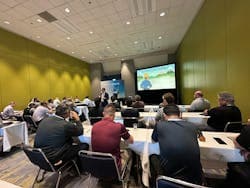
Speaking to an audience that ranged from first-time robot adopters to lab automation specialists, Perez argued that facilities with thousands of SKUs may only need to automate a handful of distinct operations if products can be grouped into part families with similar handling requirements. The critical work happens before any robot selection—analyzing part characteristics, cycle times, quality requirements, and the manual work instructions operators currently follow.
Why it matters
As collaborative robots become more accessible, manufacturers risk treating them as plug-and-play solutions rather than systems requiring careful application design. This misconception can derail automation projects before they deliver value, particularly in complex production environments where upfront engineering determines success more than the robot brand on the floor.
The collaborative application fallacy
Perez challenged a persistent industry assumption: that "cobots" are inherently safe for human collaboration. He pointed to recent revisions in ISO 10218 and ANSI/A3 R15.06 standards, which shifted focus from labeling robot arms as collaborative to evaluating complete collaborative applications.
Safety depends on the entire system design and risk assessment, not the robot alone. Even when guarding is required, Perez noted, features like lead-through teaching, lighter form factors, and simplified programming—such as FANUC's tablet-based CRX platform running on standard voltage—retain significant value.
The question isn't whether a robot arm carries a "cobot" label, but whether the complete system creates injury risks and how the application addresses them through design.
Start with high runners, not everything
For manufacturers new to automation in high-mix environments, Perez recommended targeting "high runners"—the subset of products that account for the majority of production volume. Attempting to automate thousands of SKUs simultaneously increases complexity and risk.
A system doesn't need to replace 100% of manual work to deliver value. The first successful deployment may simply build the foundation of practical experience engineers need for the next project. Automation solutions span a spectrum from DIY setups to fully pre-engineered turnkey cells, and the right choice depends on internal expertise and available engineering resources.
Engineering before equipment
Perez framed his presentation around "measure twice, cut once," applied to robotics. Manufacturers must complete the necessary upfront work to understand applications and identify potential problems before selecting automation strategies. This prework—examining what changes from part to part, documenting current processes, and mapping requirements—forms the foundation of successful deployment.
FANUC showcased its Cobot and Go exhibit alongside the session, featuring pre-engineered, application-specific systems designed to reduce deployment complexity. But Perez's core message extended beyond any product line: automation success begins with understanding the work, not selecting the robot.
These details were first reported by Machine Design, which covered Perez's Automate 2026 presentation.
This is an original analysis by the Omega editorial team. Source reporting: Automation Watch.
Want systems like this working for your business?
Book a Call