Hyundai Union Demands Veto Power Over Factory Automation
South Korean workers strike for binding consent authority on AI and humanoid robot deployment, not just compensation.
Hyundai workers strike over automation control
Hyundai's South Korean union shut down all production at the automaker's Ulsan, Jeonju, and Asan plants on August 21, staging its first full eight-hour strike in a decade. Roughly 40,000 union members walked off both shifts, idling 16 hours of production. While wage increases remain on the table, the union is pursuing something structurally different: binding consent authority over any deployment of AI or humanoid robots on assembly lines.
The demand represents a departure from traditional labor disputes focused solely on compensation. Rather than negotiating severance or retraining after automation displaces workers, Hyundai's union wants direct control over whether and how robots enter the factory floor in the first place.
Why it matters
This dispute could establish a precedent for how automakers negotiate automation with organized labor. If Hyundai grants veto power over robotics deployment, other unions facing similar technology rollouts may adopt the same strategy. The outcome will signal whether workers can slow or redirect automation plans through collective bargaining, or whether manufacturers retain unilateral control over production technology decisions.
Financial demands and company pushback
The union is seeking a monthly base salary increase of KRW 149,600 (US$96.80) per worker, a performance bonus equal to 30% of last year's net profit, an increase in existing bonuses from 750% to 800% of monthly base salary, and an extension of the retirement age from 60 to 65. Union officials argue that fixed wages currently represent only 54.8% of total compensation, leaving members dependent on overtime and holiday work.
Hyundai has resisted the financial scale of these demands, noting that operating profit fell 19.5% in 2025 to KRW 11.46 trillion. The union counters by pointing to KRW 101.3 trillion in retained earnings, framing the dispute not as a question of profitability but of how existing profits are distributed.
Humanoid robots and displacement concerns
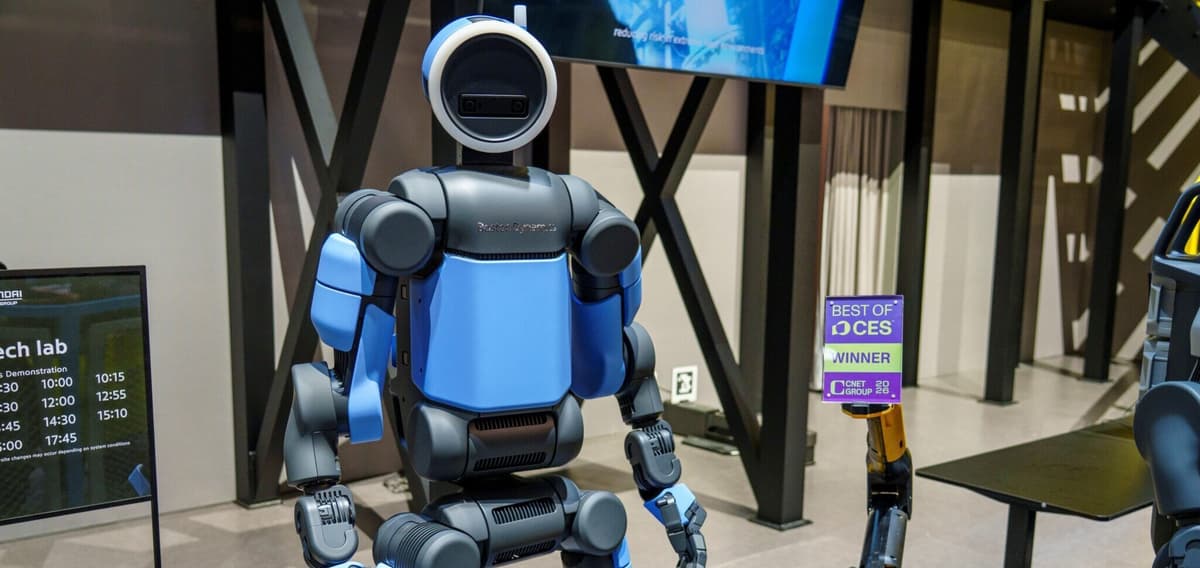
Hyundai acquired U.S. robotics firm Boston Dynamics in July 2026 and plans to deploy the company's Atlas humanoid robot in its Georgia plant by 2028. The Atlas robot offers capabilities that exceed human workers in several dimensions: 56 degrees of freedom, a continuously rotating spine, the ability to lift up to 50 kilograms, and nearly 99% uptime with battery swaps under three minutes. Software updates allow instantaneous "training" at minimal cost.
Human workers retain advantages in fine tactile assembly work—routing wiring harnesses, fitting delicate interior trim clips, and manipulating flexible rubber seals—tasks that depend on dexterity humanoid grippers have not yet replicated.
Union officials told Reuters the threat extends beyond production roles into research and engineering positions. "Even if AI is introduced, we are prepared to fight it, and prepared to win," said Kim Byung-chul, Vice President of the Korean Metal Workers' Union. "We are concerned about the future generation."
A template for other automakers
Binding an automation veto into a labor contract would give Hyundai's union direct influence over the pace of robotics rollout. The dispute is likely to set a template other automakers watch closely as humanoid robots move from pilot programs toward production line deployment. Hyundai's Georgia plant, which is not unionized despite UAW organizing efforts, has not raised similar concerns.
These details were first reported by Automotive World.
This is an original analysis by the Omega editorial team. Source reporting: Automation Watch.
Want systems like this working for your business?
Book a Call