Humanoid Robots Scale by Starting Simple, Not Solving Everything
Industry leaders say swappable hardware, narrow task focus, and realistic performance expectations are proving more effective than early AGI promises.
The unglamorous advantage of humanoid robots
When a humanoid robot fails during a warehouse pilot, the solution is straightforward: wheel it out and either swap in a working unit or have a human supervisor complete the shift. This mundane capability—the ability to simply move a robot out of the way—has emerged as a significant practical advantage as companies deploy humanoids in real-world operations.
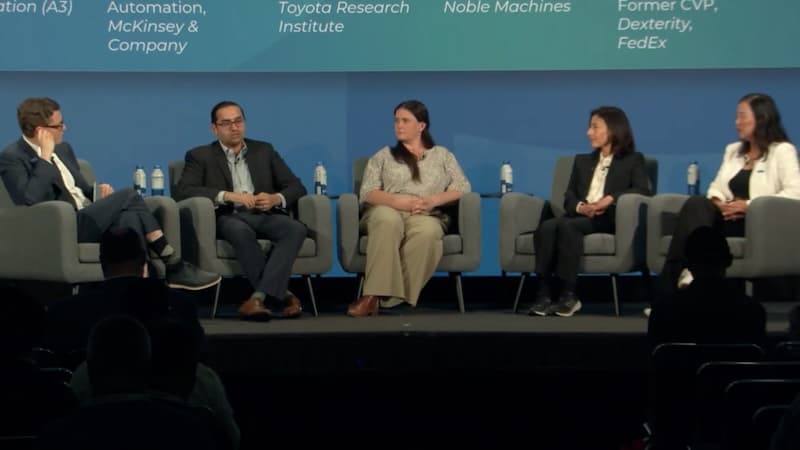
"A real positive we're seeing with this specific form factor is that you can just move it out of the way," Elizabeth Samara-Rubio, chief business officer at Noble Machines, said during A3's Humanoid Robot Forum, as first reported by Automation Watch.
The contrast with traditional automation is stark. Fixed industrial systems require extensive trials, formal sign-offs, and permanent installation with expected uptimes exceeding 99.9%. Humanoids can run in shadow mode alongside human workers, ready to step aside when problems arise. This flexibility is reshaping how organizations approach deployment.
Why it matters
The humanoid industry is abandoning ocean-boiling promises of artificial general intelligence in favor of incremental capability building. This shift toward practical, measurable progress—starting with the simplest possible tasks—represents a maturation that could determine which companies survive the transition from demo videos to production floors.
Real-world data drives capability development
Every panelist at the forum emphasized that actual deployment, not laboratory testing, provides the data needed to improve humanoid performance. Toyota Research Institute's Erin McColl described a deliberate pipeline: vision systems without hands or mobility come first, followed by specialized mobile manipulators for specific tasks like tote handling, with full humanoid dexterity reserved for later stages.
"We keep that pipeline—at the root, we always want challenge tasks informed by the real world that are measurable, but don't carry the pressure of 'it has to work,'" McColl explained. TRI's access to Toyota production lines allows this graduated approach, though most humanoid companies lack such resources and must iterate through customer pilots instead.
Expectations reset from savior to operational tool
McKinsey & Company's Ani Kelkar noted that early "almost irrational zeal" fueled by flashy demonstrations has given way to pragmatic demands. Customers now ask humanoid manufacturers to hit specific operational KPIs rather than solve all problems immediately.
Rebecca Yeung, a venture partner at Silicon Foundry with 26 years at FedEx, drew parallels to autonomous vehicle development. AV companies used operational design domains to define achievable capabilities within specific conditions, then gradually expanded as they encountered edge cases. Humanoids are following the same pattern—mastering narrow task domains before expanding capabilities.
The performance bar is surprisingly modest. "At the end of the day, it has to be as efficient, or nearly as efficient, as a human," Yeung said. Since humans make mistakes too, that sets a reasonable benchmark. The critical difference is timeline: organizations must accept that reinforcement learning improves humanoid performance over time, not on day one.
Agility Robotics cofounder Jonathan Hurst confirmed this reality. While hardware maintenance typically addresses pilot problems, the company acknowledges that in extreme cases, a supervising engineer might need to manually move totes to complete a shift—a purely hypothetical scenario so far, but one that underscores the practical nature of current deployments.
These details were first reported by Automation Watch following the A3 Humanoid Robot Forum and interviews with industry leaders.
This is an original analysis by the Omega editorial team. Source reporting: Automation Watch.
Want systems like this working for your business?
Book a Call