HII awards up to $900M in Navy shipbuilding work to robotics firms
Performance-based agreements with Path Robotics and GrayMatter aim to automate complex manufacturing processes across multiple vessel classes.
Major defense contractor bets on AI-powered manufacturing
Huntington Ingalls Industries has signed seven-year production agreements with two robotics companies that could be worth up to $900 million, contingent on their ability to deliver automated manufacturing systems for U.S. Navy vessels.
The performance-based deals with Path Robotics and GrayMatter Robotics will support production across HII's entire portfolio of naval programs, including aircraft carriers, submarines, destroyers, amphibious ships, future frigates and unmanned surface vessels, according to details first reported by WorkBoat.
The agreements form the core of HII's High-Yield Production Robotics (HYPR) program, which aims to apply artificial intelligence and robotics to shipbuilding processes that have historically resisted automation due to their complexity and variability.
Why it matters
Naval shipbuilding faces mounting pressure to increase capacity and reduce costs as geopolitical tensions drive demand for faster fleet expansion. Traditional shipyard-centric production has struggled to scale, making distributed manufacturing with autonomous systems a strategic imperative for defense contractors. If successful, this approach could reshape how the U.S. builds warships and potentially influence manufacturing strategies across other defense sectors.
Phased rollout ties payment to performance
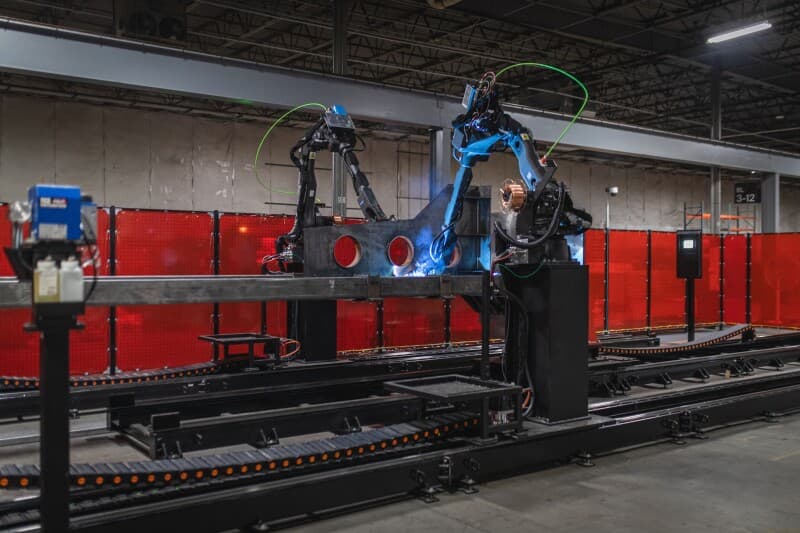
The program will advance through distinct development and delivery phases. During development, Path Robotics and GrayMatter will collaborate with HII to create, test and qualify autonomous techniques for welding, grinding, blasting, painting, assembly, inspection and other fabrication processes.
Once developed, these technologies will be integrated into autonomous production lines. HII emphasized that all equipment and processes will undergo rigorous testing and qualification to ensure compliance with Navy shipbuilding standards before any production work begins.
The delivery phase will only commence if the systems meet cost, schedule and quality benchmarks. Production would start with smaller steel structures before expanding to larger units and modules, allowing HII to validate performance at scale.
"We are committed to making generational investments to develop new shipbuilding capability and to expand capacity," said Eric Chewning, executive vice president of maritime systems and corporate strategy at HII. "Together, we are defining a new approach to robotics in shipbuilding: automation that can adapt to extreme levels of complexity, mix, and size."
Distributed manufacturing strategy
The initiative represents a shift in HII's production model. Rather than concentrating all fabrication and assembly work at its shipyards, the company intends to move more manufacturing off-site before final vessel assembly. This distributed approach could help HII increase throughput without expanding physical shipyard infrastructure.
Andy Lonsberry, CEO and co-founder of Path Robotics, characterized the agreement as validation that physical AI can scale production capacity in demanding manufacturing environments. Ariyan Kabir, CEO and co-founder of GrayMatter Robotics, highlighted the combination of artificial intelligence with autonomous systems designed to adapt and improve through operation.
The details were first reported by WorkBoat.
This is an original analysis by the Omega editorial team. Source reporting: Automation Watch.
Want systems like this working for your business?
Book a Call