Security
Hackers Deploy Autonomous AI Agents for Multi-Stage Attacks
Google reports threat actors are using frameworks like ARTEX and CyberStrikeAI to automate intrusions and rapidly weaponize vulnerabilities at machine speed.
Key takeaways
- Threat actors now deploy autonomous AI frameworks like ARTEX, CAIRN, and CyberStrikeAI to execute multi-stage attacks at machine speed rather than manual prompting.
- LLM-driven pipelines enable rapid weaponization of patched vulnerabilities through automated differential analysis, collapsing exploitation timelines.
- Criminals are stealing LLM credentials through LLMjacking attacks and reselling access via underground proxy services like APIMart and JetNight.
- Chinese phishing platform Jieyou integrates LLM chatbots that let low-skill attackers customize campaigns using natural language without technical expertise.
- Open-source pentesting frameworks lower barriers to entry, allowing threat actors to automate discrete attack phases and scale operations significantly.
Threat actors shift to autonomous AI frameworks
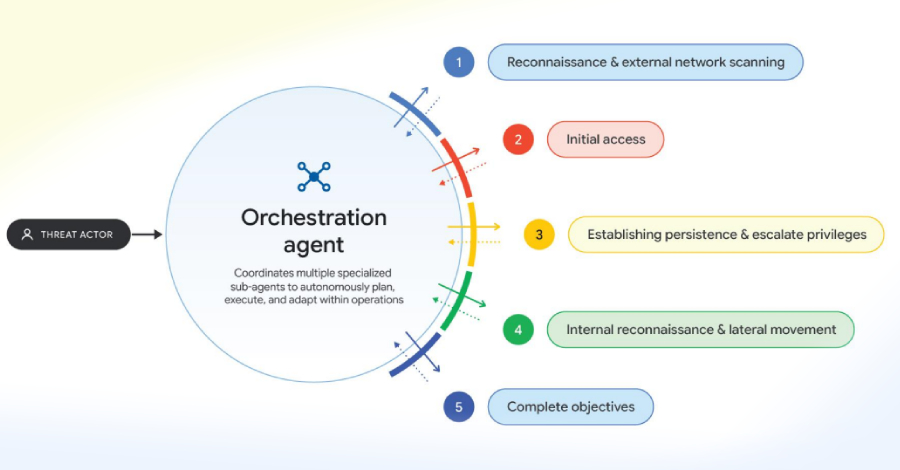
Cybercriminals have moved beyond manually prompting AI tools and now deploy autonomous multi-agent frameworks to conduct sophisticated attacks, according to new findings from Google. The company's Threat Intelligence Group identified frameworks including ARTEX, CAIRN, CyberStrikeAI, and PentAGI being used to execute multi-stage intrusions with unprecedented speed.
The shift represents a fundamental change in how cyberattacks unfold. Rather than human operators manually directing each phase, these AI agent systems can autonomously chain together attack paths and scale operations significantly, even when the underlying techniques remain conventional.
Google observed both financially motivated actors and suspected Chinese espionage groups experimenting with these frameworks during live intrusions. The adoption extends to specialized tools like ZeroHollow, an inference service for exploit development, and Agent Zero, an open-source framework featuring autonomous code execution.
Why it matters
This evolution compresses the window between vulnerability disclosure and active exploitation to dangerous levels. Organizations now face adversaries operating at machine speed, capable of automating everything from reconnaissance to exploitation. The democratization of these capabilities through open-source frameworks means even low-skill attackers can mount sophisticated campaigns, fundamentally changing the risk calculus for enterprise security teams.
Weaponizing patches through differential analysis
Threat actors are leveraging large language models to automate reverse engineering of security patches through differential analysis. This technique allows them to rapidly identify and weaponize newly disclosed vulnerabilities by comparing source code versions and analyzing release notes.
Google cited the September exploitation of PaperCut NG/MF vulnerabilities as an example where LLM-driven pipelines enabled faster weaponization. By focusing on finite source materials—including pre-release code channels and proof-of-concept research—attackers can collapse the traditionally labor-intensive process of exploit development.
LLMjacking and credential theft
Beyond offensive automation, threat actors are targeting AI infrastructure itself through LLMjacking attacks. These operations involve stealing LLM credentials and cloud resources from compromised enterprise environments, then reselling access through underground proxy services.
Google identified platforms like APIMart and JetNight functioning as "LLM mixers," offering stolen API access at discounted prices. This creates a secondary economy around compromised AI resources.
AI-powered phishing platforms
The integration of AI into criminal services extends to phishing-as-a-service operations. Google documented a Chinese-language platform called Jieyou that incorporates an LLM chatbot assistant, enabling customers to configure phishing panels and modify templates using natural language commands.
This development eliminates technical barriers for low-skilled affiliates, who can now dynamically customize phishing campaigns without coding expertise. The platform exemplifies how criminal service providers are adopting LLMs as "modular force multipliers" to expand their customer base.
Automating discrete attack phases
The abuse of open-source penetration testing frameworks allows threat actors to automate specific operational tasks during active intrusions. Rather than replacing human operators entirely, these tools handle discrete phases of attacks—from vulnerability scanning to exploit delivery—while human actors focus on strategic decisions.
The operational velocity gains are significant. Attacks that previously required hours or days of manual work can now execute in minutes, with AI agents autonomously adapting to defensive responses.
These findings were first reported by the Google Threat Intelligence Group in a report shared with The Hacker News.