Security
AI Framework Autonomously Converts Patches Into Exploits
Google's threat intelligence team reports the first observed case of attackers using LLMs to identify vulnerabilities and generate working exploits without human intervention.
Key takeaways
- Attackers deployed exploit_agent, an AI framework that autonomously converts security patches into working exploits without human oversight, marking the first observed fully autonomous attack pipeline in the wild.
- LLM-generated exploits for two PaperCut vulnerabilities appeared within one day of disclosure, with subsequent attacks achieving domain administrator access within minutes.
- Open-source agentic frameworks like CAIRN and PentAGI are now being used in live intrusions against aerospace and Asian organizations, though their noisy execution currently aids detection.
- A North Korean threat group modified Anthropic's Claude Code to automatically download backdoors, while influence operations use AI to manage over 100,000 social media accounts.
- Google believes attackers may find it more efficient to point LLMs at recently patched vulnerabilities than to hunt for zero-days due to finite, readily available source material.
Attackers have deployed an artificial intelligence framework that autonomously converts security patches into working exploits without human intervention, according to a report released today by Google's Threat Intelligence Group.
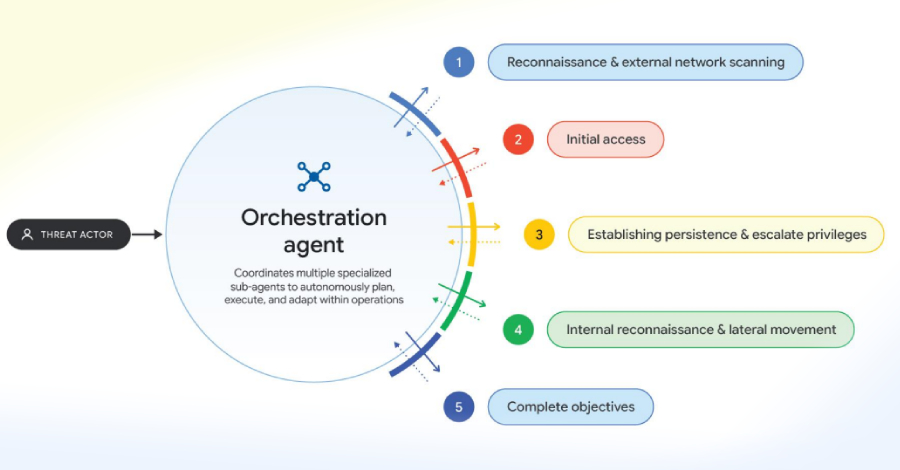
The framework, called exploit_agent, was discovered on an exposed staging server where it had been connected to multiple frontier and locally hosted large language models. The system continuously compares popular web application code before and after patch announcements, identifies likely vulnerabilities, and automatically executes the exploits it generates.
How the autonomous attack system works
The staging server contained data from compromised victims alongside scripts for brute-forcing credentials, installing webshells, and removing webshells left by competing attackers. Victim telemetry indicates the operator primarily targeted French websites in media, entertainment, and education sectors. A comment written in Russian within the framework's configuration file instructed users to enter API keys "right here, not in the chat."
This discovery marks a significant escalation in threat actor capabilities. In Google Threat Intelligence Group's previous quarterly report two months ago, the team stated it had not yet observed fully autonomous attack pipelines deployed against real-world targets.
Why it matters
The shift from human-directed to fully autonomous exploitation fundamentally changes the security landscape. Organizations now face adversaries that can identify and exploit vulnerabilities at machine speed, potentially reducing the window between patch disclosure and active exploitation from days to hours. The efficiency gains suggest attackers may increasingly focus LLMs on recently patched vulnerabilities rather than hunting for zero-days, since the source material for analyzing patches is finite and readily available.
Rapid exploitation timelines
The speed at which AI-assisted exploitation can occur is demonstrated by recent incidents. Two vulnerabilities in PaperCut print management servers, exploited as zero-days in late August, had working LLM-generated exploits within one day of disclosure by security researchers and Huntress Labs. A campaign tracked by GreyNoise Intelligence four days after disclosure, believed to rely on LLM-generated exploits, compromised hundreds of organizations. In one case, attackers achieved domain administrator access within minutes of initial foothold.
Agentic frameworks in active intrusions
Open-source agentic penetration testing frameworks are now appearing in live attacks. During an intrusion against the U.S. aerospace sector, threat actors used the multi-agent framework CAIRN. Another actor deployed a customized platform built on PentAGI between late August and early October to scan organizations across Asia for vulnerabilities. Currently, the noisy forensic trails left by unrestricted autonomous execution make these frameworks easier to detect.
AI in influence operations and state-backed attacks
Beyond exploitation, influence operations now use AI models for sophisticated automation. One commercial contractor was building a turnkey platform using the Gemini API designed to manage over 100,000 social media accounts through cloud phone farms. Another platform targeting political sentiment across Europe and the Middle East used prompts that deliberately introduced camera flaws to make AI-generated photos appear as authentic smartphone shots.
Among government-backed actors, a suspected North Korean group tracked as UNC6836 used AI-generated photos carrying Google's SynthID watermarks for fake recruiter profiles targeting cryptocurrency organizations in North America and Europe. The group later modified .claude/settings.json files in internal code repositories to make each launch of Anthropic's Claude Code automatically download its SOMBERMEME backdoor.
Google stated it disabled accounts and assets tied to the Gemini misuse it discovered. Google DeepMind has used these findings to strengthen its classifiers.
The details were first reported by Google Threat Intelligence Group in its quarterly tracker titled "Agentic Threat Activity Crosses a Significant Threshold."