Google Turns Away Meta's AI Compute Request Amid Capacity Crunch
The cloud giant's inability to fulfill demand signals infrastructure bottlenecks even as Big Tech commits $700 billion to expansion.
The artificial intelligence industry faces a new constraint: even the world's largest cloud providers cannot build computing infrastructure fast enough to meet surging enterprise demand.
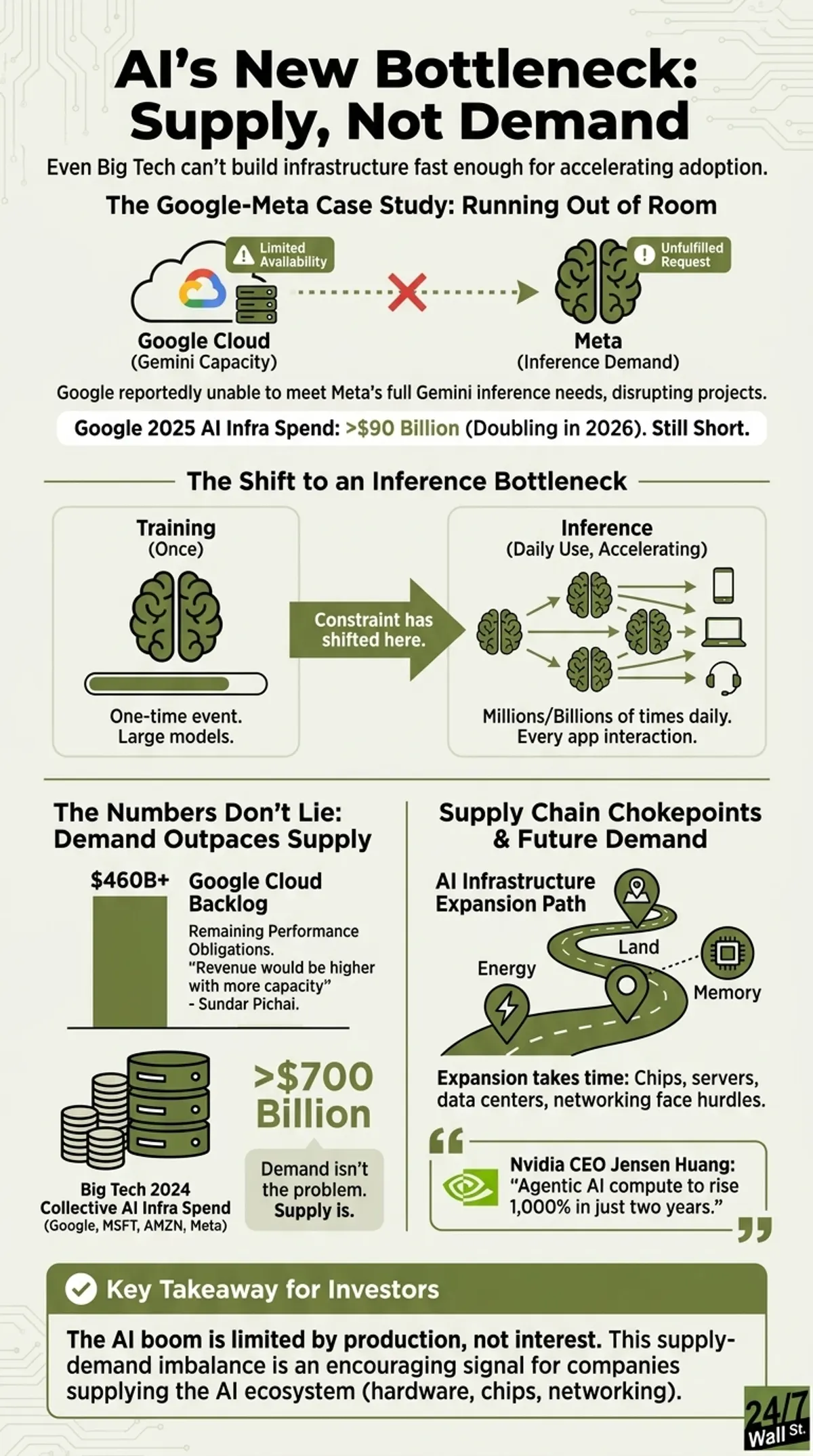
Google informed Meta Platforms around March that it could not deliver all the Gemini inference capacity the social media giant wanted to purchase, according to a Financial Times report. The shortage disrupted some of Meta's internal AI initiatives and forced the company to ration its use of Google's models. Meta was not the only customer affected, though its substantial requirements made the constraint most visible.
Why it matters
This capacity shortage reveals that AI adoption is accelerating faster than the industry can scale infrastructure to support it. For investors, the supply-demand imbalance suggests years of sustained growth ahead for companies manufacturing GPUs, high-bandwidth memory, networking equipment, and power systems—even as Big Tech collectively plans to spend over $700 billion on AI infrastructure this year alone.
The shift from training to inference
The bottleneck has migrated from model training to inference—the computing power required each time someone queries an AI system or uses it to complete a task. While training a model happens once, inference occurs millions or billions of times daily as AI integrates into software development, customer service, advertising, and productivity applications.
Alphabet's most recent quarterly earnings showed Google Cloud with more than $460 billion in remaining performance obligations, a backlog reflecting long-term customer contracts. CEO Sundar Pichai acknowledged that cloud revenue would have been higher if additional capacity had been available.
Infrastructure spending cannot keep pace
Google invested over $90 billion in AI infrastructure during 2025 and plans to double that figure this year, expanding custom Tensor Processing Units and data centers. Microsoft, Amazon, and Meta are pursuing similarly aggressive buildouts. Yet demand continues to outstrip supply.
Expanding capacity requires time-consuming steps: chip manufacturing, server assembly, data center construction, and networking installation. Multiple chokepoints complicate the process, including energy availability, suitable land, and memory supply. Nvidia CEO Jensen Huang projects that agentic AI will require at least 1,000 percent more compute than generative AI within two years.
Investment implications
The capacity crunch indicates the AI market remains far from saturation. Companies throughout the supply chain—from semiconductor manufacturers to data center operators—face sustained demand as hyperscalers race to close the infrastructure gap. The constraint is not whether enterprises want AI capabilities, but whether the industry can produce enough computing power to deliver them.
The Financial Times first reported details of Google's capacity limitations and their impact on Meta's AI projects.
This is an original analysis by the Omega editorial team. Source reporting: AI Watch.
Want systems like this working for your business?
Book a Call