DeepMind Names New Chief as Google Races to Close AI Gap
Koray Kavukcuoglu takes over from Demis Hassabis with a mandate to catch OpenAI and Anthropic at the frontier.
Leadership shift at Google's AI division
Google DeepMind has appointed Koray Kavukcuoglu as its new senior vice president, replacing cofounder Demis Hassabis, who transitions to chair. The change comes as the search giant confronts a widening performance gap with rivals OpenAI and Anthropic in building the industry's most capable AI systems.
Kavukcuoglu, who previously served as DeepMind's chief technology officer and Google's chief AI architect, inherits an organization under pressure to regain ground at the frontier of AI development. He will report directly to Alphabet CEO Sundar Pichai and oversee Gemini model development, frontier AI research, and both the Gemini app and developer teams.
Why it matters
The appointment signals a strategic pivot toward execution and competitive performance rather than exploratory research. With OpenAI and Anthropic releasing increasingly powerful systems in recent months while Google's last frontier model launched in early 2026, the leadership change reflects urgency to accelerate development cycles and ship models that compete directly with GPT-5.6 and Claude Mythos.
Falling behind at the frontier
Google briefly led the pack when it released Gemini 3 in November 2025, a model analysts said moved the frontier forward with capabilities exceeding expectations for that generation. But 2026 has seen competitors pull ahead. According to Epoch AI's capabilities index, both OpenAI's GPT-5.6 Sol and Anthropic's Claude Fable 5 now rank higher than any Google model.
The company assembled an internal team called Code Strike to strengthen coding capabilities, an area where OpenAI and Anthropic have established significant leads. Coding performance is considered crucial to developing artificial general intelligence, and Google's relative weakness there has become a strategic liability.
Alphabet shares dropped in July when Bloomberg reported that Google had delayed the release of Gemini 3.5 Pro to improve performance in coding and other areas. That model has yet to ship.
Execution over exploration
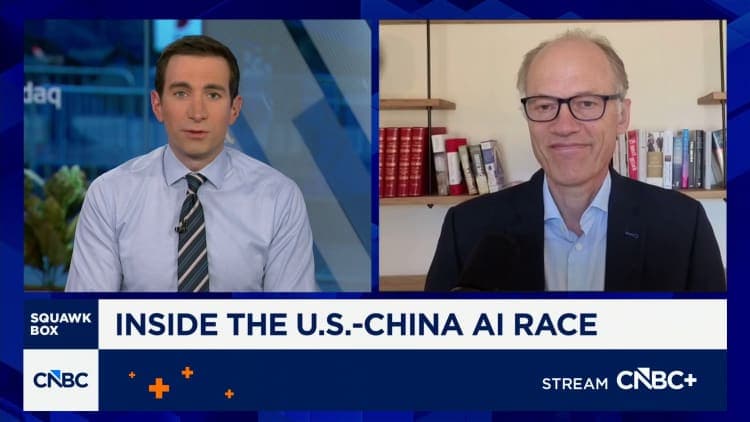
Analysts interpret Kavukcuoglu's promotion as a shift away from academic projects toward improving frontier performance and developer tools. Malik Ahmed Khan, senior equity analyst at Morningstar, told CNBC that Google fell behind because it focused on monetizable areas like search and multimodal capabilities while competitors captured the first clear killer application: coding assistance.
Hassabis, who joined Google through the 2014 DeepMind acquisition, pursued a broader AGI agenda that extended beyond large language models into robotics, health sciences through Isomorphic Labs, and world models. Kavukcuoglu is expected to bring sharper focus to language model improvements and faster release cycles.
The new leader faces immediate pressure to ship Gemini 3.5 Pro and establish a predictable cadence of competitive releases. He must also rebuild expertise after several high-profile departures from the team.
Commercial strength amid technical challenges
Despite lagging in model capabilities, Google maintains commercial advantages. Pichai noted on a recent earnings call that nearly 90 percent of Fortune 100 companies use Gemini Enterprise. The company's AI reaches consumers through Android devices and powers features in Apple Intelligence on iPhones. Alphabet shares have risen roughly 76 percent over the past year.
Kavukcuoglu's consolidated authority over models, applications, and developer relations may prove advantageous. Brian Hopkins, principal analyst at Forrester, noted that organizing these functions under one executive structures the division as a product group rather than a research lab—an approach where Google has historically excelled compared to pure AI startups.
These details were first reported by CNBC.
This is an original analysis by the Omega editorial team. Source reporting: AI Watch.
Want systems like this working for your business?
Book a Call