GE Appliances Uses AI to Cut Errors, Save Millions in Manufacturing
At a Georgia plant, cameras and sensors trained on quality control help the company compete with overseas rivals while adding hundreds of U.S. jobs.
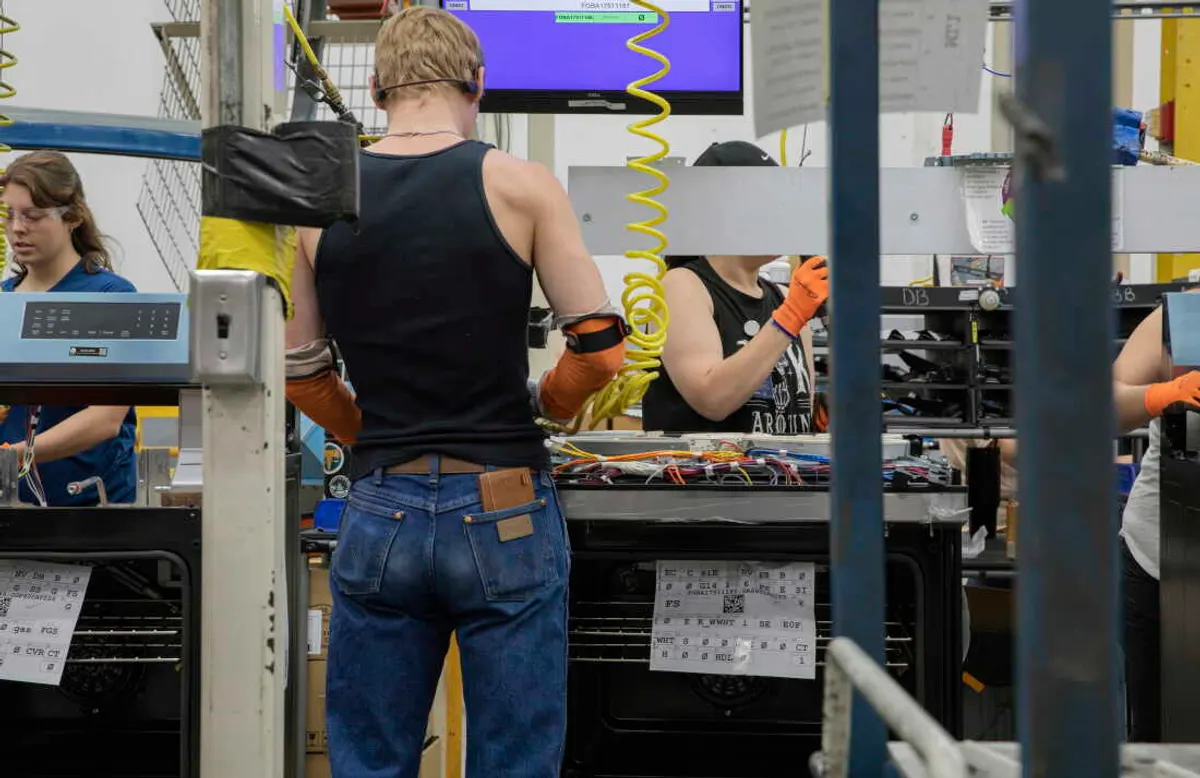
AI-powered quality control transforms factory floors
At a GE Appliances plant in Lafayette, Georgia, artificial intelligence has become the ultimate quality inspector. Cameras and sensors deployed throughout the facility monitor every step of production, trained to identify defects the moment they occur. When the system spots an anomaly—such as the wrong gasket on an oven—it immediately shuts down that section of the assembly line and blasts AC/DC to alert workers.
The approach reflects mounting pressure on American manufacturers to achieve near-perfect production. To compete with lower-cost imports, domestic factories must eliminate errors, minimize downtime, and ensure flawless output. AI has emerged as a critical tool in that fight.
Why it matters
This isn't automation replacing workers—it's intelligence augmenting decision-making at scale. The financial stakes are substantial: GE Appliances saves between $1.5 and $2 million annually for every percentage point of performance improvement. More broadly, the technology is enabling the company to manufacture competitively in the United States, recently adding 600 jobs in Georgia as part of a $180 million expansion. The case demonstrates how AI can strengthen domestic manufacturing rather than simply displacing labor.
Real-time visibility across nine plants
GE Appliances has spent more than a decade building its data infrastructure. The company's Brilliant Factory platform now ingests millions of data points daily from cameras and sensors across nine major plants, providing real-time visibility down to individual workstations.
From headquarters in Louisville, Kentucky, Bill Good, vice president of manufacturing, can see which machines are offline, why appliances are being sent to repair bays, and exactly how much scrapped parts are costing the company. "In the old days, I would call my plant manager, and I'd say 'How you running today?'" Good explained. "Now I'll call them and say 'Why are you running so poorly?'"
Predictive maintenance prevents costly breakdowns
Beyond visualization, AI analyzes the data to identify problems before they escalate. The system flags when a motor is running hot—a sign of impending failure—allowing plants to schedule repairs proactively. Avoiding unplanned downtime is critical: halting a single assembly line costs between $300 and $500 per minute, according to Good.
Plant managers now begin their days with AI-generated reports that not only highlight potential issues but suggest solutions. "The name of the game in manufacturing is speed—speed at which you see the problem, speed at which you solve the problem," Good said. "Literally, minutes matter."
Closing the experience gap
Good, who has nearly 40 years in manufacturing, says AI has narrowed the gap between veterans who have encountered every problem and newer employees with just five years of experience. "It can outthink me," he acknowledged.
Yet he doesn't see AI replacing large numbers of workers in the foreseeable future. Instead, the company uses AI to optimize staffing, moving workers to different tasks as needed, and to forecast market demand for more agile production planning.
Tony Gabbert, director of manufacturing operations at the Lafayette plant, says the goal is perfection: "We're not shooting for 97. We want to run 100 every day," referring to a key performance metric.
Good views the technology as essential to competing against overseas factories with lower labor costs. "You have to be faster, better, more flexible," he said. "That's the only thing that neutralizes the threat."
These details were first reported by NPR.
This is an original analysis by the Omega editorial team. Source reporting: AI Watch.
Want systems like this working for your business?
Book a Call